
A private label capsule collection that is designed to be manufactured efficiently is a curated group that shares common fabrics, trims, colors, branding, packaging and quality. It’s not about minimising the range. It’s sufficient diversity for the customer with no additional style, color, material and SKU fragmentation.
Four styles with one fabric family and two colors will have a much easier time of sampling, quoting, cutting, inspecting, and replacing them, than will two styles that require custom fabrics, custom trims, and custom decoration processes. Do not match colours in a moodboard, this is not a production system. With efficiency still to be approved, quality control, and all the details shaping the brand will need to be fitted in.
Define the Commercial Purpose of Your Private Label Capsule Collection
Styles should be locked after collection architecture. The garments can be sewn by a factory. The brand still needs to determine what the capsule is for and how to prove.
Everything from a streetwear drop to a premium basics line, gym wear to travelling, workwear to loungewear and coordinated everyday wear gets categorized as “small collections” on a merchandising board. They aren’t federated by the same fabric behavior or construction risk, nor do they share the same size demand or replenishment logic. When that commercial brief is murky, the style count will tend to increase to reflect that uncertainty.
Identify the Customer and Use Case
Record the customer using production terminology, not marketing terminology. Record the climate, lifestyle, activity, fit preference, purchasing occasion, sales channel and expected retail position.
Even though both happen to fall in a casual capsule category, a heavy fleece hoodie for a cold-weather streetwear drop would certainly not match a lightweight traveling tee. When you consider the distinct differences between a coordinated rail and one or two hero looks, the size depth required for each will vary. In the end, those differences manifest as trash, grading waste, carton mix, and left over stock.
Choose a Clear Product Role for Each Style
Assign each style a task that will prevent it from making another pattern, sample, material lot and warehouse line.
Typical roles include:
- Hero product: the style that tells the brand story, sample investments, and has the inventory depth.
- The part of the story that is repeated is core basic, the same as the simple, repeatable piece that supports the hero.
- Layering piece: The item which finishes an outfit without introducing an extra material system.
- A limited-run style which is not suitable for repeat; seasonal item.
- Entry price item: Lower risk style that brings in the brand.
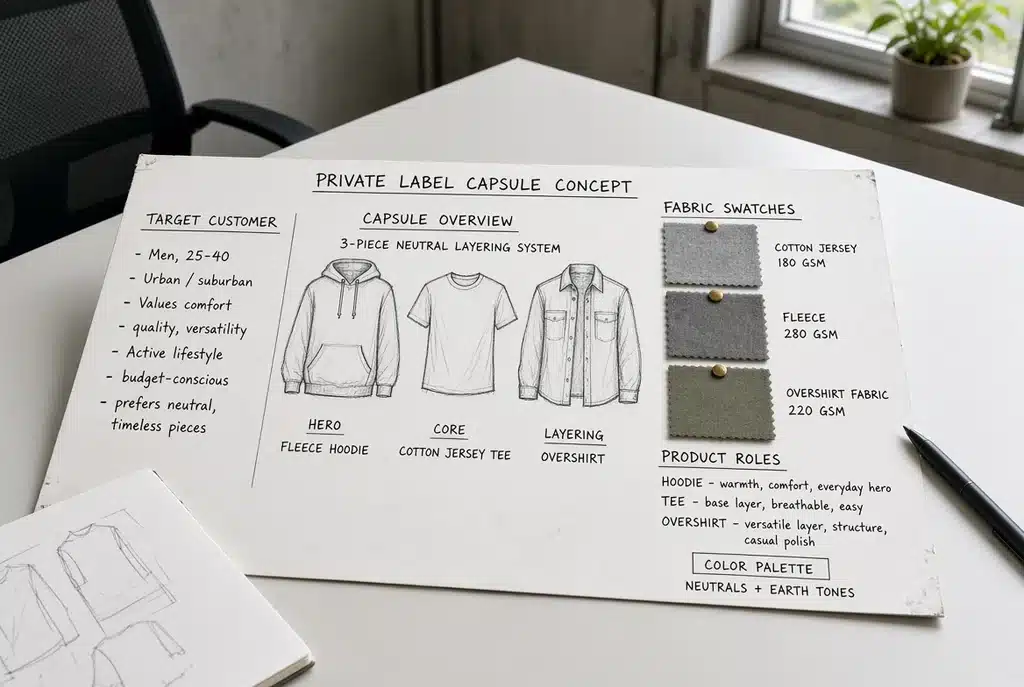
Streetwear is often worn with the basic outfit consisting of a hooded sweatshirt, t-shirt, and sweatpants. A simple overshirt and trouser will work in a more casual outfit with a signature shirt. If the tops, skirt and outer layers use the same fabric or trim logic, then a women’s casual capsule can be worn on them. Usually a style that has not resonated with the customer and does not have a commercial narrative is just another SKU.
Set the Capsule’s Price and Quality Position
Target retail price, expected margin, fabric quality, construction, trims, decoration, packaging and inspection standards need to be equally succinct.
The luxury fabric and finishing will not hold up to a price that only supports basic construction. The manufacturer should be found to reveal that trade-off instead of sneaking up on a cheaper material in the sample. Before the first quote is finalized, the brand can choose to get a heavier jersey, cleaner stitch profile or a more durable print.
Choose the Right Number of Styles
Style count is more of a production and inventory decision than a design decision. Unfortunately, there is no common number for all brands. The range should be determined by budget, evidence, complexity of the product, the capacity of the sample, and the bandwidth of the launch.
The 4 style streetwear capsule outfit may be effective. If each style requires a different trim package, a different fabric and a different decoration process, then the two-style range can be costly.
Build Around One or Two Hero Styles
With a hero product, design time, marketing, sample investment, and inventory depth are emphasized. Supporting products should play their role in enhancing the main product and not be in competition with it.
The customer is in a one-piece system with a hoodie as hero, a jersey T-shirt and a like sweatpant. A signature overshirt, coupled with a basic woven shirt and trouser, is just as functional for a workwear or smart-casual capsule. The supporting styles should share fabric, color or branding with the hero, unless it affects fit or function.
Limit Duplicate or Low-Value Styles
If the pattern is changed slightly, the hem shape is changed, or the sleeve shape is changed, it is a new pattern, a new sample, a new measurement chart, and a new SKU and the customer doesn’t need to buy it again.
Whether it’s an actual product extension or something that could be solved with color, print placement or styling. If two styles appear different on a sketch, but almost the same body, the second style might be breaking down development, but not adding to the offer.
Balance Variety With Production Control
For each additional style, you’ll also have specifications, fit decisions, quality checks, production instructions, packing data and inventory exposure. Focus resources on styles with common inputs or on separate customer needs.
A capsule wardrobe manufacturing plan works when the wardrobe feels full and manageable as it is worn, and on the factory floor. The more styles, the more not always the better.

Design the Capsule Around Shared Fabrics
One of the best methods to enhance capsule collection manufacturing without having all of the garments look alike is with fabric architecture.
The advantages of shared fabric are reduced minimums in the mill, color development, incoming inspection, left over yardage, and risk of replenishment. It does not allow to swap two patterns.
Create a Practical Fabric Family
Select qualities compatible by weight, composition, stretch, hand feel, finish and end use.
Practical examples:
- One cotton jersey for tees & tanks
- One fleece or French terry knit family for hoodies and sweatpants
- The light fabric family of shirts and lightweight overshirts.
- In the example workwear twill was worn in both a shirt and a plain pair of trousers.
Similar does not equal interchangeable. The clothes that fit for a thin t-shirt can fit awkwardly when wearing it on a big t-shirt. The right fleece will alter hip and rise action in a sweatpant. Every piece still requires its own fit, shrink and make check.
Stock Fabric Versus Custom-Developed Fabric
Stock fabric typically has much faster color turnaround time, less risk of development and better first order timings. Custom developed fabric can be used to provide a unique handfeel or color, but will introduce MOQ, lead time, cash commitment and repeatability risk.
When a startup is trying to figure out how to plan their first clothing collection, they can greatly benefit from a tried and tested stock material for the drop. If there is a well-known brand with sell-through data, then custom development for a core program can be made appropriate. The decision should reflect demand evidence, rather than a wish to have an unusual mill story on the first day.
Use Fabric Across Styles Without Ignoring Construction
A sweatpant can be used with the same fleece that can be used for a hoodie. The hoodie still requires hood construction and rib and body shrinkage control. The sweatpant still requires waistband, pocket control and rise control. Reduced material fragmentation with shared fabric. It does not cancel out style level sample and quality review.

Control Colors, Sizes, and SKU Complexity
The number of SKUs is not the only factor in determining the efficiency of a capsule range, it is also the number of garment styles. Cutting tickets, barcodes, packing and inventory depth are based on style-color-size combinations.
Build a Controlled Color Palette
Clear core neutrals, seasonal colors and test colors. Use of just a few colors makes fabric procurement easier, dyeing, cutting, decorating, packing and restocking simpler.
Don’t give all the same units for all the colors unless there is evidence of demand. Often, a black and a house neutral is more suited to a greater level of depth than a seasonal accent that is in existence to look great in the camera. Even with a low MOQ, it can still be costly to use a capsule collection if each color is considered a core color.
Set a Realistic Size Range and Ratio
The size range should be in line with the target customer, fit, region, product type and sales channel. Six size runs can work great in one type of basic program and be too big for another type of streetwear drop.
Size ratios, size-set requirements, grading and inventory depth all impact the factory’s work. No universal ratio, for all capsules. A brand with a wide retail presence typically requires a wide array of sizes, while a brand with an online drop will likely need less size depth.
Calculate the SKU Structure Before Sampling
This planning formula is used as a first indication of inventory and barcode complexity:
SKU Count = Stock Keeping Units (styles) × Stock Keeping Units (colours) × Stock Keeping Units (sizes).
Not all variations of production are included in the formula, e.g. types of decorations, packing combinations. It does illustrate some of the ways a small range can become a big range in a hurry.
Illustrative example only: 48 style-color-size SKUs – 4 styles x 2 colors x 6 sizes. Even if the rail is small, that’s already a full receiving/fulfillment job.

Standardize Trims, Branding, and Packaging
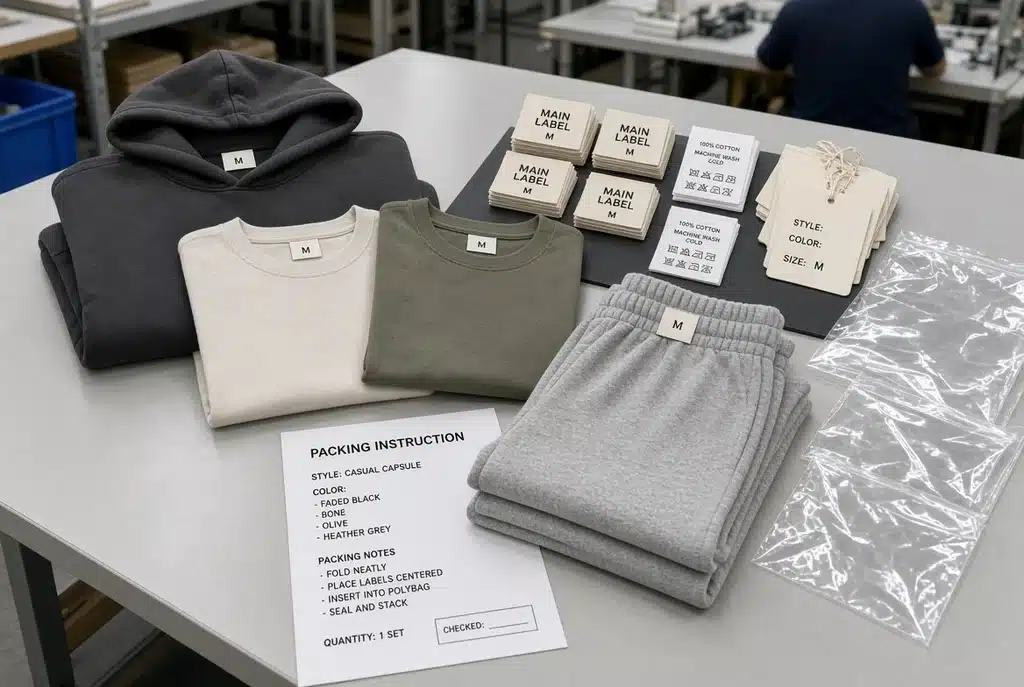
Repeatedly used brand elements enhance brand recognition and make brand setup, artwork, purchasing and packing easier for the supplier.
When the customer is able to see the same language on the labels, hangtag format, and same packing standard throughout styles, it looks more complete and well put together. Shared branding does not equal identically the same product data. Fiber content, care instructions, size, SKU and barcode can still vary by piece.
Build a Shared Label and Branding System
Before samples are considered production, determine the primary label type, care label format, size label method, hangtag structure, barcode format and placement standards.
One woven main tag plus one hang tag shape can be used to cover a T-shirt, hoodie, and pant. The care label still needs to comply with each style’s fiber/ wash rule. The sewing line should not be creating a new placement on a style, and should be written in the tech pack.
Coordinate Decoration Methods Across Styles
Using one consistent print, embroidery, patch or placement system is easier to manage than a different one on each garment. When decorations multiply, so do set up, ink or thread approval, wash testing and inspection.
Even with the hero style, there’s still a more unique application. Supporting styles may be light, soft or unadorned. Standardization reduces risk. It doesn’t expect all products to be the same.
Standardize Retail-Ready Packaging
Cover folding, tissue, packing bags (polybags), stickers, boxes, carton formats, carton marks and packing instructions. Shared Packaging decreases the amount of minimum, storage problems and packing mistakes.
Even thicker or structurally different garments may require a different fold or bag size. A hoodie can share a same system of labels with a tee, but require different carton density. Record those exceptions, don’t leave them on the packing table.
Build the MOQ and Quantity Plan
A capsule must be designed and planned on the basis of MOQ’s as given by the manufacturer and the brand’s inventory risk. The total units do not indicate if the order is practical.
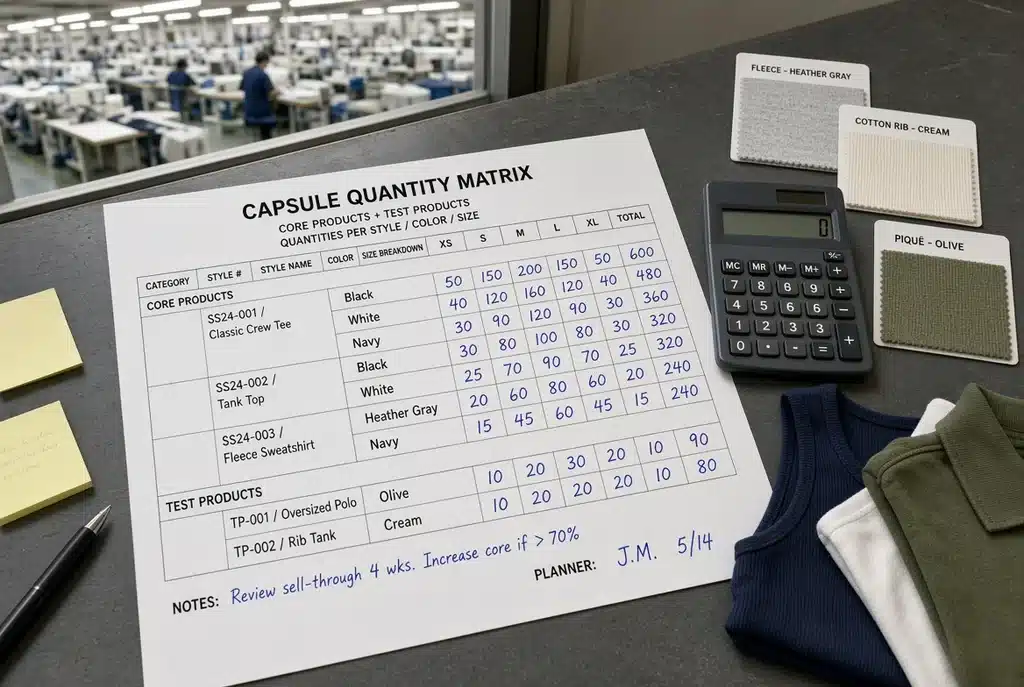
The most efficient clothing production for brands begins when quantity is allocated not when the clothing collection is simply kept small, but when quantity is allocated by the style role, color, fabric, and decoration.
Confirm MOQ by Style, Color, Fabric, and Decoration
Inquire about minimums, if any, per style, per color, per fabric, per decoration method, or against the order.
A minimum for per-color dye and a minimum for a custom-fabric mill can be met but it is still a failure. A minor accent color might not be enough to cover a minimum created during the screen print set up. Agree on the basis before it becomes final assorted.
Concentrate Quantity in Core Products
Experimental items typically need less stocking than hero and proven core styles. The concentration units significantly boost cutting efficiency, sewing continuity, inspection rhythm, packing consistency and replenishment.
When a brand is found in 800 units, but too many styles and colours, many short runs are generated. The 800 units of the same size focused in a hero tee and a core tee typically provide the factory with a cleaner plan and a better opportunity for the brand to keep the products they sell in stock, in the products that customers actually purchase.
Plan Small-Batch and Bulk Quantities by Product Role
Experimental colors and complicated styles can be in limited amounts. Larger amounts of simple core products can be placed in a core. The manufacturer has to confirm the functionality of that mixed structure after applying the fabric, decoration and packaging minimums.
If the brand is trying to gauge the demand for their product, a low MOQ capsule collection is helpful. It does not always cost less or is less difficult. This means that there is a higher unit cost for small quantities, as setup work is distributed across less garments.
Create a Sample and Approval Plan for the Whole Capsule
Sample development should be synchronized throughout the collection to ensure that fit, fabric and branding decisions occur in the proper sequence to achieve a quality collection. When every clothing style is sampled independently from any other and has its own material plan, then clothing collection production planning has failed.
Prioritize Sampling by Risk and Commercial Importance
Try these hero product and styles with a high level of technical difficulty. Once it is sure that the shared material system, simple supporting styles can follow.
Fit Risk, Fabric behaviour, Complexity of construction, Decoration, Importance of launch, Potential rework should all be taken into account. A large tee and new block might require attention sooner than a simple tank with the same jersey.
Approve Shared Materials Before Repeating Them Across Styles
Fabric, color, rib, trims, labels and decoration must be checked before being used on multiple garments.
The same fabric can be used in different ways in different styles. Endorse the material and then verify each style using it. Don’t assume that once you’ve got a successful hoodie you can pass on the sweatpant.
Use a Pre-Production Reference for Each Style
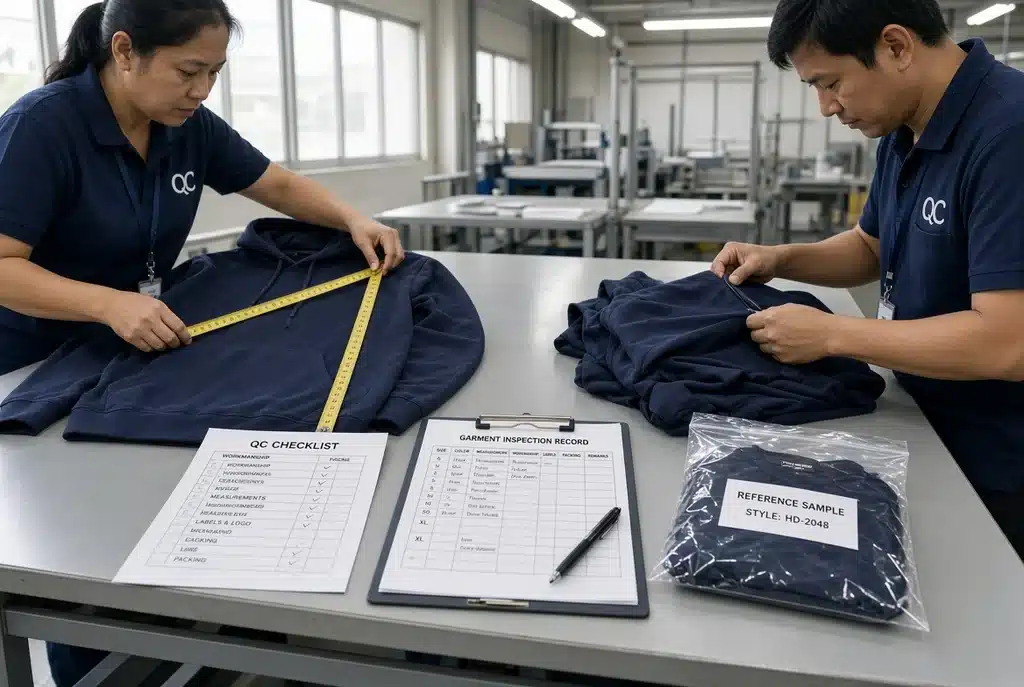
Even though several styles follow the same fabric or brand system, a production reference is still required for each style including measurements, construction, material, decoration, labels and packing.
A single approved hoodie sample is not used to control a related sweatpant. Fit varies according to the different patterns, seam patterns and finishing. Have a sealed or labeled pre-production specimen of each style that will go into bulk.

Protect Quality While Optimizing Manufacturing Efficiency
Efficiency should eliminate “unnecessary complexity. It should not eliminate controls which safeguard product performance and brand consistency.
Keep Fit, Measurement, and Grading Control
Accept points of measure, tolerances, fit, size range and grade for each style. Different patterns cannot be interchanged with shared fabric.
An oversized tee and a regular-fit tee might both require the same relationship between the jersey, length, and sleeve — but there’s a difference in the relationship between the tee and the chest. Write tolerances appropriate to the type of garment. Then check in production against those measurements.
Maintain Material and Color Consistency
Manage the composition, GSM, Shrinkage, Handfeel, color, lot identity and repeat availability. Changing one material for a “similar” material in a capsule can alter the fit, drape and customer experience.
Maintain a lot record and physical standard if there is a reorder for a core color. Visual matching from memory is NOT a colour system.
Use In-Line and Final Inspection
A common quality checklist will enhance efficiency. There will always be specific measurements and workmanship checks applicable to each garment.
Pockets, closures, hoods, prints and embroidery require style specific checkpoints. Labels, measurements and packing can be done according to one of the same procedures. In-line checks identify issues and will correct issues before the line does. The product that is packed is verified as being in conformance with the approved reference using a final inspection.
Plan Packaging, Inventory, and Replenishment Before Launch
This is an efficient capsule which must be easy to control after sewing, not just during sewing. Logistics in the warehouse, receiving SKU’s, fulfilment and replenishment are all part of the plan prior to quantities.
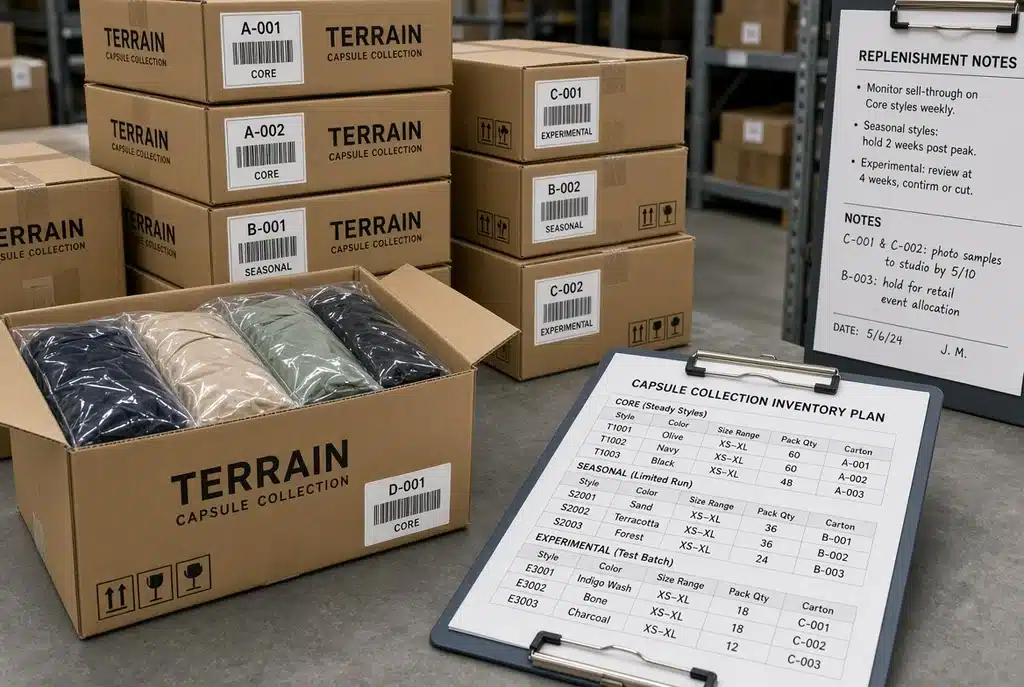
Organize SKU and Packing Information
Prior to bulk packing, set style codes, colour codes, size labels, bar codes, carton assortments, folding instructions, polybagging and packing lists.
Reducing errors that occur during data reception and fulfillment across styles with consistent data. The customer doesn’t care when he or she mistakes for sizing or color.
Identify Core, Seasonal, and Experimental Inventory
Sort products according to their predicted demand and reordering needs. Stock and repeatable materials can be more expensive than core products, but are warranted in depth by the core products. Seasonal colors and intricate patterns will require controlled amounts.
This classification should affect fabric selection, depth of colour and negotiation of MOQ. A test color isn’t meant to be the only material option that will be available if the entire capsule is sold out.
Check Replenishment Feasibility
Verify if any fabrics, colours, trims, labels and packaging can be reproduced. The capsule shouldn’t rely on the disappearing of a material because a popular style is selling.
Provide specifications, material references and production standards for future orders. Repeat production is not just for the next season: it is part of the capsule collection manufacturing.
Common Capsule-Collection Planning Mistakes
These errors typically appear to be creative at the concept level and costly at the production level.
Designing a Cohesive Moodboard Without a Production System
Similar colors and visual mood do not mean that they have similar fabric, construction, MOQ or lead time.
Create a manufacturing matrix—style to fabric, trim, decoration, size range, quantity and packing. If there is no way to fill that matrix, it’s still a mood board.
Adding Too Many Styles, Colors, or Sizes Too Early
SKU multiplication fragments inventory and increases development, material, inspection, and packing work. Protect the hero product. Use a staged expansion plan after the first sell-through data arrives.
Assuming Shared Fabric Means Shared Fit
Different patterns, garment weights, seam structures, and finishing can change fit even when the fabric is identical. Require separate sample and measurement approval for each style.
Approving Branding or Packaging Too Late
Late labels, hangtags, barcodes or packaging can make the garment take longer to be packed or alter the garment construction. If a label is added after sewing, it can result in unpicking. Make sure all branding and packing specifications are approved prior to pre-production approval.
Ignoring Replenishment When Choosing Materials
A successful style is a problem when the fabric, color, trim, or packaging is no longer available for reordering. Determine repeatability prior to approval of a material as a core capsule component.

Summary Guidance – Build a Collection That the Factory Can Repeat
Style architecture, fabrics, colors, sizes, branding, MOQ, samples, quality control, packaging and replenishment are the building blocks of a manufacturing efficient private label capsule collection.
Efficiency doesn’t imply uniformity of style and elimination of fit, material, or inspection. It involves complexification of those parts of the production system that create value for the customer, and simplification of the rest.
Design a matrix of style-color-size. Assign the product to a style. Locate common and uncommon resources. Verify MOQ conditions by style, colour, fabric and decoration. Sample by risk. Maintain an inventory reference of each style. Record the collection, so that factory can do what sold.