
Comparing quotations for clothing is only useful when all the suppliers are quoting the same product, materials, quantities, services, quality, packing and delivery scope. If the factory does not sample, label, package, inspect or freight, or if it uses a lighter material, one factory may appear less expensive than the other. In total, the other can cost more since the actual quote includes all the custom fleece, embroidery, weaved labels and retail ready packing.
Before the numbers are lined up in a hoodie quotation, the following information should be included: fabric weight and composition, scope of decoration, labels, packaging, quantity by size and colour, sample requirements, inspection, and shipping term. Higher quotes don’t necessarily mean more safety and the lowest unit price does not automatically mean the best deal. Normalize assumptions first and compare the evidence, risk, and total commercial impact.
Why Clothing Manufacturing Quotes Differ
There is no standard of ‘cheap’ or ‘expensive’ factories for quote gaps. They are typically based on different product assumptions, material quality, order structure, service scope, cost allocation and delivery terms. In the absence of the same inputs, the unit prices are not comparable.
Different Product Specifications
The cost of a category does not provide a predictive indicator of overall cost. Fabric weight, construction, size, fit, number of panels, lining, pockets, closures, stitches, washing and finishing all affect the amount of labor and materials required. There are two “black hoodies” that look alike in a photo and yet are two different products – 280 GSM fleece versus 360 GSM fleece, thin rib versus dense rib, no decoration versus chest embroidery and raw sewing versus enzyme wash. So long as those prices do not match, they should remain in separate columns.
Different Material and Branding Assumptions
Stock fabric is NOT custom dyed fabric. Standard trims cannot be compared to custom hardware. A printed heat transfer label is NOT the same as a woven label. Screen print is NOT the same as embroidery. Bulk polybag is different from retail ready folding, hangtags and branded cartons. Don’t compare the first line of the quote (garment name), compare the bill of materials and scope of the branding.
Different Quantity and MOQ Structures
Cutting efficiency, inventory and setup cost varies with style count, color count, size run, fabric type, decoration setup and total quantity. Supplier A could charge 500 units for one style and one colour. Supplier B can offer 500 units in three styles and four colours. There are the same number of pieces. The production setup isn’t. Before anyone mentions a “better” factory price, that difference should be in the comparison.

Normalize the Product Scope Before Comparing Prices
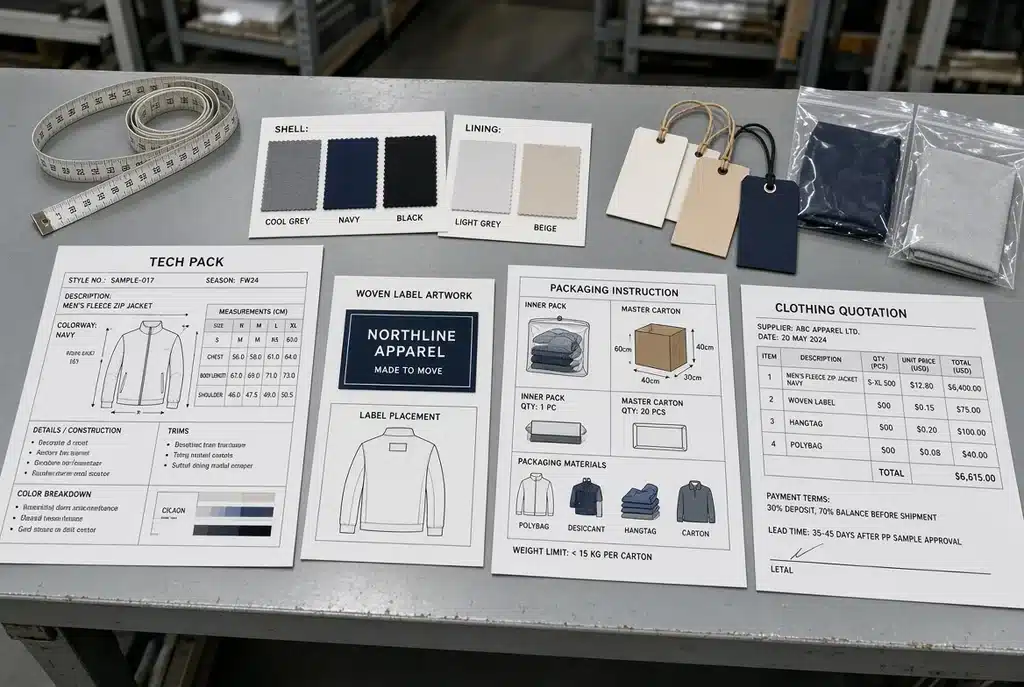
A common product definition is the first step to any clothing manufacturer quote comparison. Provide the same Tech Pack, Reference Sample or Production Specification to all suppliers. Next, review each quotation in light of that definition, line by line.
Compare Garment Construction and Measurements
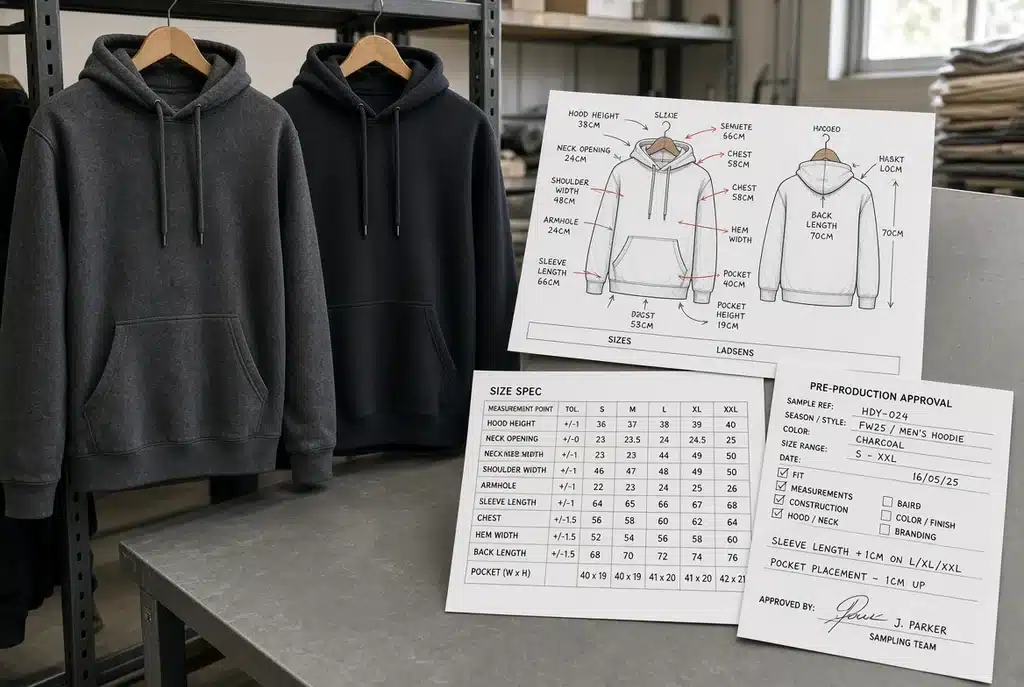
Verify garment type, desired fit, measurement chart, tolerances, stitch details, panel breakdown, closures, pockets, lining and finishing. Even if the photo appears to be the same, the difference in quotes for the construction of the factory hoodie is due to the difference in the labor content, as one may be made from a basic set in sleeve and the other a raglan with a lined hood and reinforced pocket bags. Where possible use one specification pack, allowing construction differences to be written as exceptions, not assumed.
Compare Fabric and Trim Specifications
A comparison of the manufacturing costs of an apparel product such as a t-shirt might not be sufficient if the terms used are “Cotton,” “premium fabric” or “heavyweight.” Note fiber content, knit or woven pattern, GSM, fabric width, stretch, finish, color technique, predicted shrink, rib quality, lining, interlining, thread, hardware and special trims. It is possible to get an honest quote by using a stock black fleece and a custom-dyed 340 GSM cotton-poly fleece, which is not to be confused with the same offer.
Compare Decoration, Labels, and Packaging
Print size and colour, embroidery size and stitch density, patch construction, type of main label, care label, hangtag, folding, polybag, inner box, carton quantity, and carton marks. Indicate whether the item is included, excluded or optional. If you have a quote for the sewn shell, it’s not against a quote that has sewn in, woven labels, hangtags and retail packing.
Compare Development, Sampling, and Approval Scope
Some suppliers may only sell bulk production. Others such as pattern work, sampling and revision support are included in the same offer. How to compare apparel manufacturing quotes is not a subject that is only just about the price and schedule, it’s also about scope of development.
Pattern Making and Technical Development
Inquire about the following: Does the quote cover pattern making, grading, tech-pack, construction review and revisions? A factory that refers to a running style isn’t working exactly the same as a factory that is creating a new garment from a sketch or a reference sample. When one is “ready” and the other has a “first-pattern” development, then the unit prices are on different cost bases.
Prototype, Fit, Size Set, and Pre-Production Samples
Note the type of samples, number of rounds of revision, if samples are the same as bulk materials, and if sample fees are applied to bulk materials. Bulk risk is controlled at sample approval. Even if the headline price is higher, a quote with more development support will help to decrease the errors in the future.
Approval and Change-Control Assumptions
Ask what will happen to the measurements, fabric, artwork, trims, packaging or quantities if they change after quoting. Before development begins, make sure you know about revision charges, material re-approval, additional sample time, and price-adjustment rules. Change control is not an add-on to the commercial offer.
Compare MOQ, Quantity Basis, and Unit-Cost Assumptions
You should not be able to base a unit price on the number of units the manufacturer used to determine the quantity. Different combinations of styles, colors, and sizes will result in different cutting, dyeing, decoration, and packing costs.
Per-Style, Per-Color, Fabric, and Total-Order MOQ
Clarify if the minimum is by style, by colour, by fabric, by decoration or by order. Supplier A may give a price for 100 pieces of a piece of fabric that is on stock.Supplier A might give a price for 100 pieces of a piece of fabric that is in stock. Supplier B is able to offer 300 pieces per style on custom dyed fabric. Until the order structure is written down, there is no fair way of assessing either price.
Quantity Breaks and Volume Pricing
Quiz if the unit price varies with different quantities and why – material purchase lots, cutting efficiency, decoration set up, packing, or factory scheduling. These quantity breaks are dependent on the factory. Never assume a standard rate of discount based on another supplier offering that rate.
Size, Color, and SKU Distribution
The size and color combination influence the efficiency of the marker, inventory remaining after printing, decoration set-up and carton packing. Make the same matrix for style, color, size and deliver to all suppliers. Check if there is any size that has a minimum. 200 pieces per size and 500 pieces per color is not as balanced as 500 pieces over 2 sizes.

Compare Quality Control and Production Assurance
There is a cost associated with quality-control scope. Use it as a part of the quote, don’t treat it like a courtesy. It is not a comparison of the number of items inspected as an abstraction. It is if the inspection plan is aligned with garment risk, buyer needs or order quantity.
Incoming Material and First-Piece Checks
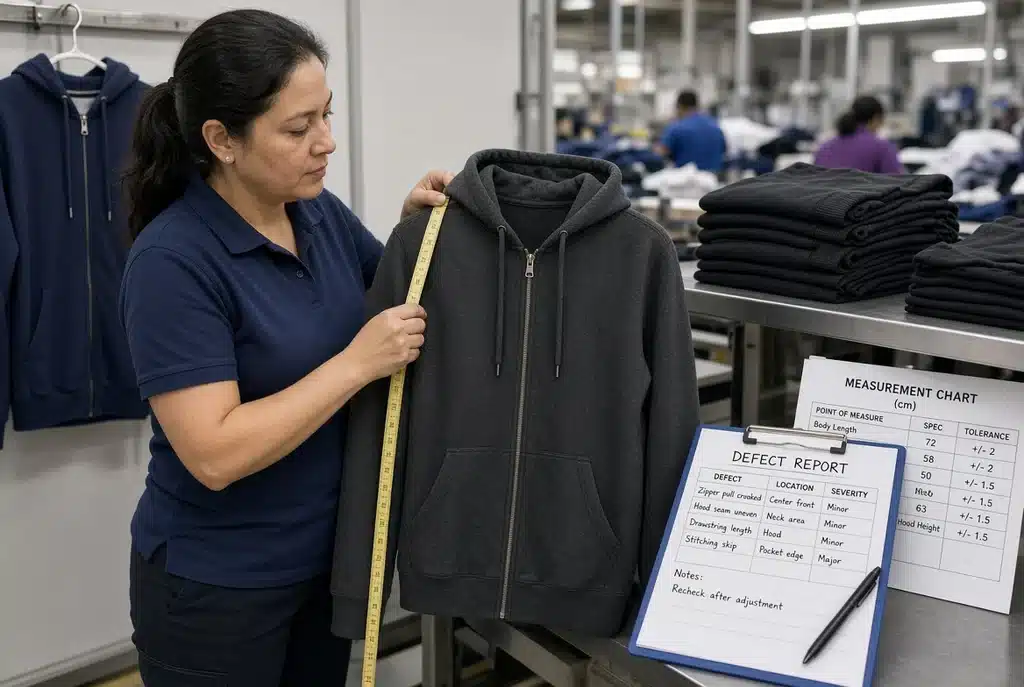
Question if fabric, trims, shade, quantity and first production pieces are verified prior to bulk continuing. Early checks prevent the repetition of the wrong GSM, off-shade dye lot, or incorrect construction throughout the entire order.
In-Line and Final Inspection
Make sure to understand what each supplier offers for in-line checks, measurement verification, workmanship review, decoration inspection, label checks, final inspection and packing inspection. One factory can be equipped with measurement reporting and final inspection with AQL. Another may be able to only visually pack. Do not conduct the same inspection on a different product simply because you’ve heard the term “strict QC” before.
Defect Handling, Rework, and Approval of Deviations
Inquire on the method used to record, correct, reinspect, repair, replace, or accept defects as deviations. Establish accountability and scheduling prior to production. A lower operational risk may be associated with a written corrective-action process in a quote than a lower quote without a written corrective-action process.
Compare Lead Time and Production Schedule
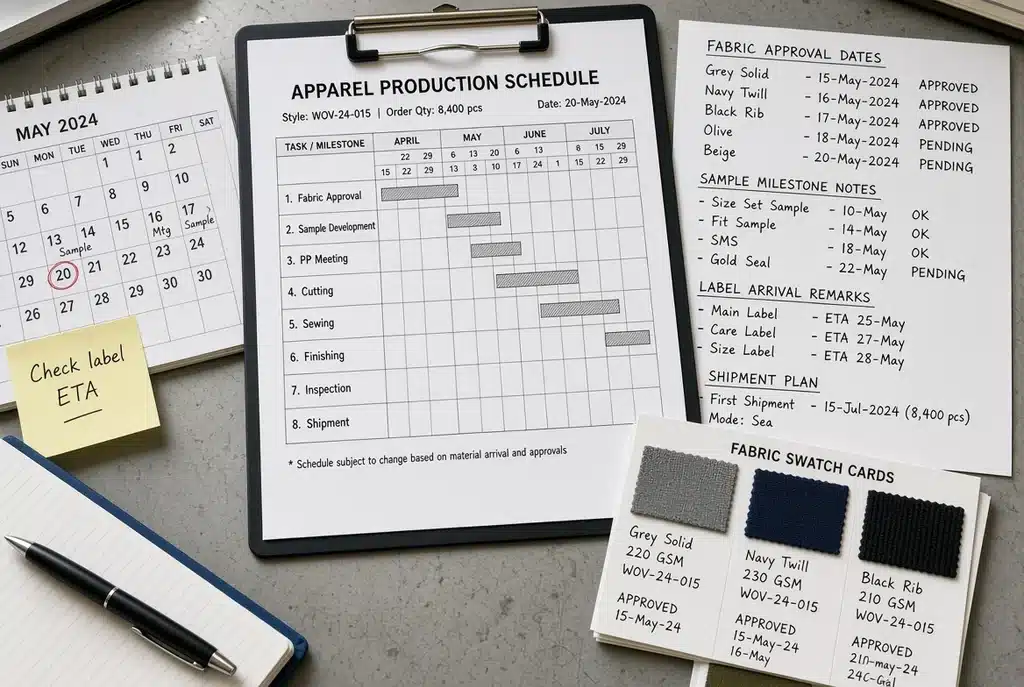
The number of sewing days listed is not sufficient information to compare quotes. A short “production time” can cover up all the steps of fabric approval, labels, sampling, inspection and shipment preparation.
What Starts the Lead-Time Clock?
Ask what milestone is used for the lead time to start, which is after the deposit, materials approval, sample approval, preproduction approval, etc. A quoted production window does not include sourcing, lab dips, revision rounds, final inspection, packing and booking space. Write the starting point on the comparison sheet and the handover point.
Which Activities Are on the Critical Path?
Identify whether fabric, custom dyeing, trims, labels, packaging, decoration, sample revisions, or inspection controls the calendar. Sewing capacity can be open while bulk still cannot start because the approved custom fabric or woven labels are late. The critical path is the real schedule.
How Are Delays and Changes Communicated?
Ask how the supplier reports material problems, updates production status, records specification changes, escalates quality issues, and revises the shipment estimate. Communication procedure is part of schedule reliability. Compare it before the order is placed.
Compare Packaging, Shipping Terms, and Landed Cost
The price of the factory unit is not the finished goods price at your warehouse. A “cheap” quote can be nullified by packaging, Incoterms, freight, duties and delivery charges.
Folding, Individual Packing, and Carton Configuration
Compare and contrast folding, tissue boxes, polybags, stickers, bar codes, hang tags, inner boxes, pieces per carton, carton marks, and export packing. Packaging impacts labor, materials, carton volume, freight, warehouse receiving and fulfillment. The cost should not be the same for retail ready packing and basic bulk packing.
EXW, FOB, DDP, and Other Delivery Assumptions
Typically, EXW delivers the goods at the factory or warehouse. Typically, FOB includes export handling up to the named port. Typically, DDP involves pushing freight, duties, taxes and delivery even further towards the buyer’s final destination. All of these terms cannot be guaranteed to be the least expensive. Verify transfer of duties and responsibilities, freight scope, duties and taxes, customs clearance, insurance and delivery assumptions.
Estimate Total Landed Cost
When considering quotations from clothing manufacturers, stick to a simple format:
Total landed cost is equal to factory production scope + packaging + freight + insurance + duties/taxes + customs or delivery charges.
The above value is the basic amount, which may vary depending on various factors such as destination, mode of shipment, product classification, carton volume, weight, and agreed term. Never use a blanket rate of freight or duty. Derive estimate based on written shipping scope and shipment plan for the order.

Compare Payment Terms, Commercial Risk, and Supplier Reliability
With two unit prices appearing similar, commercial terms will still have an impact on cash-flow exposure. The list of items required to prepare a clothing production quotation is not finished without any of the following items.
Deposits, Balance Payments, and Payment Timing
Analyze the amount of deposit, balance time, payment method, currency, bank charges, and conditions for the goods release. There is no one right structure. The interesting question is when does cash come out and what does that cash purchase cover?
Sample, Revision, and Additional-Service Charges
Do samples, pattern work, artwork set up, testing/inspection, packaging development, storage, rework and mid order changes count in or are there extra charges? A low unit-price quote may end up being more costly upon a running order, due to hidden service charges.
Communication, Documentation, and Repeat-Order Control
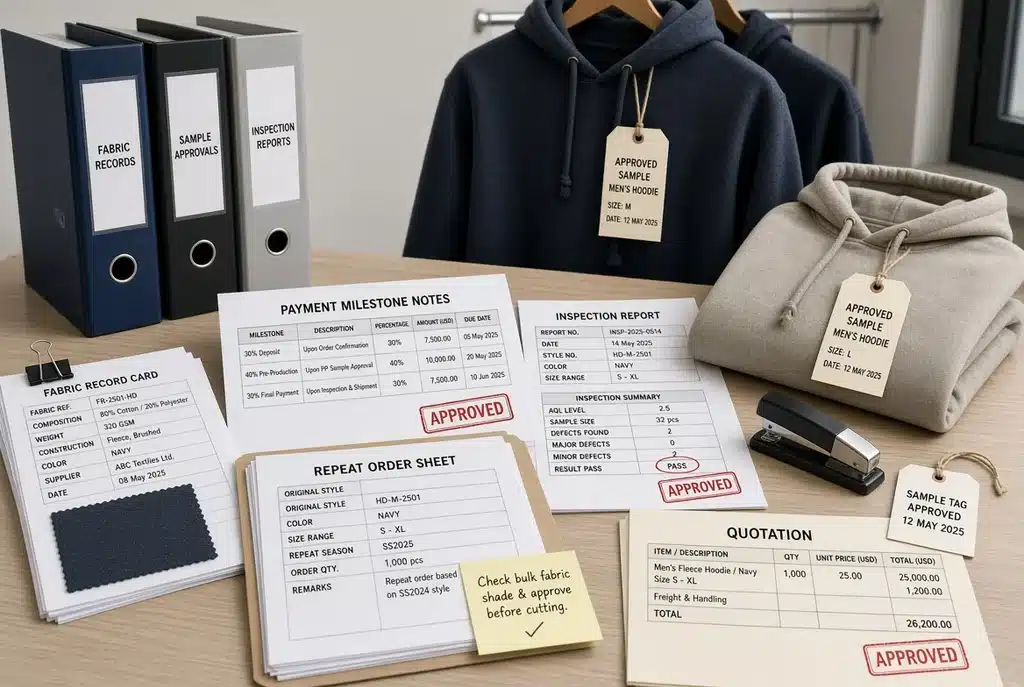
Analyze the method of maintaining tech packs, approved samples, fabric records, artwork versions, inspections reports, packing standards and repeat order specifications among suppliers. Good documentation reduces the chance of specification drift on replenishment. Even if it is not part of the initial quote, that reliability is valuable when it comes to business.
Build a Normalized Table to Compare Clothing Manufacturing Quotes
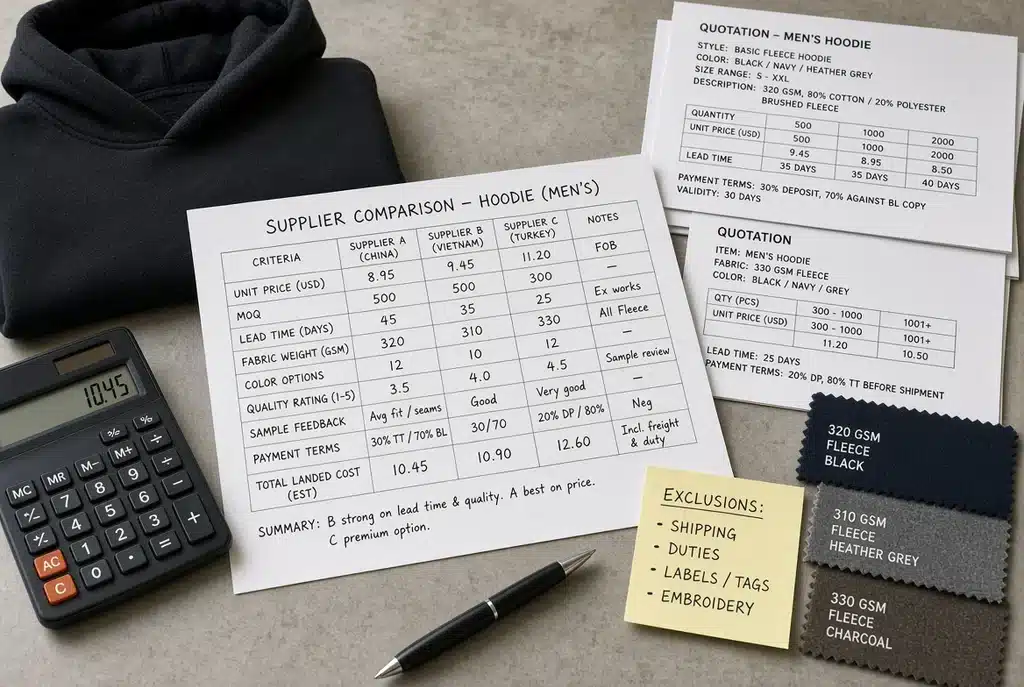
Until all the assumptions are documented, a comparison of clothing factory prices is not useful. Fill in the table from suppliers, rather than from memory. Do not fill in a “not specified” field until it is known. Never check a blank item, unless it already has a checkmark.
| Comparison area | Supplier A | Supplier B | What to confirm |
| Garment specification | Same construction and measurements? | ||
| Fabric and trims | Same composition, GSM, color, and quality? | ||
| MOQ basis | Per style, color, fabric, decoration, or total? | ||
| Sampling scope | Which sample stages and revisions are included? | ||
| Branding | Labels, decoration, hangtags, and artwork included? | ||
| Packaging | Retail-ready, export, or basic packing? | ||
| Quality control | Which inspections and reports are included? | ||
| Lead time | What starts and ends the clock? | ||
| Shipping terms | EXW, FOB, DDP, freight, duties, and delivery? | ||
| Payment terms | Deposit, balance, currency, and timing? | ||
| Exclusions and risks | What could create later cost or delay? |
Use Weighted Criteria When Price Is Not the Only Priority
Brands value different things with regard to capability, quality evidence, MOQ flexibility, lead time, communication, landed cost, and repeatability. If the initial capsule of uncertain demand requires MOQ flexibility more than a subsequent program that requires exact fabric and fit continuity, then the initial capsule is more suited to be the first program.If the first capsule has uncertain demand, it may be more practical to consider it the first program, rather than a subsequent program that requires exact fabric and fit continuity. Establish weights of product and business risk. Avoid copying a standard scoring model.
Red Flags in Clothing Manufacturing Quotes
A red flag is not a indication that a factory is not reliable. Solve it in writing before the depositing or bulk approval.
A Quote With Almost No Product Assumptions
The line if it contains nothing but T-shirt or hoodie is generally a preliminary estimate, unless there is fabric, measurements, construction, branding, a split quantity and/or a packing method. Ask the estimates in writing before using the number in a bid comparison.
A Very Low Price With Many Exclusions
Look out for any missing sampling, labels, packaging, inspection, freight, testing or material specifications. Add the excluded costs to the comparison. The full offer, not the first number on the page is the useful number.
Inconsistent Answers About MOQ or Lead Time
If the quantity or materials are different, the schedule is different, or the payment is different, then it is a documentation problem. Please finalize the agreed conditions in a single written quotation or production confirmation.
Pressure to Approve Without a Comparable Scope
Urgency cannot be a substitute for product, material, sample, quality and delivery clarifications. Settle contentious issues over materials before making a deposit or releasing large quantities of production.
Compare the Whole Production Offer
Clothing manufacturing quotation is a package: product scope, material, development, sampling, quantity structure, quality control, schedule, packaging and shipping, payment terms, supplier risk. The lowest unit price does not necessarily mean the best option. It is the offer that has a clear set of assumptions, a scope that is comparable, manageable quality and delivery risks, and a total landed cost clothing manufacturing figure that is aligned to the brand’s selling price and cash plan.
Provide the same RFQ package to all suppliers. Normalize every assumption. Mark exclusions. Compare overall expense and risk of operation. Documentation of the final agreed specification prior to sampling or bulk production.