
A men’s clothing tech pack is a work file a factory utilizes to pattern, source, stitch, measure and modify sample. Does not require fancy layout or software. It must contain sufficient content so that the sample room is not speculating on the shoulder drop, fabric weight, stitch method, placement of the logo, and the content of the labels. An oversized tee can be used to capture a mood in a photo. It does not have the ability to specify a pattern-maker the chest width, the height from neck to rib, the required GSM, body length or the tolerance.
Useful reference is a sketch, pinterest or competitor garment. It is not a complete tech pack. Without a decision, a different one will be made on the floor of the factory and it may affect the fit, cost, and identity of the product before the first sample ever leaves the table.
Understanding What a Men’s Clothing Tech Pack Must Do Before Sampling
The job of a factory-ready pack is to deliver instructions that cross handoffs, and to turn design intent into such instructions. The pattern maker requires points of measure and a block. Fabric and trim standards are provided to source. Sample room requires construction methods. The brand has a written target to be approved/rejected with. These groups are operating under varying assumptions and the samples test the factory’s conjecture rather than the product.
From Design Intent to Factory Instructions
Some good initial terms of discussion are “relaxed fit,” “premium cotton,” and “vintage hoodie.” They are not production instructions. Not one of them provides a measurement, a cloth standard, a stitch technique or an approved finish.
Bring a large T-shirt. The picture is likely to depict a dropped shoulder and a long hem. Sleeve shape, neck-rib specification, a size-grade direction, as well as chest and shoulder width, remain to be determined. As long as those numbers don’t exist, two sample rooms can both “follow the photo” and provide two different garments.
A gap exists on a fleece hoodie also. The word “vintage” may refer to a shorter body, thicker rib, bigger opening to the hood or washed handfeel. There is no way for the factory to sample all four interpretations at the same time. The tech pack needs to select the most important ones.
Why Men’s Fit Requires Specific Measurement Control
Men’s clothes should be denoted by the easily identifiable points of measurement, not by general fit labels. The right points vary according to the type of category.
Generally, a knit tee requires chest width, shoulder width, back length, sleeve length, bicep, and neck opening. A polo is a shirt that will come in a variety of styles that add collar height, placket length, and sometimes even the length of the sleeves. Trousers require a waist, hips, front rise, back rise, thigh, knee, leg opening and inseam. A jacket can add across shoulder, chest, body length, sleeve length and bicep (and additional lining/facing that can affect the block).
If a single measurement sheet is copied from a T-shirt and onto trousers, the rise, fly and pocket bag will not be specified. The gaps will be filled by the sample maker from the house block. When no one says it’ll be low-rise, that’s how a “regular” trouser turns into a low-rise sample.

Core Tech Pack Components for Custom Men’s Clothing
Creating a usable tech pack for male apparel does not need to be a single massive file. It may be a series of interconnected pages. It needs to have one source and a revision date. All pattern, BOM, artwork and comments should have the same style code and version.
Style Information and Technical Flats
Open with product name/style number, category, season/drop, sample size, colorways, owner, date and version number. This header seems like an administrative one. It is when five versions of a file are in email and the factory must find the current file.
Front and back technical flats should contain seams, panels, pockets, collars, plackets, hoods, rib areas, closures, topstitching, or any change of the assembly, and should clearly show these. There is a construction behind a fashion illustration of a posed figure. It becomes visible when it is drawn with a clean flat surface. The flat should be showing three pieces if the hoodie is a 3-piece. If the shirt is woven with a two piece collar and a box pleat, these must be drawn.
Side or detail flats are helpful with features that are difficult to read when facing them from the front and back: vent, a hidden placket, a shoulder that has dropped, a side seam pocket.
Measurement Spec Sheet, Points of Measure, and Tolerances
A men’s clothing measurement spec sheet must have a basis sample size, known as points of measure, a method of measuring each point, target measurements, and tolerances. “Looks close” is NOT a QC standard. The factory should be aware if 1 cm off in chest, sleeve or inseam is acceptable or not.
All four of chest width, body length, hood opening, and sleeve length affect the way the garment fits on a men’s hoodie. Even if the chest target is hit, a hoodie with a close hood opening or short sleeves may look wrong. Label the point, demonstrate how the point is measured, and provide a tolerance. If the brand desires a dropped shoulder tee, write shoulder width and the shoulder slope/drop, not “oversized.”
The tolerances should be the same as the product. Jersey knit is not a close knitted shirt. The tolerance for a heavy weight tee could be 1cm. on the chest. What is acceptable for a customized collar length is too loose for another one.
Grading Rules and Size-Range Direction
Grading adjusts each point between the base size and the range of full size. Expanding all measurements by the same amount will destroy proportion. An oversized tee that is the same size as a standard tee can end up looking large at the waist and small at the neck. A fitted (non-hooded) polo can lose its collar definition in larger sizes. If pants are not graded at the waist, there is no rise or thigh rule, the thigh and seat change.
Brands can provide grade rules, can provide a technical partner to recommend grading, or can utilize a tested reference block. It needs to be reviewed again before bulk in the final grade direction. First sample does not constitute a size run.

Materials and BOM: Specify Every Physical Component
The bill of materials or BOM includes all the individual physical components required to manufacture the finished garment, including fabric, lining, rib, interfacing, trims, packaging, labels and decoration inputs. For custom clothing production a BOM should include the material, location, colour, no. of per garment and a product note. Otherwise sourcing and costing are done on memory.
Main Fabric, Lining, Rib, and Interfacing Specifications
The factory requires composition, GSM, knit or weave type, width (if applicable), handfeel, stretch and recovery, finish, color reference, shrinkage expectation and performance requirement. Cotton hoodie fabric is not a spec. Shell fabric, matching rib, pocket lining and sometimes hood lining may be required for a fleece hoodie. If you take one of those off the page the sample room will select a house standard.
Explain the source of the fabric decision. Three different jobs are to be done: An exact mill article, a supplied swatch and a requested equivalent. An equivalent may be sampled but the pack ought to state it is an equivalent. Otherwise the brand might approve a handfeel which bulk fabric cannot replicate.
For heavy weight T-shirts, the GSM and shrinkage are as important as the fibre content. A 220 GSM jersey and 160 GSM jersey can be drawn from the same drawing, still sew, drape and print differently.
Trims, Hardware, Labels, and Packaging
Each item other than the fabric should be called out or designated by its own line: zipper type and length, slider, button material and size, drawcord construction, eyelets, elastic, thread color, patches, woven labels, size labels, care labels, hangtags, polybags, and carton marks. Add location, size, colors, numbers of garments, supplier or reference codes (if available).
“Add our label later” is not sample ready. If the items listed above are still imaginary, then the factory can’t price a woven neck label, a printed care label, and a hangtag string. There are many reasons why a first sample may return with the wrong closure, such as a missing zipper length on a jacket or trouser fly.
Bill of Materials Quantities and Backup Decisions
Describe the number of units and where they are used for each component. Two zipper pulls, one neck label, one care label, one hangtag or three embroidery thread colors look small on a page. They alter the materials order and unit price.
Write the approved substitution(s) and condition(s) for the use of the substitute(s). A blank cell does not mean that an improvisation is welcome. This is a space that the factory will fill with anything they can find on the shelf.

Construction Notes That Stop the Sample Room From Guessing
Many features are exhibited in technical flats. These features are not always described as to how they are to be sewn. Construction Callouts are a method to create an assembly. If not, the sample room uses its default procedures.
Seams, Stitch Types, and Finishing Details
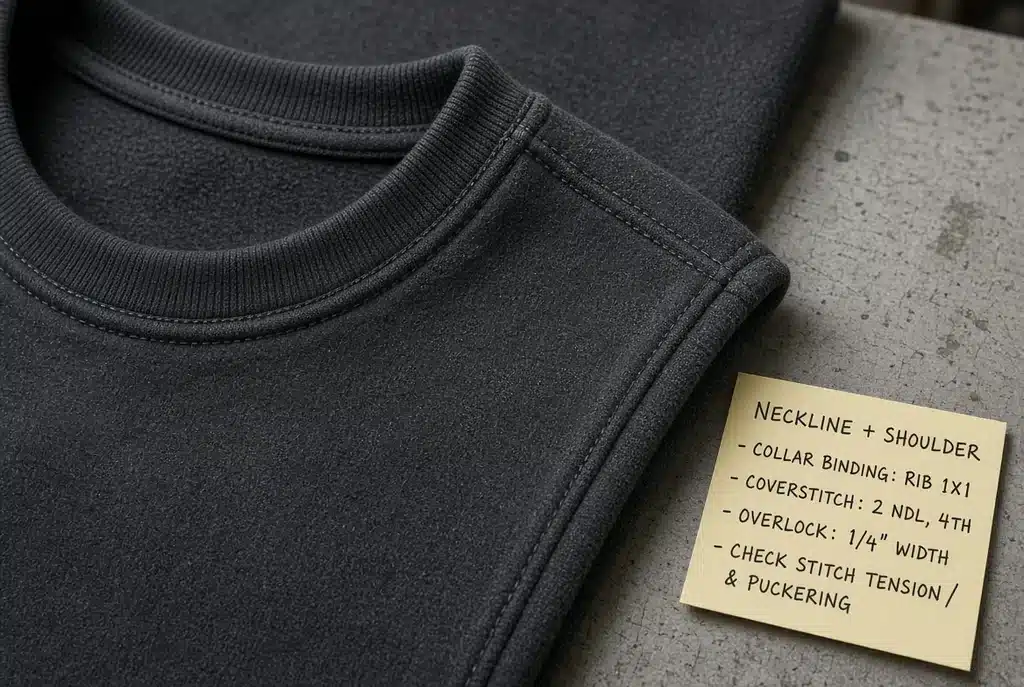
Seam type, stitch type, stitch density (where applicable), seam allowance, topstitching, binding, hemming method, reinforcement and inside finishing. These decisions will impact on the durability, look, labor time and the quote.
The T-shirt hem may be a cover stitch hem or twin needle hem. Either flat felled or overlocked, a woven shirt side seam can be done. Bartacks may be required when dealing with pocket corners. Neck tape may be required with a knit neckline. When silence occurs the factory will use the method fastest or easiest to them, not necessarily the one the brand were thinking of.
Category-Specific Construction Callouts
Technical detail varies from one garment to another.
When talking about a polo, explain collar construction, length of placket, number of buttons, interlining and vents on the sides. If it’s a hoodie, explain about hood panel count, lining, drawcord path, the position of the eyelet, the size of the ribs, and the pocket attachment. If trousers, explain the construction of the fly, material of the pocket-bag, how the waistband is finished, how many and where are the belt-loops, and bartacks. If the shirt is woven, explain yoke, placket, cuff, collar stand and any darts/pleats.
These are the characteristics a factory will determine from a house sample. Write it once, and the first sample is used to test the intended garment rather than the factory’s habits.
Wash, Finishing, and Special Treatment Instructions
The following finishes such as enzyme wash, garment wash, pigment dye, silicone softener, brushing, peaching, printing, embroidery, heat transfer, distressing, or water-repellent finishes should be communicated visually and with an approval requirement. Completing handfeel, colour, measurements, shrinkage and cost.
When washing is an integral part of the product identity, approve the wash using a sample of the intended fabric. A clean proto won’t make a washed hoodie. Printed placements on non-washed jersey may move after washing.
Color, Artwork, Branding, and Packaging Must Be Sample-Ready
Colour, print, embroidery, labels and packing should be included in the pack prior to sampling if the sample is intended to represent the bulk product. A blank proto will test fit. It can’t test branded product.
Colorways, Pantone References, and Lab-Dip Expectations
Name each colorway and give a reference; a Pantone standard, approved swatch, mill dye code, or other named standard. Does the color of the screen or the words “washed olive” suffice for custom dyeing?
Sometimes it is necessary to obtain lab dips or fabric samples for approval before a sample is used as a substitution for bulk color. The dyeing of knit & fleece is different from a woven shirt. Allow the use of color on the actual fabric family, when the colour is commercial.
Print, Embroidery, and Artwork Placement
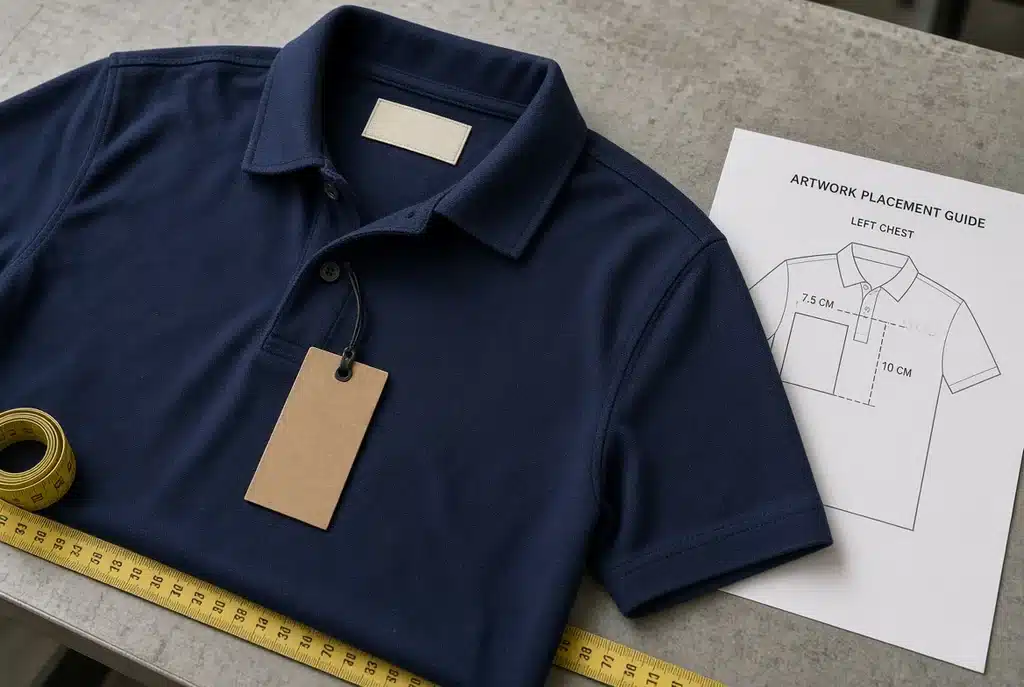
Artwork files require measurements of dimensions, method, color, and placement from stable garment points. Left chest logo is not an applicable callout. The pack should include the size of the logo and the distance from center front, neckline or armhole.
Approve artwork on the actual fabric. The result will vary based on the ink coverage, density of the embroidery, and the stretch of the knits. The print will crack or pucker on a light jersey.
Labels, Care Content, Folding, and Pack-Out Instructions
Add principal, care, size, hang, barcode, folding, polybag, warning, carton assort, carton marks etc. labels. Packaging should be included in tech pack because it has an impact on sourcing, unit cost, export packing, and retail readiness.
Verify the legal and market specific care and fiber content by yourself. A label can be sewn on a given factory. It shouldn’t be expected to guess another country’s labelling requirement.
Common Tech Pack Mistakes Before Men’s Clothing Sampling
The majority of sample delays aren’t due to the absence of a CAD license. They are a result of missed decisions. The following problems tend to reappear on men’s clothing tech packs pre-sample.
Using Only Inspiration Photos and General Fit Words
A reference photo and either “oversized,” “premium,” “relaxed” or “like this” means proportion cannot be determined. Common results: a wide-fitting tee with a too-short length, a hoodie with an incorrect shoulder slope or the rise of a pair of trousers that varies between sample makers. Measure and cut-out callouts before requesting a sample.
Leaving Fabric and Trim Choices Open Until After the First Sample
The drape, shrink, print, and cost of a sample in substitute fabric cannot be accurately determined. A tee that is sampled in lighter jersey, will hang differently. A generic rib on the hood of a hoodie will not be indicative of the brand’s collar or cuff. A quote prior to zipper and label selections is a provisional number, not a production cost.
If the first sample needs to be a stand-in fabric, then indicate this as a development proto. Don’t consider that proto as bulk approval.
Losing Track of Revisions and Unapproved Changes
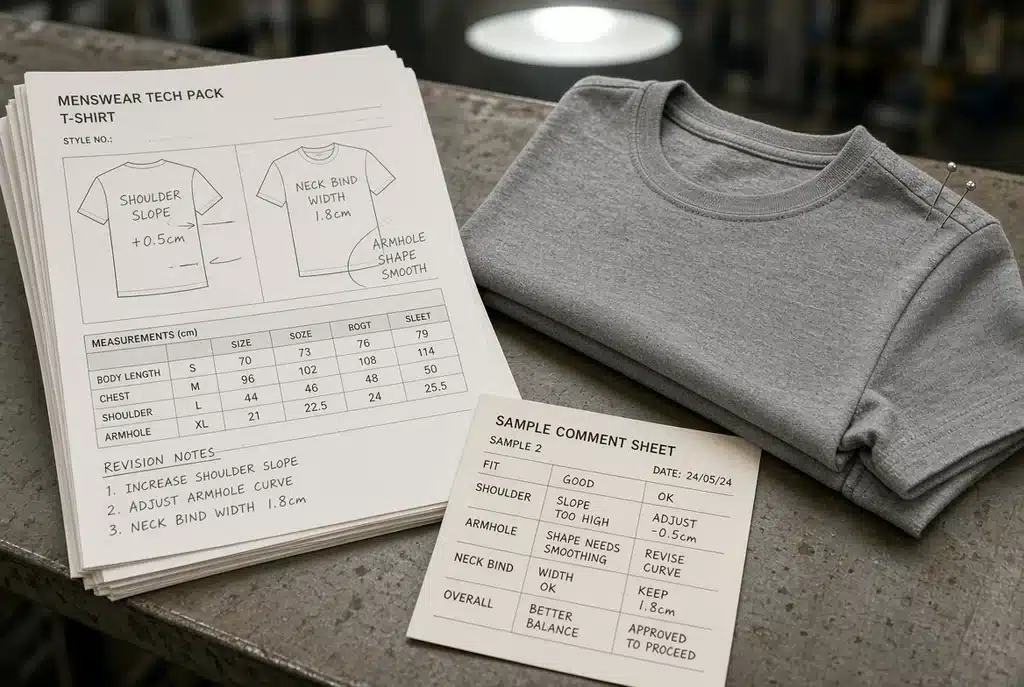
Marked up photos, chat and e-mail communications littered with comments make factories work in outdated versions. All changes should be documented by version, date, sample stage, page or measurement reference, and be marked as approved.
Red flags are if you have multiple “final” files, changes that are only in a voice comment, and a fit comment that isn’t referencing a size or point of measure. The following sentences are not a revision: “Make the sleeve better.” Sample 2, size L, sleeve length +2cm, version 03 is a revision.
Practical Ways to Make the Tech Pack Easier for a Factory to Use
Even if the factory is able to identify the page, a full pack still fails if the factory is not able to determine the current page. Technical work includes document control.
Build One Clear Source of Truth
Apply the same style code, document title, revision number, revision date and sample-stage label throughout the document. Technical Flats, Measurement sheets, BOM pages, Artwork file and comment logs need to be the same version. This control will not allow a pattern maker to cut old measurements with a new fabric request.
Name files to facilitate their sorting by a stranger. The “Hoodie_navy_final_USE_THIS_v3” is a risk already. “ST-2408-HD01_TP_v03_2026-08-21_FitSample” can be found later.
Separate Must-Have Specifications From Open Development Questions
Unresolved items may be included in the first tech pack. The items should include “to be proposed,” “pending swatch approval” and “requires sample test.” If a cell is blank, it must be guessed. A written proposal is requested by a labeled open question.
When approving a bulk-ready sample, focus on measurements, fit, fabric type, construction, and brand placement. Open questions may be left it the wash recipes or carton marks. Ideally, they should not be at the chest width level.
Use the Sample Review to Improve the Pack, Not Replace It
Documented changes to measurements, construction, materials or artwork placement should result from each sample round. On a fit sample, the pages should be revised, but not a message stating the next one should “feel better.”
This habit provides a pre-production sample, bulk QC and repeat order production record. The accepted pack is the clothing’s remembrance. The sample is the memory tested.
A Factory-Ready Tech Pack Checklist Before You Request a Sample
The purpose of an apparel tech pack checklist isn’t additional paperwork. It’s to prevent a manufacturer from making business or technical choices for the brand.
Required Information Before the First Sample
Check that the pack contains:
- The styles, the number of samples, colors, the date and the version.
- Technical flats in front and back, including detail views in the case of unclear construction.
- Marking the base size will require a specification for measurement, points of measure, methods, and tolerances.
- Note or inform the student that an attempt is to be made to grade, or provide a direction to grade.
- The properties of fabric, such as composition, GSM, construction, finish and what can be expected from the shrinkage.
- BOM – covering fabric, rib or lining, trim, label, decoration and packaging.
The construction notes for seams, stitches, reinforcements, and category specific are included.
Questions to Ask the Factory After Sending the Tech Pack
Send the pack, then ask for written clarification before sewing starts:
- Send pack, ask for written clarification before sewing!
- Are there any other parts you don’t yet understand?
- Are the desired fabrics and trims available in the desired quantity?
- What need to be confirmed by the pattern maker?
- What, if anything, will be substituted on this development sample?
- Which type of sample stage is this?
- What is different between this sample and bulk?
Those questions surface gaps while they are still cheap to fix.
Make the Sample a Test of the Product, Not of Guesswork
The ideal garment tech pack allows the factory to produce a sample to test the product they will be producing. It will not remove all the revisions. Although fabric, fit, and finish are still to be seen on a body and a table, there still is a need for sampling. A robust pack minimises unnecessary guess work and ensures that any changes to the pack are identifiable.
Use the document as a ‘production file’. Approved decisions should be transferred from a comment into the flats, measurement sheet, BOM or construction notes. That’s how a first sample transforms into a standard that really is “bulk-ready”.