
Consistent kids clothing size grading starts with a defined age block, a base size that represents the product, shared points of measure, age-appropriate grade rules, and checks on both fit and bulk measurements. It is not a reduced adult chart, and it is not one jump applied from toddler through older child.
Chest, body length, sleeve length, neck opening, rise, and waistband do not have to change at the same rate. A toddler T-shirt and a school-age jogger can share a brand and still need different logic. This guide is the method for locking that system before a graded range is approved for production.
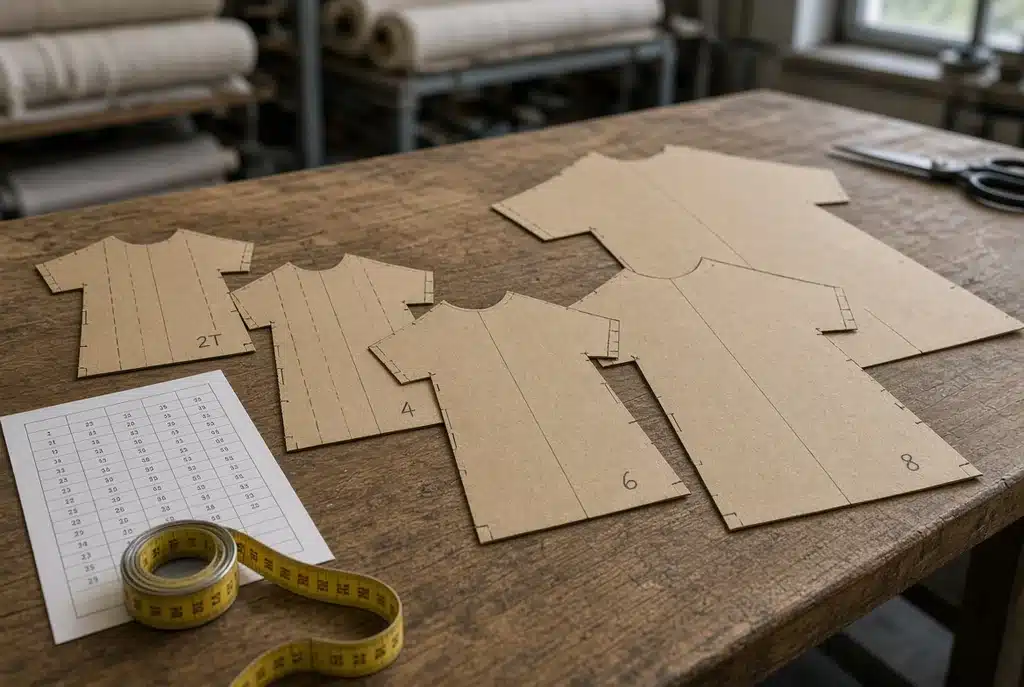
Define the Age Blocks Before Creating Grade Rules
The first grading decision is not a number. It is which ages, body stages, and product groups the size run is for. A toddler T-shirt often needs extra room through the neck and armhole so it can be pulled on, plus body length for a nappy or a tucked layer. An older child’s T-shirt sits closer to a stable shoulder-to-chest relationship, so sleeve and body length should not keep stretching at the toddler rate. A toddler jogger rise and a school-age jogger rise are a separate decision, not a column filled because the site lists every age.
Do Not Grade Across Every Age With One Formula
A single grade rule from baby sizes through older children distorts proportions. Height can outpace chest for a stretch of years, then the relationship shifts. Shoulder, neck, and armhole rarely track body length in a straight line. Where body shape or product purpose changes, use a separate base-size block. Age bands are a brand and market choice: a US age label, a EU height band, and a market that sells by years will not line up garment for garment.
Define the Garment’s Intended Use and Fit
Ease follows the job of the garment. A fitted base layer, a relaxed T-shirt, a school shirt, a sweatshirt worn over another layer, and a jogger are not graded from the same ease idea. The jogger needs rise and thigh room a T-shirt chart will never describe. A retail body chart says who the size is aimed at. A factory specification says what the sewn garment should measure. One table used for both is a common reason the sample “matches the chart” and still does not fit.
Choose a Base Size That Can Represent the Product
The kids clothing base size is the size the pattern and measurement system are reviewed from. A weak base copies into every grade above and below it. Pick a size near the middle of the block, in the fabric and fit you intend to repeat. On the T-shirt, review chest, shoulder, body length, sleeve length, neck opening, armhole, and hem. On the jogger, add waist, hip, rise, thigh, inseam, and leg opening.
Review the Base Size on the Actual Garment
Do not approve the base size from a chart alone. Review the sample on a suitable fit form, a child fitting where that is appropriate, or another method the process already uses. A T-shirt can hit chest width and still fail at the neck, or run short once the hem is finished. A jogger can hit the waist and sit wrong through the rise. Write the comment against the point and the wearing position.
Build the Base Size Around the Target Product, Not an Adult Template
Children’s proportions should set the base shape. A scaled-down adult block often leaves the shoulder too wide, the armhole too deep, the neck too small, or the rise too long. Those errors survive grading because the grade only moves an already wrong shape.
Before grade rules are written, ask whether this base belongs to this garment and this age block. Brands still shaping that pattern with a factory can fold the decision into custom kids clothing development, so the age block, the base-size review, and the first graded sample sit in one brief. It puts the base where later grades can be judged.
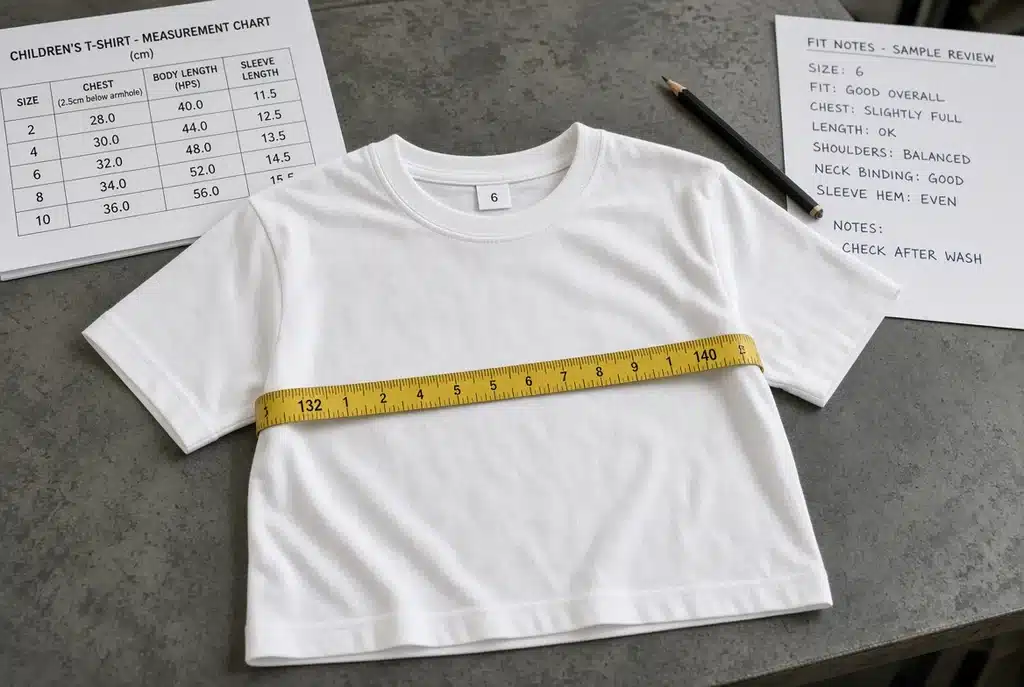
Build a Clear Measurement Chart and Points of Measure
Grading cannot stay consistent if the starting measurements are ambiguous. Brand and factory have to use the same points, the same direction, and the same words. A kids apparel measurement chart that says “width” without saying where the tape sits will be read three ways on one line. For the T-shirt, body length, chest, shoulder, sleeve length, sleeve opening, neck opening, armhole, and hem usually carry the grade. For the jogger, waist, hip, rise, inseam, outseam, thigh, and leg opening matter more. Hoodies add hood opening. Points nobody checks only create false disagreements.
Distinguish Body Measurements From Finished-Garment Measurements
Body measurements describe the wearer. Finished-garment measurements describe the product. Ease is the difference, and it is a design decision. The child’s chest circumference and the finished T-shirt’s chest width are not the same number, and they are often not taken the same way. One may be around the body. The other may be flat, side seam to side seam.
Label both if the brand needs both. Children’s clothing size chart development for the website is not the factory spec. The two have to agree. They do not have to be the same table.
Use Diagrams and Measurement Definitions
Mark children’s garment points of measure on a flat or a diagram. “Length” is not a point until the document says whether it starts at the high-point shoulder, the center-back neck, or the shoulder seam, and whether it ends at the hem edge. Say if it is taken flat, along a seam, or around the body.
If one side measures sleeve length from the neck and the other from the shoulder seam, every size will look out for a reason that is not grading. Once points, finished measurements, and the body-versus-garment split are written the same way, kidswear fit and measurement control is what keeps those definitions from drifting between the approved sample and later checks.
Create Grade Rules That Reflect Children’s Proportions
Grade rules describe how the pattern and the measurements change from the base size. Build them from the base, the age block, the garment, and the fit direction. There is no universal increment, and a rule copied from another market can be wrong even when the arithmetic is neat. How to grade kids clothing sizes is a product decision reviewed on garments, not a table borrowed from an adult spec.
How Kids Clothing Size Grading Should Differ by Measurement
Kidswear size grading rules should follow the job of each point. Chest, body length, shoulder, sleeve length, neck opening, rise, and waistband do not have to move together.
On the T-shirt, chest may need a modest change while body length needs a larger one through a growth stretch, or the reverse where height has slowed. Shoulder often should move less than chest, or the neckline and armhole look borrowed from a bigger body. Check sleeve length against the arm, not as a percentage of body length. On the jogger, waist, hip, rise, thigh, inseam, and leg opening each need their own rule. A waist that grows with the hip leaves smaller sizes tight and larger sizes loose. Inseam that tracks outseam without a rise check produces a long-looking leg and a seat that does not move. Size grading for children’s apparel falls apart when one jump is pasted down the column.
Watch for Distortion at the Ends of the Range
A rule that looks fine next to the base can fail at the smallest or largest size. The neck becomes hard to pull on. The sleeve grows past the wrist while the body still looks short. The jogger rise no longer gives room to sit, or waistband ease that worked at the base clamps the smaller size. Checking the base and one neighbor will not show that. If an end size only works after the grade is bent by hand, the rule needs a break.
Separate Age Blocks When the Fit Logic Changes
When proportion or use changes in a real way, split the block. A toddler T-shirt and a school-age T-shirt can share a graphic and still need different grade rules, different neck ease, and a different base. Record which sizes belong to which block so a reorder does not fill the gap with a grade that was never approved.
Control Ease, Movement, and Comfort Across the Size Range
Ease has to cover movement, dressing, layering, and the activity the style is sold for. A base layer, a relaxed T-shirt, a sweatshirt worn over another layer, a play jogger, and a woven dress do not share one allowance. Smaller sizes sometimes need more relative room to get the garment on.
Check Openings and Stress Areas
Openings are where wearers feel the grade: neck, armhole, sleeve opening, waistband, cuff, rise, pockets, and closures. A tee can measure well at the chest and still be hard to pull on. A jogger can have hip room and a waistband that bites once elastic is added.
Keep Garment Proportions Visually Balanced
A garment can hit every number and still look wrong if sleeve length grades faster than body length, or rise does not move with inseam.
Validate Grading Through Fittings and Size-Set Samples
Approving the base size does not prove the range. Check the graded pattern across more than one size before bulk: a size-set sample, sizes at the ends and middle, fit forms or appropriate child fittings, flat measurement against the spec, and movement notes where that review is part of the process. No fixed count of sizes or wearers fits every brand.
Kidswear size-set sample development is the practical check. Sew the selected sizes in the intended fabric, measure them the agreed way, and record what each size does. A base-size prototype is not a size set.

Select Sizes That Expose Problems
Check the base, one smaller size, one larger size, and any size on a block transition. The ends usually show distortion first: neck, sleeve, rise, waistband, and hem. If the range crosses a toddler-to-school split, include a size on each side rather than assuming the grade carries through.
Record Fit Comments by Size
“The range is too long” is not a correction. Name the size, the point, what was seen, and what should change. “Size 6 T-shirt body length is long at the hem when the arms are raised; reduce the grade into this size and recheck sleeve length” can be patterned. “Too big” cannot. Keep rise comments separate from inseam comments. Store the note on the revision, not in a chat thread the pattern file will never see.
Set Tolerances and Control Measurement Consistency in Bulk
Tolerances are the agreed variation around a target. Set them for the point, the material, the construction, and the finish. A body-length tolerance is not automatically right for a neck opening, a waistband, or a sleeve. Rib, elastic, and a wash can move some points more than others. Do not copy one number down the spec to fill the column.
Connect Tolerances to the Approved Sample and Spec
Check production against the approved specification and the approved sample, not against a memory of the fitting. Agree the method: flat or around, from which point, before or after finishing, and what happens outside the range. A sample accepted with a known deviation should say so. Otherwise bulk is judged against a garment the spec does not describe.
Check Measurement Trends, Not Only Individual Pieces
Single pieces vary. Trends are the grading problem: every body in one size running short, one size drifting wide, or one color finishing differently after wash. Catching that pattern is part of kidswear production measurement inspection, where workmanship and measurement are checked against the approved spec before the order is treated as finished. One pass does not prove every unit matches. It is a control on the run you are shipping.

Document the Size System Before Bulk Production
Consistent kids clothing sizing needs one shared record. Tech pack, pattern files, measurement chart, grade rules, sample comments, and approval notes should tell the same story: target market and sizing convention, age or body blocks, base size, points of measure, body and finished measurements, ease direction, grade rules, tolerances, size-set comments, approved sample reference, and revision date.
Children’s clothing size chart development belongs on its own page if customers will see a chart. Name the convention. Do not paste another brand’s ages into it.
Make the Retail Size Chart Match the Product
The customer chart helps a buyer choose. The factory spec tells a sewing line what to hit. They must not contradict. Before launch, check the published chart against the approved measurements and the size-set notes. If the site claims a height band the sample never covered, fix the chart or the grade before the first order.
Keep Grading Controlled During Reorders
A repeat should not quietly change the grade rule, the fabric, or the measurement reference. A new mill, a different rib, or a wash absent from the approved sample can move chest, length, and waistband without anyone editing the grade. If the fit changes, record a new revision and say which sizes were rechecked. “Same as last time” is only true when the pattern, the spec, and the approved sample still match.
If you already have a size chart, a base sample, graded measurements, or a children’s garment specification, you can discuss your kidswear sizing requirements against the actual product, age block, and size range. A grading review only helps once those files are on the table.