
A kids clothing MOQ is the minimum a factory, or the suppliers behind it, will cut and sew under a stated set of assumptions. It is not one garment count that applies to every children’s style. Style count, color, fabric, size range, trims, decoration, packaging, and whether the order is a first run or a repeat can all move the number.
The same factory may quote one structure for a stock-fabric T-shirt and a different one for a custom-dyed hoodie, a printed tracksuit, or a fully developed collection. “What is your MOQ?” is the wrong first question. Ask what the minimum is per style, per color, per fabric, and per size range, and which assumption creates it. A quote of 300 pieces means little until you know whether that is 300 total, 300 per color, or 300 per style with a required size mix. A T-shirt in two colors and six sizes is already a planning problem, not one SKU.

What Does MOQ Mean in Kids Clothing Manufacturing?
The minimum order quantity for children’s clothing is the smallest quantity a manufacturer is willing, or able, to produce once the production assumptions are named. Those assumptions include the style, the fabric, the color count, the size run, the decoration, and the trims. The term can mean total units, one style, one color, one fabric, or one production run. It does not automatically mean the quantity you hoped to buy.
A quoted minimum often reflects something the factory has to purchase or set up before sewing starts. Fabric has to be bought. A custom color has to be dyed. A marker has to be planned. Screens, embroidery files, labels, and cartons may sit with other suppliers. A line also has to be scheduled. If any one of those steps has its own floor, that floor can become the number you see on the quote.
Ask Whether MOQ Is Per Style, Color, Fabric, or Total Order
Before you compare two quotes, get the basis in writing. Useful questions are direct:
- Is the MOQ per style?
- Is it per color?
- Is it per fabric?
- Is it per size?
- Is it calculated across the whole order?
- Can several colors share the same fabric minimum?
- Are sizes required in a fixed ratio?
The answers change the order you can actually place. A total of 400 pieces can look manageable until it is split across three styles and four colors. Twelve colorways at a thin quantity each is a different job from one body in two colors. If the factory also wants a size ratio, some sizes may have to be cut even when your forecast for those sizes is weak.
Take the running example. A children’s T-shirt in two colors and six sizes is one style with twelve size-color cells. If the quoted minimum is 300 per color, you are looking at 600 pieces before a second style exists. If it is 300 total, and sizes can be mixed, the same sentence means something else. Write the basis next to the number. Do not leave it implied.
Separate Factory MOQ From Material MOQ
The sewing floor and the material supplier do not always share a minimum. A line may be able to sew a short run. The mill, the dye house, the printer, the embroiderer, the label supplier, or the packaging vendor may not accept that same quantity.
A common split looks like this. The factory can cut and sew a limited T-shirt run from fabric already in stock. A custom color, though, needs a dye lot large enough for the mill to run. The sewing minimum is no longer the number that matters. The fabric purchase is. Ask which supplier or process creates the floor, and whether a different material path changes it. If the answer is only “our MOQ is X,” you do not yet have a production plan.
Fabric and Color Are Often the Biggest MOQ Drivers
Fabric choice is usually the first place a kids clothing order gets larger than the sewing plan. Stock cloth can be more flexible when the color, weight, and quality you need are already available. Custom color, a special finish, an unusual composition, or a new development can force a dedicated purchase. Stock fabric does not always produce a lower minimum. Availability, shade, hand feel, and the supplier’s own buying rules still decide the result.
Ask three things before you treat a fabric as settled. Is it in stock in the colors and weight you need? Is it available for sampling only? Or does it require a new production order? A swatch that looks right in a meeting can still be a sampling lot. That is not the same as cloth a mill will sell at your first-run quantity.
Stock Fabric Versus Custom-Developed Fabric
An existing jersey in a few colors and a known weight can often be planned around what the supplier already holds. You still need to confirm width, shrinkage, and whether that lot will exist again for a reorder. A developed fabric is a different commitment. It may need knitting or weaving, lab dips, finishing, and a mill run that is sized for the mill, not for your first cartons.
A special hand feel or a performance finish can add another purchasing step. Brushing, moisture management, or a tighter shade tolerance may be available only above the mill’s own floor. None of that is a reason to avoid development. It is a reason to know, before you sketch a six-style collection, whether the cloth is a stock choice or a new program.
Buyers still choosing between a stock jersey and a developed knit can look at fabric sourcing for kidswear before they freeze a quote. Composition, weight, color, and finish belong in that conversation, because each one can change what the mill will sell.
Why Every New Color Can Change the Order Structure
Each new color can mean a separate dye lot, a separate shade approval, and a separate cutting plan. A kidswear MOQ per color is often higher than buyers expect, because the cost and the control sit in the color, not in the sketch. A six-size T-shirt in four colors is not one style with four visual options. It can be four color-specific material plans, each with its own shade risk.
If fit coverage matters more than palette, cut colors before you cut the core size range. Two colors across six sizes will teach you more about sell-through than four colors that leave the end sizes too thin to judge. Adding a custom-dyed hoodie on top of that T-shirt is a second fabric program, not a colorway of the first one. Treat it as its own minimum until the manufacturer confirms the two bodies can share anything.
Size Range and Color Count Multiply the Production Combinations
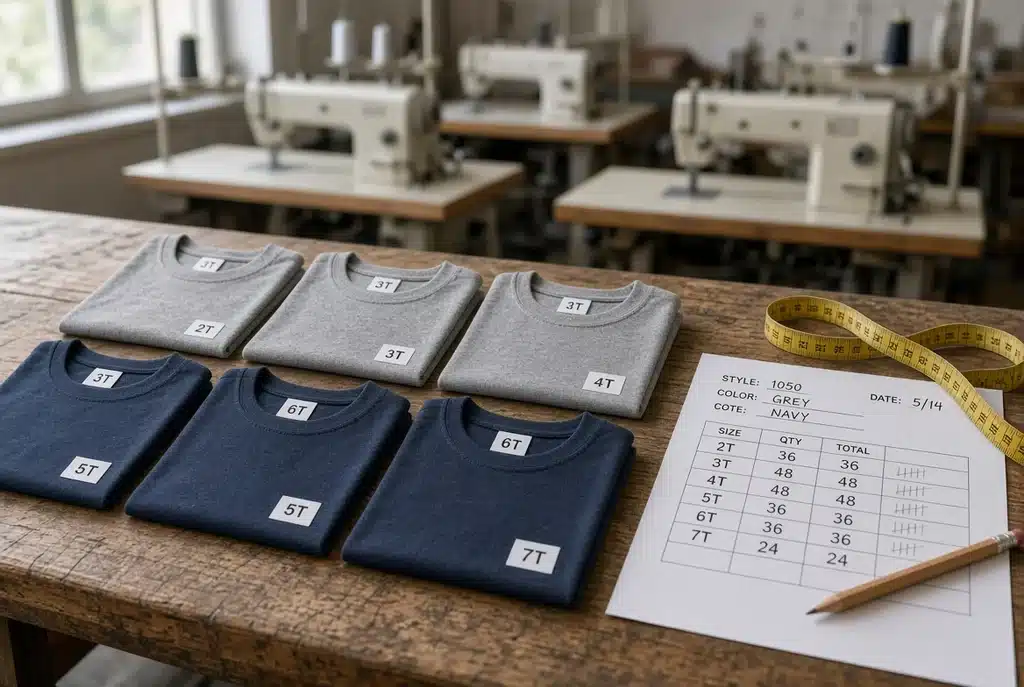
Children’s apparel rarely lives in one size. Each extra size has to be patterned, cut, sewn, checked, packed, and often labeled on its own. Color multiplies that work again. One T-shirt in six sizes and three colors is eighteen size-color combinations before the factory has cut a second style. Add a hoodie in the same size run and the planning sheet doubles, even if the brand still thinks of the order as “two products.”
Factories plan markers and bundles around those cells. A very thin quantity in one size can be awkward to cut and easy to lose in packing. A very wide size run with no forecast leaves the factory guessing which sizes you actually intend to sell.
Why a Broad Size Range Consumes Quantity
You may need enough pieces across the range so key sizes are not empty. The factory may also need a practical quantity before cutting and sewing are worth setting up. Those two needs are not the same, and neither is solved by writing “kids sizes” on an inquiry.
Send the age block and the size run early. Toddler, child, and youth are different grading jobs. A brand that needs 2T through youth is asking for more than a brand testing one age block. An expected size breakdown, even a rough one, lets the merchandiser see whether the quoted total can cover the run without starving the middle sizes.
How to Reduce Complexity Without Removing Important Sizes
You can usually simplify the order without dropping the sizes your customer actually needs. Practical options:
- Start with fewer colors on the same body.
- Focus on one age block for the first run.
- Use the same fabric across related styles when the supplier confirms it is the same cloth.
- Limit decoration changes from size to size.
- Add a second style only after the first body is approved.
- Test the collection before you expand the range.
Do not assume a supplier will fold every style and color into one minimum. Some will combine colors on a shared fabric. Some will not. Ask, and keep the answer attached to the quote.
Style Complexity and Construction Affect MOQ
A single minimum cannot cover every kidswear product, because the work is not the same. A basic cotton jersey T-shirt is a short sew. A raglan sweatshirt adds sleeve construction and rib. A hooded fleece top adds a hood, drawcord channel, and usually a heavier cloth. A woven dress with lining adds a second material and more handling. A jacket with a zipper, pockets, and hardware is a different line balance again.
That gap is why a number quoted for a blank tee is a poor guide for a tracksuit or an outer layer. Cutting time, stitch count, trim count, and the inspection points all rise as components are added. A printed tracksuit is not “the T-shirt order, plus printing.” It is another body, another fabric weight, and another decoration setup.
Trims, Closures, and Special Components
Buttons, snaps, zippers, elastic, drawcords, patches, woven labels, and special hardware often come from trim suppliers with their own floors. A small metal snap in a custom finish can require more pieces than the garment order needs. Elastic and zipper tape are commonly bought by length, not by garment. Leftover trim is a real cost if the style does not reorder.
For children’s product, also confirm that the closure and the trim suit the age range and the market you are shipping to. A drawcord, a small part, or a sharp hardware finish can be the wrong choice for younger sizes even when it looks right on a youth sample. That is a product decision, not a certificate. Do not treat a factory’s general experience as proof that a specific trim meets a specific regulation.
Decoration Can Create a Separate Minimum
Printing, embroidery, patches, washing, and special finishes can add setup that the blank garment never had. A small one-color chest print is a different task from a large multi-color graphic. Embroidery has digitizing, backing, and stitch-count limits. A wash can need its own lot size before the result is stable.
Send artwork size, placement, color count, and the decoration method before you compare minimums. A quote that excludes printing is not comparable to one that includes it. Fabric compatibility matters too. A print that sits well on a stable jersey can behave differently on a light or stretchy kidswear cloth.
Those details are why garment printing for kidswear should be specified before a manufacturer builds the order structure. Color count, placement, and how the print has to survive wear all sit inside the setup, not beside it.
Labels, Hangtags, and Packaging Can Add Separate Minimums
Branded details are often purchased outside the sewing line. A woven main label, a printed care label, a hangtag, a sticker, a polybag, a carton, or a custom mailer can each carry its own quantity. The garment minimum and the branding minimum are not automatically the same number.
Ask the questions in the quote, not after the deposit:
- Are labels included in the garment minimum?
- Can unused labels be kept for a later order, or is that your problem to solve?
- Is packaging bought per garment or per shipment?
- Do custom cartons or printed bags have a separate floor?
- Can a first test run use standard packing?
No supplier owes you storage or a guarantee that spare labels will be usable next season. If a trim house will hold stock, get that in writing, with a time limit. If it will not, the first order has to absorb the label buy.
Keep Branding Requirements Proportional to the First Order
A clear woven label and a correct care label are part of the product. An elaborate box, a printed mailer, or a custom tissue program may not be, especially before you know which styles sell. For a first ecommerce test, standard packing plus a proper label is often enough. Wholesale may need a hangtag and a carton mark earlier, because the buyer’s floor expects them.
That is a commercial choice, not a rule. Match the branding spend to the channel and to how sure you are about the style. Custom labels and hangtags are worth specifying early, including label type, attachment, and whether a repeat order can use the same trim. Leaving them as “branding to follow” is how a second minimum appears after you thought the quote was closed.
Product Development and Sampling Can Affect the First Order
Development is not the bulk minimum, but it changes what a new brand should commit. A simple body may need one pattern and a fit sample. A complex style may need new patterns, material development, several samples, fit revisions, and special trims before anyone should talk about a large cut. Sample quantity is not bulk quantity. Ask how sample cost, sample cloth, and revisions are handled. Do not assume an approved sample automatically qualifies the style for every later order size.
Simple Base Style Versus Fully Custom Development
An existing base T-shirt can mean fewer open decisions: a known block, a known stitch, a fabric the factory has sewn before. A fully custom hoodie or jacket can mean a new pattern, a new hood or lining, and trims that have not been bought before. Neither path is always cheaper or better. The base style gives you less control over proportion. The custom style gives you more control and more development work. Pick the path that matches how specific the product has to be, then ask what that path does to the first production quantity.
Why a Better Sample Can Reduce Bulk Risk
Cutting the sample to save money can cost more once bulk is cut. Wrong fit, unexpected shrinkage, a print that cracks, or a collar that will not recover are expensive to discover after the fabric is spread. A useful sample lets you check those points while the quantity is still a choice. Extra sample rounds do not guarantee a clean bulk order. They do give you a reference to measure against.
Patterns, cloth, fit, construction, trims, and branding should be settled in kidswear sample development before a larger quantity is treated as committed. If the sample was sewn in a substitute fabric, say so on the approval. A passed sample in the wrong cloth is not a bulk standard.
Small-Batch Production Can Help, But It Is Not a Universal MOQ Solution
Small-batch production is a reasonable way for a startup to test a style when demand is still a guess. It can put a limited run into the market so you can read fit comments and sell-through before you scale. It does not erase fabric minimums, dye lots, trim floors, or print setup. Not every factory runs this way, and not every style can be made at the same small quantity. A fleece hoodie with a custom shade is still a material problem, even when the sewing line is willing to take a short order.
When a Trial Order Makes Sense
A trial is useful when you have little sales history, when you need to see the product on real customers, or when you are testing one or two core styles rather than a season. One T-shirt body in two colors is usually easier to plan than four unrelated styles in one color each. The first version concentrates quantity where you can learn. The second version spends the same pieces across bodies you cannot compare.
Special packaging and a full custom color on that first trial add commitments you may not need yet. If the goal is to test the body, use cloth and packing you can actually reorder. A trial that cannot be repeated is a one-off, not a product test.
What to Clarify Before Accepting a Small-Batch Quote
Get these points in the quotation, not in a follow-up call:
- Is the quantity per style or total?
- Are colors combined?
- Can existing fabrics be used?
- Are labels and packaging included?
- Will the same materials be available for a reorder?
- Does the quoted quantity include every size you plan to sell?
- Are setup or development charges outside the unit price?
Small-batch kids clothing manufacturing still has to answer those questions. Brands planning a limited first run can review small-batch clothing manufacturing as the production mode for a test collection. Read it as a way to structure a short run, not as proof that every material floor can be waived.
How to Ask a Manufacturer for a Useful MOQ Breakdown
A useful reply needs a useful brief. Send enough for a merchandiser to see what creates the minimum, then ask for the breakdown rather than a single figure.
Include the product category, target age range, size range, fabric composition and weight, and whether the fabric is existing or custom. State the number of colors, the decoration method, and the artwork size. Name the labels, hangtags, and packaging you actually need. Give an estimated quantity, and say whether this is a trial or a repeat. Attach a reference sample, a sketch, or a tech pack. Name the target market so packing and labeling can be discussed against the right destination.
Ask the factory to reply with the minimum per style, per color, and per fabric, plus any trim minimum and decoration minimum. Ask for the required size distribution, development charges, packaging assumptions, and what has to stay the same for a repeat order. If a line is missing, the number you received is still a guess.
Do Not Compare MOQ Without Comparing Assumptions
One factory’s 300-piece figure may assume stock fabric and plain packing. Another factory’s lower headline may exclude custom dyeing, labels, and decoration. The smaller number is not the better offer until the exclusions are priced and the materials are named. Compare the bill of materials and the size-color plan, then compare the quantities.
This is also where private-label kidswear quotes go wrong. Two programs can share a silhouette and still differ on label buy, carton print, and whether the fabric is exclusive. An MOQ for private-label kidswear is only meaningful next to those extras.
Questions That Reveal Whether the MOQ Is Flexible
Flexibility is usually a change in assumptions, not a discount. Ask whether existing fabric can replace a custom dye. Ask what happens if you drop a color, use standard packing, simplify the print, or start with one core style. Ask whether sizes can be mixed inside a color, and what ratio the cutting room needs.
Stop where the answer becomes unrealistic. A mill that needs a dye lot cannot sew you out of that lot. Pressing for a quantity the process cannot support produces a quote that will be revised later, often after artwork and labels are already in motion.

A Practical Checklist Before You Accept a Kids Clothing MOQ
Use this before you accept a quotation. If a line is unanswered, the minimum is not ready to approve.
- Is the MOQ stated per style, per color, per fabric, or as a total order?
- Is the fabric stock, custom-developed, or subject to a supplier minimum?
- Is the size range included in the quantity, or added on top?
- Are colors and sizes required in a specific ratio?
- Are labels, hangtags, trims, and packaging included?
- Is decoration included, and is the artwork size named?
- Are sample and development charges separate from the unit price?
- Can a test order use standard materials and plain packing?
- Can the same fabric and trims be repeated later?
- Does the order size fit a sales forecast you can defend?
- Is this quote built on the same assumptions as the quotes you are comparing?
The lowest number is not automatically the best option. A smaller figure can come with higher setup cost, a narrow material choice, or a product you cannot reorder in the same cloth. What affects garment MOQ is the structure behind the figure. Read that structure, then decide.
If you already have a style, a quantity band, a fabric direction, and a size plan, request an MOQ breakdown against those assumptions. A project-specific reply is the only number worth comparing.