
There is no single clothing sample cost that fits every style. A sample is a one-off development job, not one bulk unit pulled from a finished run, so the quote depends on pattern work, fabric and trim sourcing, sewing complexity, decoration, washing or finishing, and how many revision rounds the brief implies. A plain jersey T-shirt and a lined jacket do not share the same cost structure.
The useful question is not what a sample always costs. It is what this quote includes. Compare the same scope across suppliers—pattern development, materials, cutting and sewing, decoration, labels, revision allowance, and shipping—before you judge a number. A lower first figure can leave out the work required to reach an approved sample.
What Goes Into Clothing Sample Cost
A sample quote is usually a stack of jobs, not a single sewing price. Someone has to read the brief, build or adjust a pattern, find cloth and trims in sample quantities, cut one garment by hand, set machines, sew, decorate, finish, and then absorb comments. On a basic T-shirt, that stack is short: a block or a simple new pattern, jersey, rib if the neck needs it, a label, and a straight sew. On a hoodie, a woven shirt, or an embroidered dress, pattern panels, trims, and setup multiply before a needle moves.
Think of the quote as sample development cost for apparel, not as the bulk garment price written once. Bulk spreads marker planning, machine setup, and material buying across many units. A prototype carries that work on one piece.
Pattern and technical development
Pattern work is often the first cost a brand does not see on a bulk price list. If you send a graded pattern that the sample room can use, the factory still has to check seam allowances, grain, notch placement, and whether the construction notes match the sketch. If you send a flat sketch or a reference garment, someone has to interpret fit, ease, and construction before a single panel is cut.
That gap shows up quickly on real styles. A regular T-shirt with a set-in sleeve and a rib neck is a known shape. A polo adds a collar, placket, and often a taped or reinforced opening. A tailored shirt adds a yoke, cuff, collar stand, and darts. A dress with a shaped waist and lining adds another pattern set. None of those steps disappear because the brand already owns a mood board.
A complete tech pack reduces guesswork. It does not remove every development hour. Measurement points can still conflict with the sketch, a grade can be missing, or a pocket position can be shown without a finished width. The sample room has to resolve those points before sewing, and that time belongs in the quote.
Fabric and trim sourcing
Materials are the second block, and they rarely price like bulk cloth. The sample may need jersey, fleece, poplin, lining, rib, elastic, a zipper, buttons, a drawcord, interlining, a care label, and a hangtag. Buying a few meters, or one zipper, is inefficient. A mill or trim supplier may not sell at the same rate used for a later production order, and some items are simply awkward in small amounts.
A stock jersey swatch for a T-shirt is a different purchase from custom-dyed fleece for a hoodie, specialty lace for a dress, a waterproof zipper for a jacket, or branded metal hardware for a trouser or outerwear style. If the color has to be matched, or the trim has to be made rather than pulled from stock, sourcing sits in front of sewing. The quote should say whether those materials are included, substituted, or still to be confirmed.
Cutting, sewing, and sample-room labor
One sample does not get the efficiency of a production line. Cutting a single garment means laying a short length, marking, and cutting by hand or on a small table. Sewing means setting machines for that construction, checking alignment, and often stopping to correct a collar, a hood seam, or a pocket that does not sit as drawn. On a bulk order, that setup is absorbed across the run. On a sample, it sits on one piece.
A children’s jogger with elastic, a fly, and rib cuffs can take more handling than a plain adult tee, even though the garment is smaller. An activewear top with bonded seams or a jacket with a lining and sleeve head needs more checkpoints before it leaves the sample room. Labor rates vary by factory and are not a number this article can fix. What you can compare is the work: how many operations, how much hand adjustment, and whether decoration or washing is still ahead.
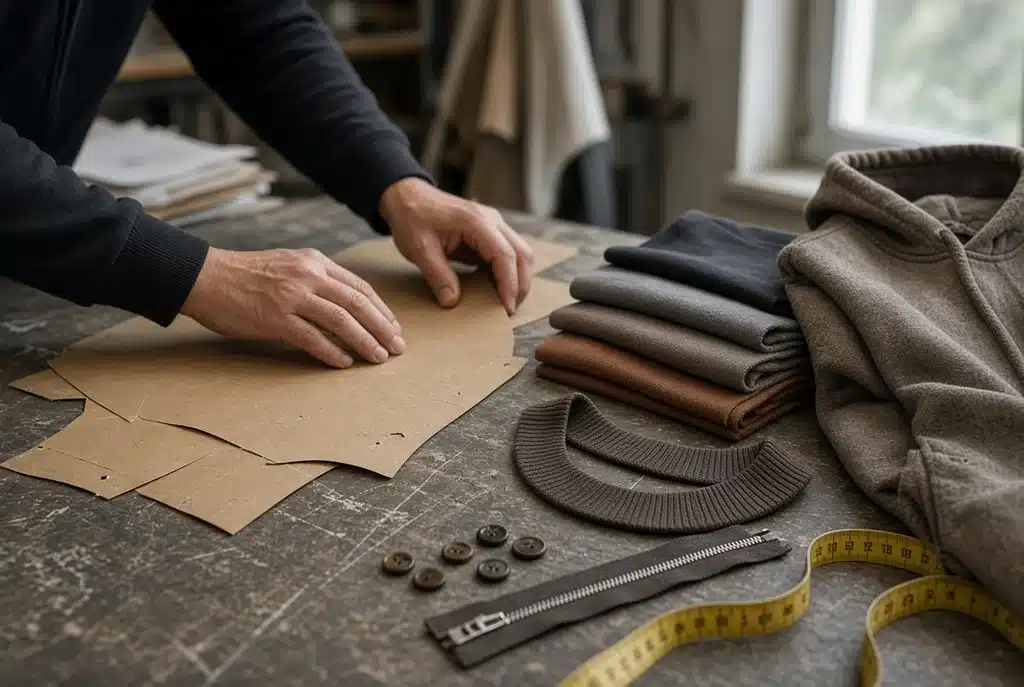
Why Garment Complexity Changes Sample Cost
Category is a weak price signal. Two hoodies can land far apart if one is a basic pullover and the other has color-block panels, a lining, embroidery, a wash, and metal eyelets. Construction, decoration, and finishing change the sample more than the word “hoodie” or “jacket” on the inquiry.
Construction and pattern complexity
Extra panels, shaped seams, pleats, darts, collars, cuffs, and pockets each add pattern time and sewing checkpoints. A simple trouser with a plain waistband is not the same job as a trouser with a zip fly, coin pocket, and lined waist. A shirt with a standard collar is not the same job as a shirt with a contrast inner collar and a gusset. A jacket with a full lining, sleeve vents, and a two-way zipper carries more handling than an unlined overshirt.
Reversible garments and bonded activewear raise the same issue in a different form. The sample room has to prove that both faces, or both seam types, can be made without the cloth twisting or the bond opening. Loungewear with a simple rib hem rarely needs that proof. A kids’ jacket with a hood, snap placket, and inner facing often does.
Decoration and branding
Printing, embroidery, patches, appliqué, and heat transfers are separate setups. Artwork size, placement, stitch or ink count, and fabric type all change the job. A one-color chest print on a T-shirt is a short setup. A five-color back print, or a left-chest embroidery with small lettering on a fleece hoodie, needs art review, a stable placement, and often a strike-off before the sample is called finished.
Labels and branded trims belong here too. A standard size label is a small line on the quote. A custom woven neck label, a heat-seal brand mark, and a hangtag with a string and barcode are extra components and an extra approval. The quote should say whether decoration is sampled on the garment, shown on a swatch, or excluded until art is final.
Washing, dyeing, and finishing
Garment washing, enzyme or softening treatments, pigment effects, and light distressing are not free add-ons to sewing. They can change measurement, hand feel, color, and surface. A hoodie that must be washed before you judge the fit needs that process in the sample, or the approval will not match bulk. A dress that only needs a light press does not.
If the finish is new to that fabric, the sample may also need a trial piece so the factory can see shrinkage and shade before the wearable sample is cut. That trial is part of development cost. It should be named in the quote rather than discovered after the first garment comes back short or stiff.
Why Sample Materials Can Cost More Than Bulk Materials
Sample cloth and trims are often bought outside the bulk program. They may come from stock, a remnant, or a special purchase that will not be repeated at the same rate. That is a normal reason clothing samples cost more than bulk garments, even when the style itself looks simple.
Small-quantity fabric and trim purchases
A sample might need only enough cloth for one body and a spare panel. The supplier may still sell a small cut, a roll end, or a minimum piece. Rib, elastic, drawcord, and buttons have the same problem. A stock button from the sample room is cheap to attach. A specific metal button that has to be ordered for one jacket is not.
The sample material may also differ from the bulk mill. Say so on the spec if that is the case. Approving fit on a substitute jersey, then cutting bulk in a heavier or less stable cloth, is how measurement comments restart.
Custom color and material development
Custom color, a lab dip, a printed base fabric, or a special finish adds steps before the sample exists. A black fleece from stock can be cut this week. A fleece that must match a pantone, or a shirting that must be yarn-dyed, waits on color approval and a small dye or print lot. Custom cord ends, molded snaps, or a jacquard label wait on the trim maker.
Using available cloth for an early silhouette check can be sensible. The limit is honesty about what that sample proves. Hand feel, drape, shrinkage, and color may all move when the final material arrives. If the quote is lower because the fabric is a substitute, the spec should say the sample is not a material approval.
Material minimums and unused balance
A mill or trim house may sell more than one sample can use. The unused balance is not automatically waste, but it is not automatically free either. The quote may include that balance, hold it for a later order, or leave it off and bill only what is cut. Ask which of those three is in the number. Do not assume a single sample consumes only the meters visible on the table.
Revisions, Re-Sampling, and Additional Development Work
The first sample is a test, not a promise that the style is finished. Cost moves when a comment needs a new pattern, a new material, a new decoration setup, or a garment that has to be made again. How much it costs to make a clothing sample the second time depends on what changed, not on a fixed revision rule.
What counts as a minor versus major revision
A minor comment often stays on the existing sample or needs a small resew. Moving a label, taking a sleeve down while keeping the cuff width, or changing a stitch type at a hem are typical examples. A major comment usually means new work: a different fabric, a redrawn block, a lining added to a jacket, a print method swapped for embroidery, or a trouser rise changed enough to rebuild the front.
There is no universal count of included rounds. One factory may include a measurement tweak. Another may treat any new sample as a new quote. Read that line before you compare numbers.
Why unclear feedback increases cost
“The sleeve looks wrong” can mean length, pitch, cap height, or cuff tightness. Each reading produces a different pattern. “Reduce the sleeve length and keep the cuff width” can be sewn against a tape. Conflicting notes from two people—one asking for a closer body, one asking for more ease—send the sample room in a circle.
One decision owner and one consolidated note cut that loop. Photos with arrows help. So does a short list that separates must-change points from preferences. Vague rounds are a real revision expense, even when no one calls them that.
When re-sampling is safer than patching
Some changes should not be patched onto the first garment. A new fabric with different shrinkage will not tell you the truth if it is only swapped into one panel. A fit-block change that affects the side seam, armhole, and neck will not read clearly if those seams are unpicked and resewn on a tired cloth. A construction change on a lined jacket—moving a pocket, altering the facing, changing the zipper—often needs a new body.
Remaking costs more than a quick alteration. It also stops you approving a garment that cannot be repeated. Ask the sample room which comments can be shown on the existing piece and which need a new one.
How to Compare Clothing Sample Quotes Fairly
A clothing sample quote comparison only works when both numbers cover the same garment. The lower quote may omit pattern work, final materials, decoration, a wash, revisions, or shipping. That is not a bargain until you know what was left out.
Ask what the quoted sample includes
Before you rank suppliers, ask each quote to answer the same list:
- Pattern development or pattern adjustment, and whether grading is included.
- Fabric, lining, rib, elastic, and trims, and whether any item is a substitute.
- Cutting and sewing of the sample.
- Printing, embroidery, washing, or other finishing.
- Labels, hangtags, and other branding.
- How many samples, and which type.
- What revision or re-sampling is included, if any.
- Packing and shipping.
- Services or materials explicitly excluded.
If a line is blank, treat it as unknown, not as included.
Compare like with like
Two quotes are comparable when they use the same style, the same material direction, the same decoration, the same sample count, and the same service scope. A T-shirt sample in stock jersey with no print is not the same offer as a T-shirt sample in a custom-dyed cloth with a chest embroidery. A hoodie quote that stops at sewing is not the same offer as one that includes a wash and a woven label.
Choosing the lowest opening number is reasonable only after those gaps are closed. A cheap first sample that cannot be used for fit, material, or art approval often creates a second sample you did not budget.
Ask what can change the final cost
Ask which assumptions move the price. Common ones are a material substitution, an artwork change, a new pocket or lining, a special finish, an extra size, or another sample round. The cost to make a prototype garment is stable only while the spec is stable. If the dress gains a lining after the quote, or the activewear top moves from a print to embroidery, the original number was for a different job.
Get those variables in writing before cutting starts. You are not asking for a locked price on an unfinished design. You are asking what would make this quote wrong.
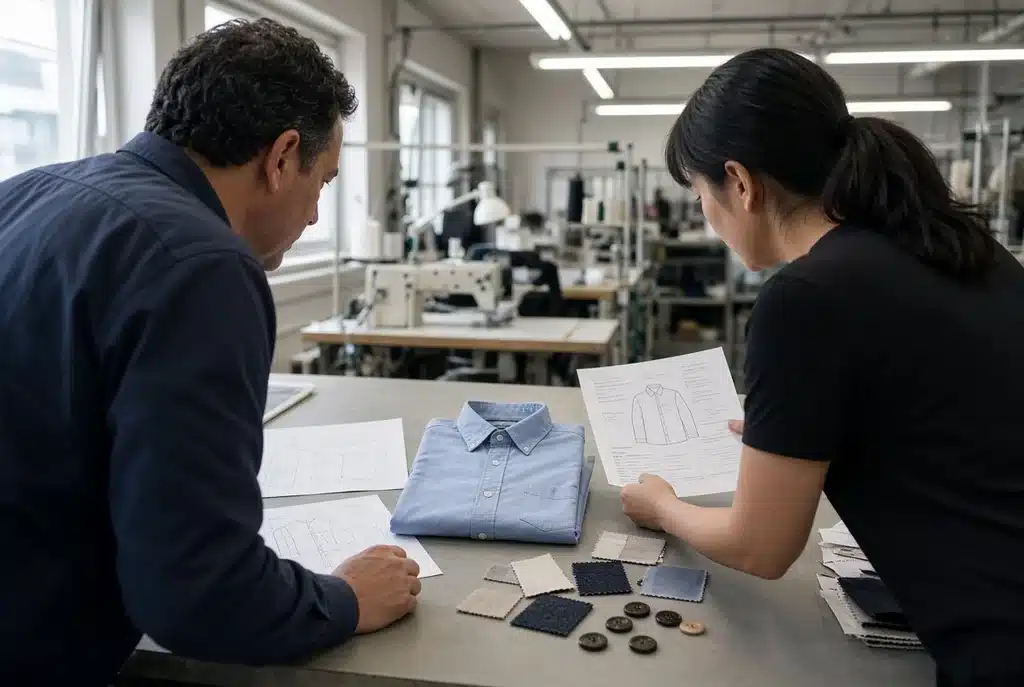
How Brands Can Reduce Avoidable Sample Costs
Cost control here means removing avoidable work, not skipping the checks that make a sample useful. A sample that never tests the real construction, the intended cloth, or the decoration you plan to sell is a weak saving.
Improve the brief before requesting a quote
A clear sketch, a measurement target, a fabric direction, artwork with placement, and a note on labels give the sample room less to invent. Say what the sample is for: silhouette only, fit, material approval, or a selling sample. That single line changes what must be included.
A full tech pack helps. It does not guarantee the lowest quote. A dense pack for a complicated jacket can still cost more to sample than a simple tee with a one-page spec. Clarity reduces wrong turns. Complexity still has to be made.
Use available or stock materials for early feasibility checks
Stock fabric and available trims can be enough to test a silhouette or a construction idea. A first hoodie in a house fleece can show hood depth and rib balance before you commit to a custom dye. A first trouser in a stock twill can show rise and pocket position.
Mark that sample as a feasibility piece if the bulk cloth is different. Shrinkage, drape, and color are not approved until they are checked on the material you intend to cut.
Limit unnecessary style and color changes
Lock the main silhouette and construction before you multiply colorways, prints, and optional details. Three colors of the same polo, each with a different embroidery, are three approvals. Two pocket styles on the same jacket are two patterns. Reducing clothing sample development costs often means sequencing the work: prove the body, then add color and branding.
Approve comments in one controlled round where possible
Collect comments once, from one owner, and send them together. That cuts contradictory instructions, a second courier trip for a half-reviewed sample, and a resew that has to be undone. If a fit model still needs to try the garment, wait for that note before the factory recuts. A controlled round is slower by a day and cheaper than two partial rounds.
What to Send When Requesting a Clothing Sample Quote
A clearer inquiry does not remove every unknown. It does stop the factory from pricing a garment you did not mean. Send:
- Garment category and a short style description.
- Sketch, tech pack, or reference garment, and what must be copied.
- Intended fit and the size to sample.
- Fabric composition or a material direction, including lining and rib if relevant.
- An estimated quantity range for later bulk, so material choices are not guessed in a vacuum.
- Color count and decoration method, placement, and art status.
- Labels, trims, and any packaging that must appear on the sample.
- The sample objective: fit, material, decoration, or a selling piece.
- Target market and intended use, including children’s wear or workwear if that changes construction.
- Your questions on what the quote includes and excludes.
Until cloth, construction, and decoration are confirmed, some lines in the quote will stay conditional. That is normal. A quote that pretends otherwise is the one to read twice.
Frequently Asked Questions
Why does a clothing sample cost more than a bulk garment?
Sampling carries pattern interpretation, small material purchases, machine setup, and manual adjustment on one piece. Bulk spreads that work across the order. The sample can also include decoration, washing, or a revision that never appears in a standard unit price.
What factors affect clothing sample cost?
Pattern work, fabric and trims, cutting and sewing time, decoration, washing or finishing, sample quantity, and revision scope. Garment complexity matters more than category. A lined jacket with hardware will not price like a plain T-shirt.
Does a tech pack reduce sample cost?
A usable tech pack or pattern cuts interpretation and wrong revisions. It does not remove material cost, sewing, or decoration setup, and it does not guarantee the lowest quote if the style itself is complex.
Are fabric and trims included in a sample quote?
Sometimes. Ask whether cloth, lining, rib, zippers, buttons, labels, and decoration are included, substituted, or excluded. Small buys and custom items are a common reason the material line looks high next to a bulk estimate.
How can I compare sample prices from different manufacturers?
Match the spec, materials, decoration, sample count, and included services before you compare the number. Ask what is excluded and what would change the price. The lower quote is only better value if it covers the work you need to reach an approved sample.