
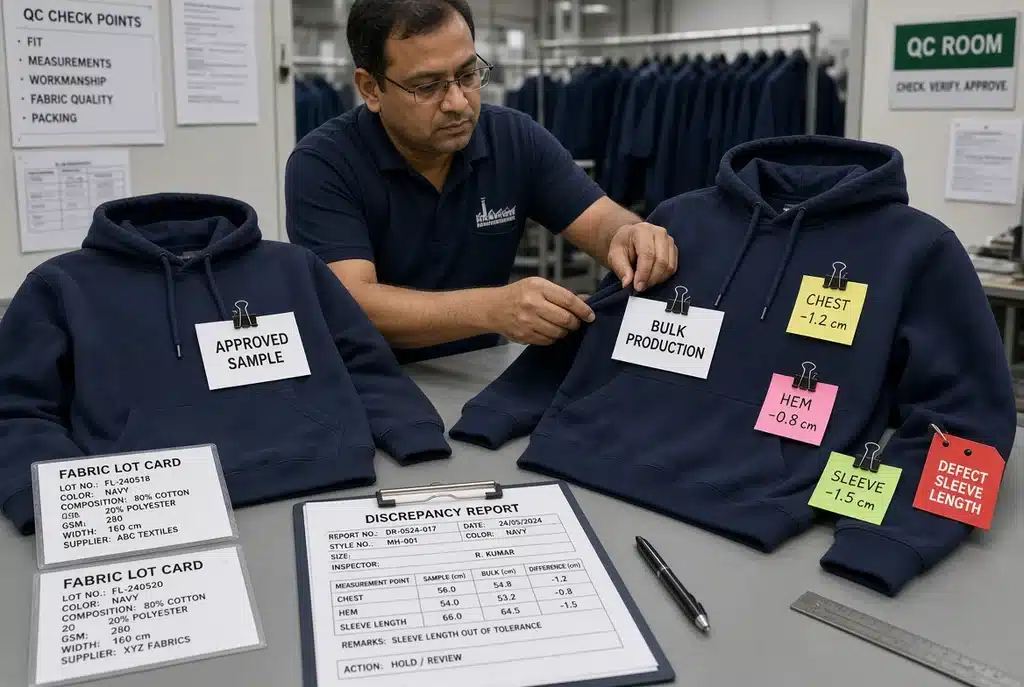
A good fit is just the beginning. When this approved sample is translated into a controlled system – a finished measurement chart, defined points of measure, a written method for measuring, tolerances, locked pattern and grade, approved fabric and finishing, and checks at first-piece, in-line and final inspection, garment fit and measurements transition from sample to bulk production. A sample is one size, one material lot and one production context of one piece. Bulk work introduces a dimension of size range, lots of fabric, operators, cutting bundles, wash/press, and multiple inspection points.
If fabric is not controlled, fit is not controlled, or finish is not controlled, then a size M hoodie can fit on the fit model properly and still cause a sleeve-length drift, body-length variation, or a change in the drape when it is created in bulk. When the sample is placed next to each piece of production garment and eye judging is done, it cannot capture every POM, size or fabric change. The approved sample will always be required. It must be located next to technical documents, the same measure and production checks that detect drift prior to order packing.
What “Fit” and “Measurements” Mean in Apparel Production
Fit describes the way the garment sits, moves, balances and looks on the intended body or fit model. Measurements are the measurements that are used in building, grading, inspecting and reproducing that fit. Ease/balance/fabric behavior or some other factor can be incorrect and the garment can fit just fine with the right number, and still be a mess. Chest width may be correct, but the shoulder may be too wide, sleeve pitches forward or hem twists after wash.
This is the starting point for apparel measurement control. Fit is what the wearer will see and feel. The language the factory uses to cut, sew and inspect that result are the measurements.
Finished Garment Measurements Versus Body Measurements
The body measurements will describe the person or fit model. Finished garment size refers to the size of the garment after it is made and to the agreed finishing point. Finished numbers include ease. They also vary according to category, fit, direction, stretch and construction.
A relaxed T-shirt requires more ease for the chest and body than a fitted dress in a stable woven. This is because the pattern length doesn’t necessarily make for an oversized hooded design when a heavier fleece is used. Tailored trousers should have a clear rise, seat, thigh and inseam, not a “waist” figure based on a size chart.
If you just send the body measurements, it is up to the factory to create ease. Typically, this guess is not the same as that of the brand’s intended silhouette. For the base size, provide finished garment POM, then grade from.
Points of Measure and Measurement Method
Points of measure for clothing are locations and methods such as chest width, body length from HPS or CB, sleeve length from shoulder or CB, shoulder width, across back, rise, inseam, waistband, hem opening, etc., which are important for the style.
The method has to be written, not assumed:
- With a flat and relaxed shape, or on a form.
- Edge-to-edge or seam-to-seam
- At what point on the body (HPS, CB neck, underarm, crotch intersection)
- Steam, press or garment dye before or after washing
- Stretch Fabrics: measured under a stated tension (or relaxed)
If one team has started from the HPS and the other team has started at the side neck, the two teams can measure the same T-shirt body length and get a difference of 1-1.5 cm.
Fit Intent, Ease, and Silhouette
There are a number of helpful words to use in a design meeting: slim; regular; relaxed; oversized; cropped; tailored; and dropped-shoulder. They don’t represent production standards. Fit intent must include measurements, a reference sample, a fit-model review, and visual balance notes: shoulder pitch, sleeve hang, side seams, collar stand, waist position, and hem level.
If the armhole depth and sleeve cap are set in like one of the sleeves in a set-in sleeve, a dropped-shoulder hoodie can still look bad if it doesn’t fit against the chest width. If the shoulder slope and hem curve change in bulk, a cropped tee can be just as long as body length.
How Fit Is Approved During Sample Development
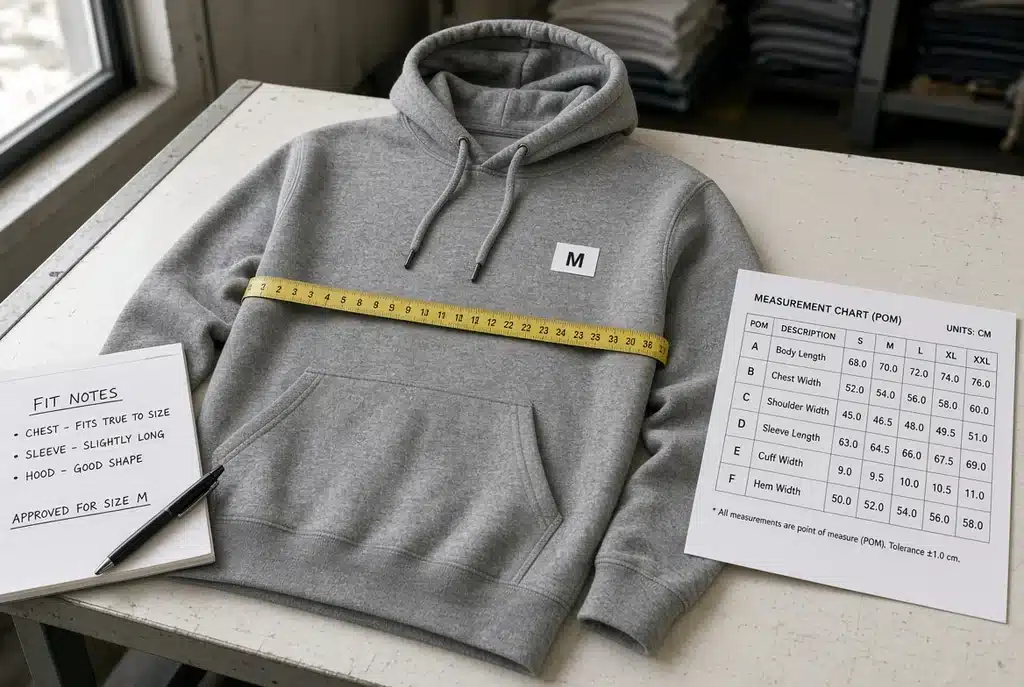
Fit approval is done in stages. The first sample is a preliminary test to see if the idea can be constructed. Post processing samples are tested for wear, balance and production materials. For every comment, the commenter must indicate what changed, which POM moved, and pattern, construction, material, or bulk risk.
Prototype and First Fit Sample
Basic silhouette and construction of prototype: positioning of seams, position of pockets, shape of hood/collar, ability to sew the pattern as it is drawn. The first fit sample will check proportions, ease, balance and wearability in the agreed model or form.
Separate styling from technical correction. There is no factory setting for “Make it slightly larger. Make it a pOm change: +1.5 cm Chest, CB body length, CB sleeve length. When the request is visual – “the shoulder looks heavy” add the following points: shoulder width, armhole depth, sleeve cap height.
Fit Comments and Pattern Corrections
A usable fit comment is used to indicate the point, the outcome obtained, the desired change, what was observed on the body, priority, and approval.
Examples that remain specific:
- Body +2.0 cm, sleeve length (CB) unchanged
- Less shoulder width -1.0cm and chest ease
- Raise front rise +1.0 cm; keep hem width and inseam the same.
- Neck opening (close) -1.0 cm (rib height not changed)
Changing one point without naming the other points is the way a T-shirt adds length to its body and the sleeve becomes short, or how the trousers add rise and the crotch curve is unchanged and the seat wrinkles.
Pre-Production Sample and Final Fit Reference
The pre-production sample must be with the end product or the accepted equivalent fabric, trims, decoration, wash and construction. The sample is expected to be the reference bulk.
Drape, stretch, shrinkage and finished measurements may vary from approved to changed material. Even with the same pattern, a midweight French terry hoodie will not perform the same in a heavier brushed fleece. When the fabric, wash or embroidery changes since the last approved fit, this is not a fit paper change, but a new fit review.
Convert the Approved Fit Into a Technical Production Standard
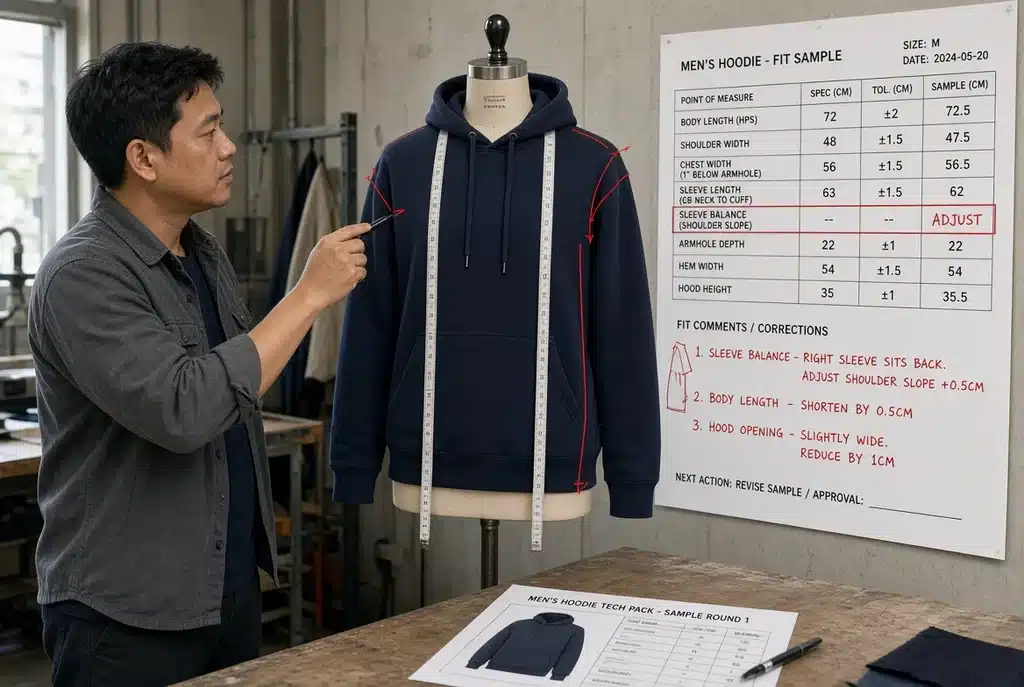
Consistency in the production of clothing sample to bulk fit relies on a fit record that is created at the end of the fitting rather than relying on memory of the last fitting. Lock the documents the cutting room and QC team will use once sample approved.
Final Measurement Chart and Tolerances
For each point on the chart the following information should be included: POM name, base size, size range, finished measurements, units, measurement method, and garment measurement tolerance.
Tolerance does not apply to each and every garment. It will depend on the type of material, fabric, POM, construction, and need of the customer. A wider window might be permitted on a jersey T-shirt chest, compared to a cutaway woven waistband. Window size for a washed article of clothing may be different than that of an unwashed article. A decorative pocket width is typically not required at high-risk points like rise, inseam, or the chest on a fitted style, neck opening, and is generally more tightly controlled than the other areas.
Write the tolerance next to the method. In order to have a chest tolerance of +/- 1.0cm, you need to measure from both inspectors at that same point.If one inspector is measuring 2.5cm under the armhole whilst the other is measuring at the underarm seam, then a +/- 1.0cm tolerance is meaningless.
Pattern, Grading, and Size-Set Control
The approved base pattern is within the size range. Apparel Grading/Size consistency involves maintaining silhouette and proportion, rather than adding the same amount at any point.
Fitted dress with even growth at bust, waist and hip may suppress the waist and cause the look to be boxy at the bottom and top of the range. The dropped shoulder relationship of an oversized T-shirt can be lost when the grade is the same as that of a regular T-shirt. Prior to cutting bulk, children have a size-set review of high-risk styles and very wide adult ranges are required.
Lock pattern version, seam allowance, grainline, notches and grade rules. Do not send an older marker that is on a local drive, the same file the sample was made from.
Material and Finishing Reference
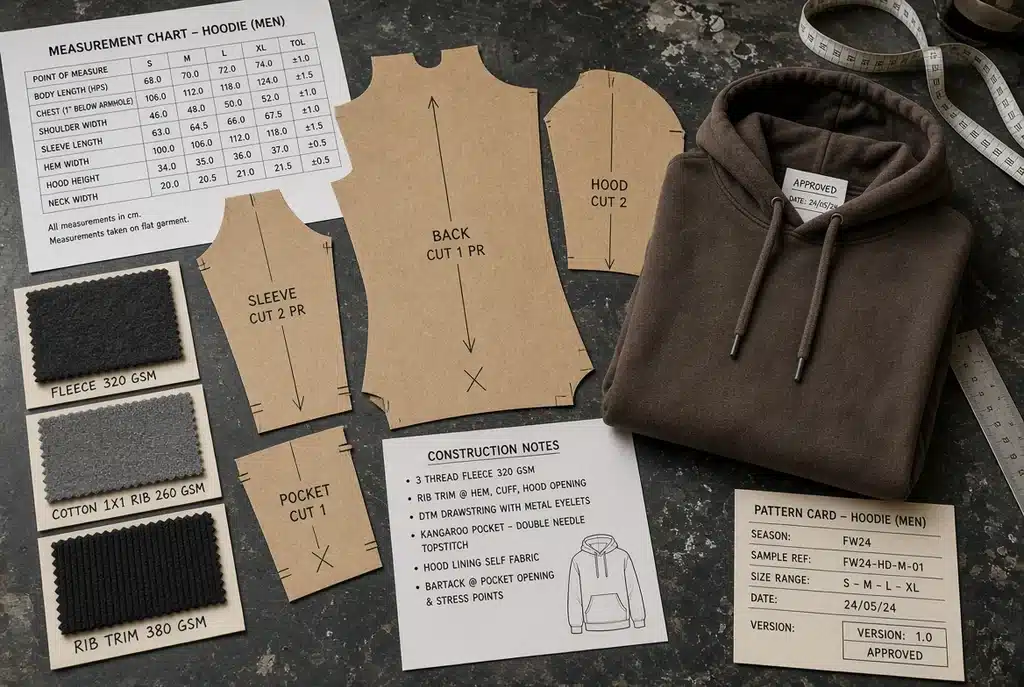
Write down: composition, GSM, width, stretch and recovery, shrink, colour or shade standard, finish, wash recipe, and press method. This is the reference of a measurement chart. The same pattern on a different cloth = different clothes.
Indicate if the measurements are before wash, after wash and dry, after steam, or after garment dye. Sample and bulk must be compared when both are at the same stage.
Construction and Sewing Reference
Finished measurements and balance are moved and affected by seam allowance, stitch type, SPI, topstitching, rib height and recovery, extension of elastic, lining, interfacing, closures, and reinforcement. Even a 1cm variation in the side-seam allowance at a single station can cause a variation in the width of the chest larger than the tolerance. A close-stitch hem will attract the opening. Record construction that will impact fit, not just a flat sketch.
How Fabric and Finishing Change Bulk Fit
When finishing and/or material induce dimensional change, a correct pattern still creates a different fit. One of the main reasons why garment fit from sample to bulk production does not work even after a clean fitting is because of this.
Fabric Weight, Stretch, and Recovery
Change ease, silhouette, ease of neckline, sleeve hang, ease of length, and handfeel are affected by GSM, thickness, stretch, and recovery, as well as drape.
A heavier fleece will make a hoodie look shorter and stiffer the same size as another with a lighter fleece. A low-recovery neck rib can spread out after wearing and cause the sample neck to appear correct while bulk appears loose. If the brand desires the same worn ease as a stable cotton jersey, they may need to adjust the finished ease of the jersey for the jersey to be cut from the Stretch jersey material.
DO NOT approve ‘similar’ fabric without samples. Compare weight, stretch percentage, recovery and width to the approved weight.
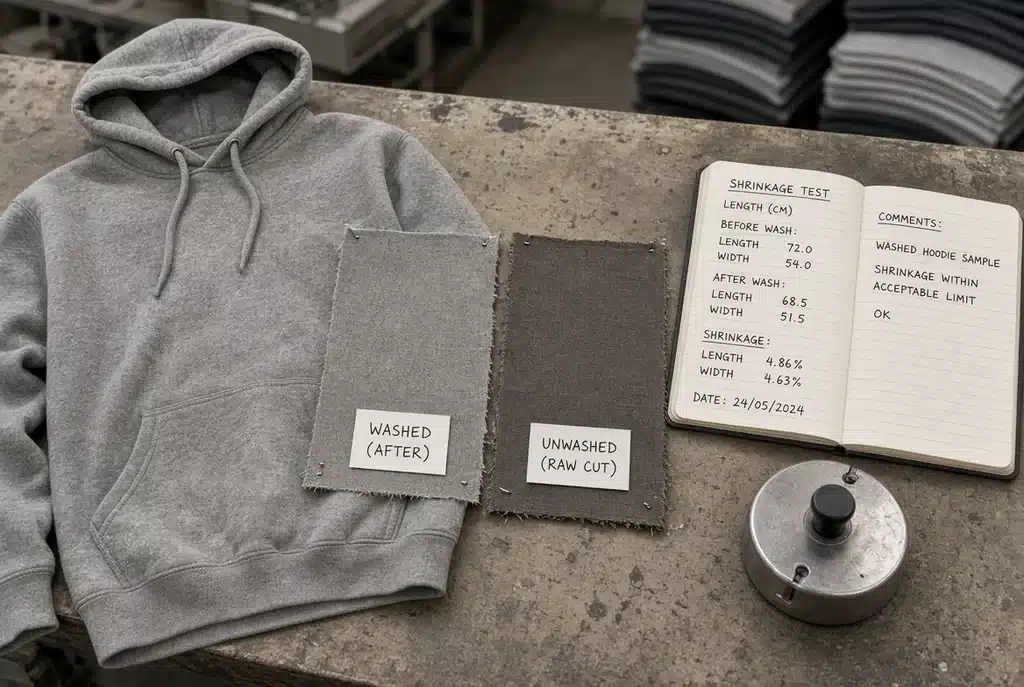
Shrinkage and Dimensional Stability
The length, width, twist and shape are changed by washing, drying, steaming, pressing and dyeing of garments. A washed streetwear tee may fall within pre-wash lengths but not meet the post-wash length requirements. Even if the cut parts were on measurement a pair of trousers can twist after finishing.
Identify the inspection stage. Bulk must be measured in the same way as the approved sample if the sample was measured after wash and tumble dry. Making a comparison between a pressed pre-wash first piece and a packed post-wash carton is not a valid comparison.
Lot, Shade, and Material Substitution Risks
The same mill code does not necessarily guarantee that the width, finish, shrinkage and/or elongation of a new fabric lot will be comparable. Shade bands may necessitate the changes of markers. “Close GSM” substitutions can alter cutting efficiency and garment drape.
Need written permission for substitutes. If the difference may impact fit, run a measurement or fit review on the new lot prior to releasing the full cut.
How Garment Fit and Measurements Are Controlled During Bulk Production
Documentation is only effective if the floor uses it! The sequence for controlling garment fit in production is to check pattern/marker, approve first, monitor high risk POMs in-line and approve finished garments after process agreed.
Pattern and Marker Verification Before Cutting
Follow approved pattern, grade, seam allowance, grainline, notches and marker. Examine relaxation time of knits and stretch direction, nap or brush direction, shade grouping and cut-part numbering as needed.
Twist is seen as an off-grain cut on a T-shirt side panel. When shades are mixed within a single garment, it appears as a visual defect, as described by customers on the “fit looks off” level, regardless of the tape measure.
First-Piece and Line-Start Measurement Checks
Check one finished piece against approved standard before the line is set to full volume. Review critical POMs, construction, balance and fabric performance at scheduled time.
If the first hoodie sleeve is 1.5cm in length and the shoulder is forward, STOP and correct pattern, sewing or pressing. When 400 pieces turns out to be a cost problem and not a QC surprise, that’s when you should know that you’ve got one of these.
In-Line Measurement Monitoring
In-line checks detect measurement drift, operator variation, seam movement and pressing change, still on the line. Note that the focus will be on high risk POMs and not all points measured at the same frequency.
Typical drift points:
- T-shirt body length and chest after hem and neck setting
- Attach sleeves to the hoodie with rib and hoodie body length.
- Trousers rise, waistband and inseam after finishing.
- The dress is lined up and/or the zipper is set in the side-seam shape.
Write the answer and correction down. One off is not the same as a bundle continuing on its way.
Final Measurement and Fit Verification
Final inspection for relevant measurements completed – appearance, symmetry, labels, decoration and packing. Does not substitute first-piece or in-line control. It is the last confirmation of completed stock.
Take a planned sample of the packed goods under the same condition as the approved sample. Inspect washed if bulk is washed. Inspect if bulk is only steamed.

Why Sample Fit and Bulk Fit Can Differ
If there’s a discrepancy between sample and bulk, determine what has happened. A majority of gaps are caused by material, pattern version, measurement stage, process variance or late design additions.
The Bulk Fabric Is Not the Approved Fabric
GSM, stretch, width, finish, shrinkage and/or handfeel variations affect both tape measure and worn appearance. If you order a hoodie again with a similar fleece, sleeve balance could be lost due to the heavier weight and less drapey of the new hoodie.
Test the fabric to determine its identity when receiving goods in the shop. Hold substitutions in writing. Re-measure/re-fit if material difference causes the garment to move.
Pattern or Grading Version Changed
If patterns are not up-to-date, if they are not graduated or have the wrong seam allowances, or if a pattern is not submitted to cutting with revision control, the wrong garment will be produced at scale. If an older grade rule is used, a dress may lose the waist shape between sizes in the size set.
Utilize one controlled production file, version numbers and dated approvals. If a pattern correction was approved since the previous sample, then the bulk file must include that correction.
Garments Were Measured at Different Stages
Different numbers for pre-wash, post wash, pressed, relaxed and packed clothing. A washed chino may fall outside the approved finished inseam, and may be the same size as the pre-wash inseam. When comparing two products, teams then argue about the factory capability.
Write the measurement condition on the chart and on the inspection form. Use for sample and bulk.
Cutting, Sewing, or Finishing Introduced Variation
Any of the following produces a movement of measurements: Off grain cutting, mixed bundles, seam-allowance drift, uneven tension, aggressive pressing, stretching on the machine and operator variation. There are checks in place to detect this class of errors (1st piece), before the line is too late (in-line).
Brand Changes Were Added After Fit Approval
Labels, embroidery, patches, late washing or last minute processing methods may alter the look, feel or a nearby measurement. Embroidering a tight front can be created by using heavy chest embroidery. A new wash will reduce the length of a previously approved unwashed tee.
Apply fit-relevant branding and finishing to the end sample, if possible, when the calendar calls for it. If they are in after approval, consider them a controlled change.
How to Maintain Fit Across Sizes and Repeat Orders
Fit control is not finished at the time of the first order. Repeat production does not occur if the brand reshoots a “same style” without locking fabric, pattern version and the last approved reference.
Size-Range and Grading Review
Look over the base size, grade rules, size set and high-risk POMs that cover the range. The customer’s comments on early orders can be recorded as an adjustment, such as more ease in XL, a shorter rise in the smallest size, etc., which will then be approved and recorded before the next cut.
Avoid changing one size on the line and not changing the grade rule. The following order will reconstruct the old problem.
Repeat-Order Material and Pattern Records
Add composition, GSM, width, finish, color, shrinkage, pattern version, grading, construction, and approved sample reference. If the mill, finish or pattern version has changed, “same style number” is not sufficient.
Even if the marker appears the same, a second order T-shirt can have some body length variation.
Compare Repeat Production Against the Previous Approved Order
Make comparisons of measurements, fabric lots (lots), shade, handfeel, workmanship, decoration, returns, etc., against the most recent order received, rather than the original sample from year one. Monitor consistent variations and response to variations. Memory is NOT a QC System.

Garment Fit and Measurement Control Checklist
Employ this as an example model of control. Customize it according to the apparel type, fabric, risk of fit, size range or buyer preferences. It’s not a complete tolerance list.
| Control area | What to verify | Evidence or action |
| Sample identity | Style, size, color, version, date | Record the approved reference and keep it available on the line |
| POM chart | Points, units, method, tolerances | Measure sample and bulk with the same method and stage |
| Fit intent | Silhouette, ease, balance, wearability | Approve on the agreed fit model or form |
| Pattern | Version, seam allowance, grainline, notches | Lock the production pattern before marker making |
| Grading | Size range, grade rules, high-risk POMs | Review a size set on fitted or wide-range styles |
| Fabric | Composition, GSM, width, stretch, recovery | Approve material; control substitutions in writing |
| Finishing | Wash, press, dye, shrinkage | Measure at the same production stage as the sample |
| First piece | Construction and key measurements | Correct before full-volume sewing |
| In-line checks | Measurement drift and process variation | Record recurring misses and fix the process |
| Final inspection | Measurements, symmetry, appearance | Verify finished garments after the agreed process |
| Repeat orders | Material, pattern, sample, deviations | Compare against the latest approved record |
A washed streetwear program should be more robust by itself than an unwashed basic tee. A personalized trouser program must be focused on the increase and inseam as compared to a boxy jersey brief.

Summary Guidance – Turn the Approved Fit Into a Repeatable System
Once the factory can replicate it, Fit leaves the sample room. This requires an approved sample, a POM chart, specified tolerances, a locked pattern/grade, a material and finishing reference, first-piece approval, in-line monitoring and final inspection at the same point as applied to the sample.
Even if a garment looks similar on the hanger, it will not pass if there are discrepancies between the sizes, balance, fabric or finishing. Secure sample and Production records. Explain what each of the points is measuring. Keep an eye on high risk POMs during the line’s operation. If you are approved to make a change, note it down before the next order uses it.