
A fit sample vs pre-production sample comparison comes down to two different questions. A fit sample asks whether the garment sits, measures, balances, and moves correctly on the intended body or fit form. A pre-production sample, often shortened to PP sample, asks whether this is the version bulk production should reproduce, including confirmed fabric, trims, construction, decoration, and finishing.
Some projects combine the stages, or run them more than once, when the garment is simple, the cloth is already locked, or the buyer wants another round. The purposes should still stay separate. A sample that looks right on a model does not automatically approve bulk, especially if it was sewn in substitute cloth or shipped without final branding.
Fit Sample: Primarily for Shape, Measurements, and Wearability
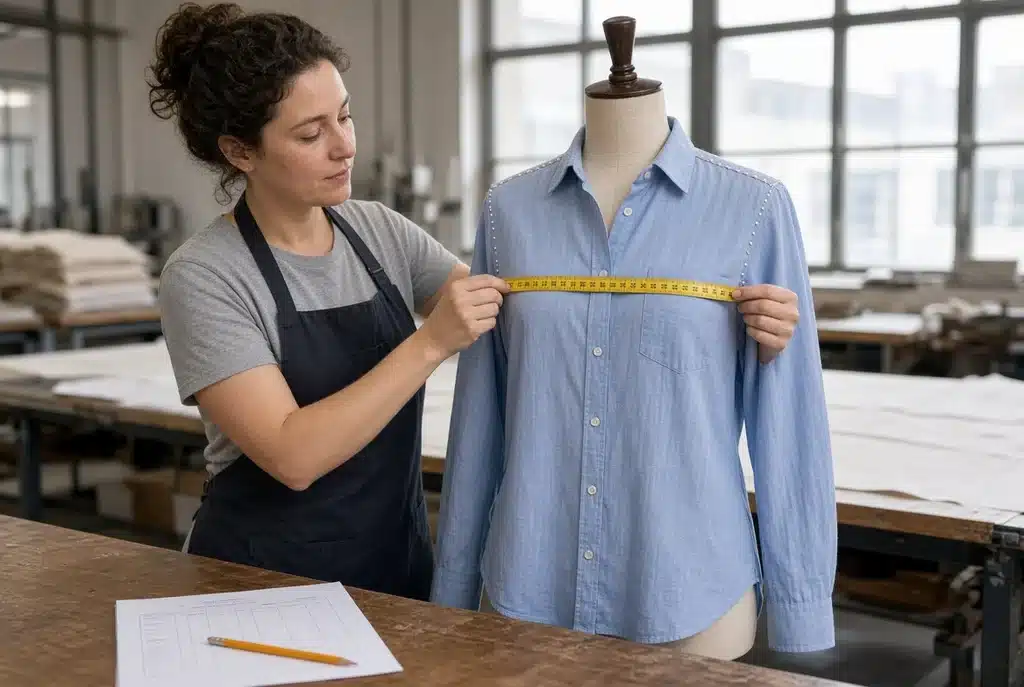
A fit sample is the garment used to judge how the pattern relates to a body. The reviewer is looking at balance, ease, proportion, and movement, not at whether every production detail is already final. In a shirt, that might mean whether the shoulder sits on the shoulder point. In trousers, it might mean whether the rise and thigh ease work when the wearer sits. In a kids’ tee, it might mean whether the neck opening clears the head without gaping once it is on.
The sample is usually made in a base size, on the block the brand intends to grade from. It can be tried on a fit model, a dress form built to the brand’s body spec, or both. What matters is that the review method is recorded. A comment taken on a form with no bust shaping will not transfer cleanly to a fitted dress.
What to check on a fit sample
Work through the points that actually change the pattern, and match the list to the garment.
On a woven shirt, check shoulder balance, chest ease, armhole depth, sleeve length, collar stand, and whether the hem is level when the arms hang. On a jacket, add movement: can the arm reach forward without the back climbing, and does the lining or interlining steal ease that the shell measurement hid? On trousers, check rise, hip, thigh, knee, and how the waistband sits after the wearer sits and stands. On a dress, look at bust shaping, waist position, and whether the skirt hangs without pulling at a dart or seam. On activewear, check recovery and compression where the brand promised them, not only the flat measurement. A legging can measure correctly on the table and still feel wrong once the knit opens at the knee.
Ease and movement belong in the same pass. A polo can meet the chest spec and still bind across the back when the arms lift. A hoodie can look relaxed on a form and ride up once the wearer bends, if the body length was set without the rib and pocket weight.
How fit comments become pattern changes
A useful fit note names the location, the direction, and the amount. “Reduce front shoulder width by 1 cm and keep the back shoulder as cut” can go to a pattern maker. “The fit feels wrong” cannot. The same rule applies to neckline depth, sleeve cap ease, hem balance, rise, and pocket position.
Tie each comment to the sample version and the size that was reviewed. If the brand wants a closer neck on a T-shirt, say whether that change is for the crew only or for the whole neck family. If a dress needs more room through the hip, say whether the extra comes from the side seam, the dart, or a grade rule. Vague notes get interpreted twice: once in the sample room, and again when someone later argues about what was approved.
What a fit sample may not confirm
A fit sample often uses an interim or substitute fabric so the pattern can be tested before bulk cloth arrives. That is a normal development choice. It also means the sample may not confirm final hand feel, final color, full branding, production decoration, washing, packaging, or every size in the range.
Do not treat that sample as a complete production approval. A T-shirt that fits in a stock jersey has not approved the heavier bulk jersey, the plastisol print, or the neck label. A jacket that balances in an unlined shell has not approved the lining, the zipper, or the wash.
Pre-Production Sample: Primarily for the Bulk Manufacturing Standard
A pre-production sample is the version prepared to stand for the approved garment before bulk cutting, or at the point the order is considered ready to cut. It should reflect the product decisions that define the order: fabric, color, trims, labels, decoration, construction, washing, finishing, and the measurements those choices produce. Buyers use different forms and different names. Some call it a PP sample, some a pre-production approval sample, some a gold seal. The name matters less than the status written on it.
Identify the sample by version, size, color, and material status. “PP, size M, navy, bulk fleece lot approved, rib still substitute” is a usable record. “Final sample” is not, if nobody can say final against what.
What a PP sample should represent
Where the order depends on it, the PP sample should carry the confirmed production inputs. That includes the bulk or confirmed fabric, not a stand-in kept only because it was already on the shelf. It includes the color the brand accepted, the rib, zipper, buttons, or drawcord specified for the style, and the labels and decoration planned for that colorway. Construction should follow the seam type, stitch density, and assembly order intended for the line. If the garment is washed, bonded, or lined, those steps should already have been done on this sample, or the record should say they have not.
A hoodie PP in the correct fleece, with the approved rib, chest print, neck label, and wash, can act as the production reference for that style and color. The same hoodie in a development fleece, with a paper printout pinned to the chest, cannot.
What to approve on a PP sample
Review the sample against the decisions that will be hard to change once the marker is cut. Teams do not all use the same form. The useful checks are usually these:
- Fit and measurements against the agreed spec, including any fit changes already accepted.
- Fabric and hand feel against the approved swatch or bulk lot.
- Color and shade, including rib, tape, and thread where they are meant to match.
- Construction and workmanship: seams, stitches, bartacks, pocket bags, lining attachment.
- Print, embroidery, or patch, checked for placement, scale, edge, and hand.
- Labels and trims, including care content and position.
- Wash and finishing, if the bulk garment will be washed, brushed, or pressed.
- Packing or presentation details, when the sample is also standing in for how the unit will be folded or tagged.
Approve what you can see and measure. Write a hold on anything still open. A clean sew on the shell does not approve an embroidery file that has not been stitched yet.
What a PP sample may not prove
A PP sample sets a production reference. It does not remove incoming fabric inspection, in-line checks, measurement verification, or final inspection. One approved unit, in one size and one color, cannot prove that every bulk piece will match. Shade can shift between dye lots. A print can drift after a screen is remade. A size grade can open a problem the base size never showed.
Treat the PP sample as the standard the line should follow, then check the line against it. Do not treat it as a promise that every carton will be identical.

Fit Sample vs Pre-Production Sample: Key Differences at a Glance
The difference between a fit and pre-production sample is the decision each one is allowed to make. A fit review changes the pattern. A pre-production sample approval accepts, or holds, the version bulk should follow. Sampling stages still vary with garment complexity, buyer rules, materials, and how much risk the style carries. The table below is a working distinction, not a required sequence.
| Review point | Fit sample | Pre-production sample |
| Main question | Does the garment fit and move correctly? | Is this the version bulk production should reproduce? |
| Main focus | Shape, balance, measurements, ease, movement | Materials, construction, decoration, finishing, and production readiness |
| Typical material status | May use an interim or substitute material | Should use final or confirmed production materials where applicable |
| Main decision | Pattern and fit adjustment | Approval or hold before bulk |
| Main limitation | Does not automatically approve bulk | Does not remove the need for bulk inspection |
Read the row for material status with the actual sample in hand. If the PP sample is still in substitute cloth, it is not yet doing the job the right-hand column describes. If the fit sample happens to be in bulk fabric, the fit comments are stronger, but the sample still has not approved labels, decoration, or wash unless those were reviewed and written down.
Why the same garment can require both
Fit can be right while the production version is still open. A hoodie may balance in a development fleece and still need a PP sample in the final fleece, with the approved rib, print, labels, and wash. The heavier fleece can shorten the body, change the hood drape, and make the pocket sit lower. Those are fit issues created by a material change, and they belong in a later review, not in an assumption that the first fitting still holds.
The reverse is also common. A polo can be fully trimmed, correctly colored, and still have a collar that stands away from the neck. Final materials do not repair a block problem. That is why garment sample approval stages should name what was accepted, instead of using one “approved” stamp for every question.
How Fabric and Construction Affect the Comparison
Material changes can empty a fit approval. Stretch, weight, drape, recovery, shrinkage, surface finish, lining, and trims all change how a garment sits. A comment taken on one cloth should say which cloth it was taken on.
Substitute fabric risks during fit review
A substitute fabric is useful when bulk cloth is late and the pattern still needs a first read. It is a poor stand-in if nobody records the gap. A lighter jersey can make a T-shirt look longer and cleaner than the 220 GSM bulk cloth will. A woven with less stretch can make trousers feel tight through the thigh even when the flat spec matches. A substitute fleece can hide the warmth, the opacity, and the way the real cloth collapses at the hem.
Write the limitation on the fit record: fabric used, what it does not represent, and which points must be rechecked when the final material arrives. Reassess length, ease, and movement on that later cloth. Do not carry the old “fit approved” line forward without looking.
Construction and decoration can affect final fit
What gets added after the first fitting can move the garment. A lining reduces ease. A fusible can stiffen a shirt collar and also pull the front. Heavy embroidery on a lightweight jersey can pucker the chest and shorten the body. A patch on a kids’ sweatshirt can do the same at a smaller scale. A metal zipper can pull a jacket front off balance. A garment wash can shrink length and open the hand feel after the fit was signed on an unwashed sample.
Check those additions on a sample that actually has them. Embroidery pulling a tee, a lining stealing ease in a dress, or a heavy zipper changing a jacket front are production-fit issues. They will not show on a plain shell.
What Happens When Fit and PP Approval Are Confused
Most bulk arguments in this area start from one sample being asked to answer both questions. The garment was attractive, the email said approved, and the factory cut. The missing line was what, exactly, had been approved.
Approving bulk from a fit sample
A fit sample can leave fabric, trims, decoration, wash, and construction method unconfirmed. If that sample is used as the bulk standard, the line has no agreed reference for those points. The factory may sew the correct shape in a cloth the brand has not accepted, place a print from an unapproved file, or wash a lot that was never seen at sample stage. The fit can still be right. The product the brand meant to sell may not be.
Hold bulk until the open items are either approved on a later sample or written as accepted deviations. “Proceed on fit, fabric to follow” is only safe if both sides know that fabric approval is still outstanding and that cutting waits for it.
Using a PP sample to hide unresolved fit problems
Final cloth, a sharp print, and a correct label can make a weak block look finished. They do not fix it. If the shoulder is wide, the rise is short, or the sleeve binds, a production-ready appearance is not a substitute for a fit review. Approving that sample for bulk locks the problem into the size run.
Separate the decisions. The PP sample can be accepted for materials and decoration while fit stays on hold, or the reverse. Mixing the two into one yes is how a bad measurement becomes a carton problem.
Approving by photograph rather than physical comparison
Photos help a remote team see color, placement, and obvious construction. They hide the rest. A picture will not show chest ease, hand feel, stretch at the knee, inside seam finish, a shade shift under workshop light, or a wash that has flattened the fabric. Fit approval and pre-production sample approval both need the garment in hand when the decision is about how it measures, how it moves, or how it should be reproduced.
If a photo review is all that time allows, limit what it approves. Placement of a chest print can sometimes be judged from a clear, scaled photo. Shoulder balance and thigh ease cannot.
How to Document Fit and PP Approval Separately
Clear records stop the later argument about what was accepted. Keep the fit file and the PP file separate, even if they live in the same folder. Each one should name the sample version, the date, the size, and the person who signed.
Fit approval record
Record the sample version, the size, and whether the review was on a fit model, a form, or both. Attach the measurements taken, not only the spec. List the fit comments that became pattern changes, and list anything left open: substitute fabric, missing wash, unchecked sizes. A one-line “fit OK” with no version number is how the wrong sample gets cut from later.
PP approval record
Record the sample version, fabric and trim status, color, decoration, construction, finishing, and measurements. Note approved deviations, such as a rib that is one shade off but accepted for this colorway only. State the bulk scope: which styles, colors, and sizes this sample covers. A navy PP does not approve the grey colorway. A size M does not, by itself, approve the grade.
State what remains open
A sample can be approved for one purpose and still open for another. Fit may be signed while final embroidery or bulk fabric is pending. Fabric and labels may be signed while a sleeve-length change is still in the pattern. Write that split in the approval note. The next person who reads the file, including the cutting room, should be able to see what is cleared and what is not.
Frequently Asked Questions
What is the main difference between a fit sample and a PP sample?
A fit sample is used to judge shape, measurements, ease, and movement, and to decide pattern changes. A PP sample is the pre-production reference for the version bulk should follow, including the materials, construction, decoration, and finishing that define the order. They answer different questions, even when one physical garment is asked to do both jobs.
Can a fit sample be used for bulk approval?
Not by itself. Fit approval says the pattern can proceed on the points reviewed. It does not approve unconfirmed fabric, trims, decoration, wash, or production method. Bulk should follow a sample whose production-defining details have been accepted, or a written deviation list that says what is still allowed to change.
Should a PP sample use the final fabric?
It should use the final or confirmed production fabric where that fabric defines the order. If bulk cloth is not available, the sample can still be reviewed, but the record should say the fabric is substitute and which points must be rechecked. Hand feel, shrinkage, drape, and fit on the real cloth are the usual ones.
Which sample should be checked for measurements?
Both, for different reasons. Measure the fit sample to decide pattern changes. Measure the PP sample to confirm the production reference still meets the spec after final materials, decoration, and finishing. One set of numbers does not replace the other if the cloth or the construction changed between them.
Do all clothing brands need both a fit sample and a PP sample?
No. A simple reorder in an unchanged fabric may not need a new fit round. A first style in a new block, a new fabric, or a decorated garment often needs both, or a repeated review when the material changes. The stage count depends on fit sensitivity, materials, decoration, size range, and what the buyer requires. There is no single sequence that fits every garment.
What should be documented after each approval?
After a fit review, record version, size, review method, measurements, pattern changes, and open issues. After a PP review, record version, fabric and trim status, color, decoration, construction, finishing, measurements, accepted deviations, and which bulk styles the sample covers. State what is still open so a later approval is not read as a blanket yes.