
DTF vs DTG is a garment decision, not a printer contest. Direct-to-garment printing lays digital artwork onto a suitable garment surface. Direct-to-film printing builds the image on transfer film first, then applies that film to the garment. DTG may fit selected garments where a brand wants direct digital printing, detailed artwork, or a more integrated surface. DTF may fit brands evaluating a digital transfer for selected fabrics, garment colors, detailed graphics, or mixed small-run production.
The useful choice depends on the garment in front of you. Fabric, color, surface texture, stretch, artwork, hand feel, order size, and the sample itself decide which method belongs on that style. A process that looks right on a smooth cotton tee can fail on fleece, polyester, or a dark colorway. Start with the garment, then test the print.
How DTF and DTG Work Differently
Both methods print digital artwork. They do not meet the garment in the same way, and that difference shows up in feel, coverage, and what you check before approving a style.
DTG prints directly onto the garment
Direct-to-garment printing applies the artwork to the garment surface. Fiber, knit or weave, fabric color, and any pretreatment sit between the file and the finished print. A smooth cotton jersey may take ink differently from a brushed fleece or a finished blend. Dark garments often need a white support layer, and that extra coverage can change both color and hand. A clean result on a light shirt does not prove the same file on black or navy.
DTF transfers artwork from film
Direct-to-film printing produces the image on a film, then applies a transfer layer to the garment. What the customer feels is the transferred design: its thickness, edge, flexibility, and how well it stays bonded when the garment moves. A transfer can help when the same graphic must be evaluated across more than one fabric or color. It is not an automatic fix. A film that bonds on a smooth tee may lift at a seam, a pocket edge, or a looped fleece.
Why the workflow matters to the buyer
DTG needs a surface that can take direct digital printing. If the garment is too textured, too slick, or the wrong fiber for the process being offered, the print may look uneven before durability is discussed. DTF introduces a transfer layer, so hand feel, edge, and peel risk belong in that review. The two processes can look similar in a photo and feel different in the hand. Neither file nor printer name replaces a physical sample.
Fabric Compatibility Should Come Before Artwork Preference
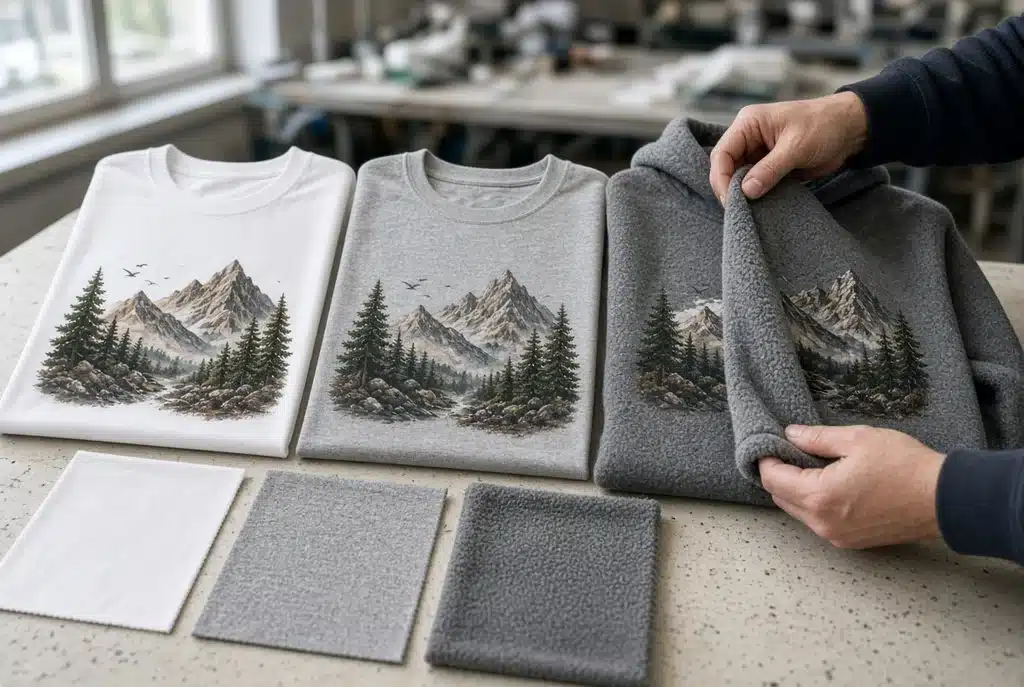
The same artwork can need a different process once the fabric changes. Cotton jersey, polyester, a cotton blend, and a textured fleece do not present the same surface to ink or to a transfer. For clothing brands, DTF vs DTG for different fabrics is the first filter.
Cotton and cotton-rich garments
Cotton and cotton-rich shirts are often the first garments brands send for DTG evaluation. A light color can show detail without a heavy white support, but smoothness, absorbency, garment color, and pretreatment still change the result. DTF may also be evaluated on cotton when the brand accepts the transfer surface and adhesion holds on that tee. DTG or DTF for cotton shirts should be settled by handling both samples, not by a general rule about cotton.
Polyester, blends, and performance fabrics
Synthetic and blended garments bring different risks: adhesion, dye migration, stretch, and surface slickness. Color from the garment can move into a print. A stretch panel can stress a transfer at the edge. A water-repellent finish can resist both direct ink and a film. DTF printing for polyester garments is worth testing, but it does not automatically solve polyester or performance-fabric problems. Check the actual garment, in the actual color.
Fleece, textured, and heavyweight garments
Fleece, brushed faces, loops, and thick fabric change contact. Direct printing can sit on the high points of a texture and miss the low points. A transfer can bridge some of that texture, then show a harder edge once the hoodie is worn. A method that suits a smooth tee needs a separate review on fleece. Print the graphic on the hoodie you intend to sell, then check the edge against the pile and whether the design cracks when the sleeve moves.
Artwork Detail, Color, and Print Coverage
Both DTF and DTG can carry digital artwork. The finished print still depends on the graphic, the garment, and the process used on that color.
Photographs, gradients, and detailed illustrations
Photo-based graphics, soft gradients, and many-color illustrations are a common reason brands look at digital printing. DTG printing for detailed artwork is often reviewed first on a suitable light garment, because fine tonal steps can be judged on the fabric itself. DTF can hold detailed art on film, then move that art onto the garment as a transfer. Prepare the file at the size you will actually print. A portrait that looks sharp on screen can lose midtones or small type once it is reduced to a left-chest or a narrow sleeve.
Small logos and fine details
Small logos fail for ordinary reasons: lettering that is too thin, gaps that close, and contrast that disappears into the fabric color. Check readability, edge sharpness, and narrow gaps at the final print size. A 12 cm chest mark and a 28 cm front print are different jobs even when they use the same file. If the logo has to stay legible after a care test and after the garment stretches, say so before sampling.
Dark garments and color coverage
Dark garments need their own test. Visibility, white support or underbase, coverage, and hand feel all change on black, navy, or a deep dye. A light-shirt sample cannot approve a dark colorway. DTF vs DTG for dark shirts often comes down to how each method builds that support. DTG may lay a white base on the garment. DTF may carry white within the transfer. Either route can add thickness. Judge color, edge flash, and whether the print still feels acceptable.
Hand Feel: Direct Print or Transfer Surface?
A brand can accept the artwork from both methods and still reject one because of how it feels. On a tee worn against the skin, hand feel is part of the product.
DTG surface feel
DTG surface feel depends on the garment, ink coverage, artwork density, garment color, and process conditions. A light print on a suitable cotton tee can sit relatively close to the fabric. A dense graphic, a dark shirt with a white base, or a large coverage area can feel more present. Soft is not a property of the method. It is a result you confirm on that print.
DTF surface feel
DTF creates a transferred layer. Assess thickness, edge feel, flexibility, gloss or sheen, and how the design moves with the garment. Some transfers feel light on a heavyweight tee. Others read as a film, especially on a thin jersey or at a large print area. Results vary by artwork, transfer construction, garment, and supplier process. The edge is often where the customer notices the method. If it catches, lifts, or shines in a way the brand does not want, that sample is not approved.
Match hand feel to the product concept
Match the feel to the product, not to a general preference for one process. A lightweight fashion tee usually needs a print that does not dominate the cloth. A heavyweight streetwear tee can carry more surface. A hoodie already has thickness, so the question is whether the print adds a hard patch on a soft pile. DTF vs DTG hand feel cannot be judged from a photo. Handle the sample and, where the placement sits against the body, wear it.
Durability, Adhesion, and Stretch
Neither method has a universal durability result. Performance depends on fabric, coverage, application, pretreatment or transfer adhesion, finishing, placement, use, and care. DTF vs DTG durability is a test on the garment you will sell, not a spec sheet claim.
Questions to ask about DTG
On a DTG sample, inspect coverage, adhesion, cracking, fading, and how the print looks after an agreed care test. Pay closer attention on dark garments, stretch areas, and high-contact placements. Ask whether bulk will match the sample’s pretreatment and coverage. Do not accept a fixed wash-cycle promise in place of a test you can see.
Questions to ask about DTF
On a DTF sample, inspect edge lifting, peeling, cracking, flexibility, and transfer adhesion. Stretch the garment the way it will be worn. Sleeve movement, pocket edges, and seams are common places where a transfer shows stress first. Ask whether bulk will use the same film, temperature, pressure, and peel step.
Test the actual garment
A sample on one fabric does not prove performance on another. Test the intended garment, color, print size, and placement before bulk production. If the graphic moves from a center chest to a sleeve, test the sleeve. The approved sample should be producible again under the same conditions.
Order Size, Design Variety, and Production Practicality
Order structure can influence which digital path is practical. It does not reduce to “DTF for small orders” or “DTG for large orders.” Quantity, design count, garment type, and how often the art will repeat sit in the same decision.
Short runs and multiple designs
Digital methods are often attractive for small runs, detailed designs, or a collection with many graphics. There is no screen to build for each color in the artwork. DTF or DTG for small orders still involves garment handling, artwork preparation, sample review, and process limits. Count designs, placements, garment colors, and whether each combination needs its own sample.
Repeat designs and scale
Repeat artwork on a stable program should be judged on consistency and repeatability. If the same chest graphic will return on the same cotton tee, ask whether the method can match color, feel, and adhesion on later lots. If the art changes every drop, flexibility may matter more than a long repeat setup. A light cotton tee and a dark fleece will not share a single cost curve.
Mixed garment programs
A brand may use different methods for different garments in the same collection. A smooth cotton tee, a synthetic activewear piece, and a fleece hoodie may not share one ideal process. Forcing one method across the line because it won on the hero tee is a common way to weaken the rest of the range.
Order size, fabric, artwork, garment color, and repeatability have to be read together. A production partner that reviews those factors with you can place the style in the wider set of garment printing options, including artwork, fabric compatibility, placement, durability, samples, and how the print will be applied in bulk.
Cost Factors Without Relying on a Universal Winner
Total cost follows the job, not the acronym. Artwork preparation, the transfer or direct-print process, garment handling, print size, placements, quantity, colorways, sampling, and finishing all move the number. Neither method is always cheaper.
DTF cost questions
Ask how transfer size, film use, application, garment count, placements, and artwork variety are priced. A small left-chest film and a large back film are not the same consumption. Do not assume DTF is always cheaper for small orders.
DTG cost questions
Ask how garment preparation, artwork, print area, garment color, pretreatment, quantity, and handling are priced. A dark garment that needs a white support can take more process time than a light garment with the same file.
Compare identical assumptions
Compare quotes on the same garment, fabric, color, artwork, dimensions, placement, quantity, packaging, and inspection requirements. A DTF transfer-only price is not comparable to a quote that includes the garment, pretreatment, printing, and packing. A DTG price on a white tee is not comparable to a DTF price on a black hoodie.
How to Compare DTF and DTG Samples Fairly
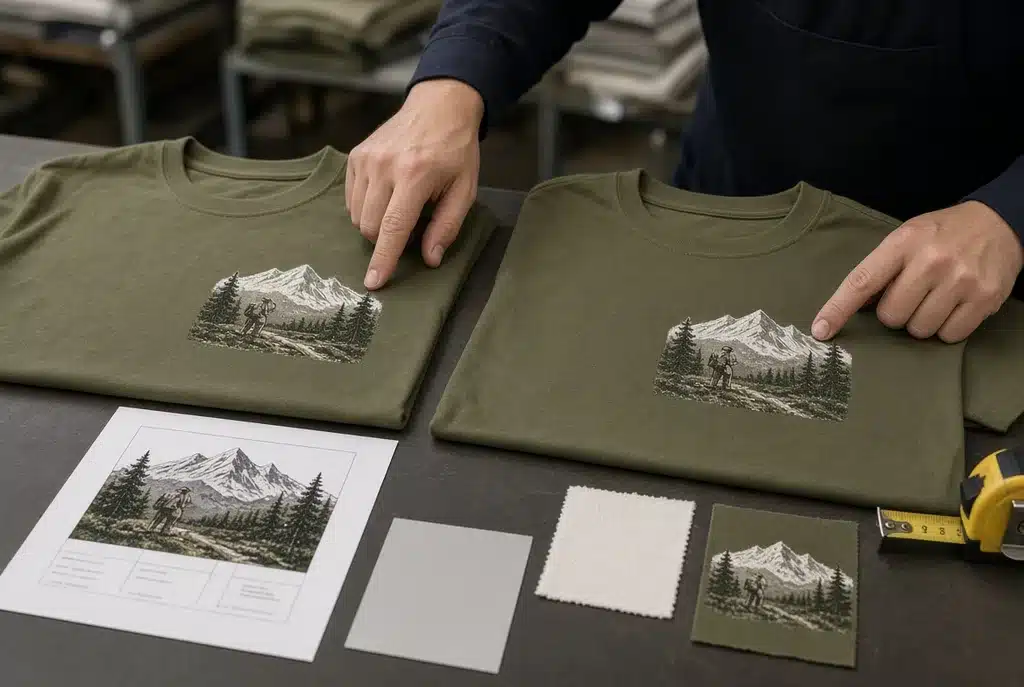
A fair comparison uses the same artwork, garment style, fabric, color, print size, placement, and intended production conditions. Changing two variables at once makes the test useless. Do not treat a single-fabric result as approval for the rest of the line.
Sampling is where the method either earns the style or gets dropped. Structured garment sample development checks design, fabric, construction, decoration, measurements, and branding before bulk production. The print test should sit inside that review.
Compare appearance
Check color, coverage, sharpness, small details, edge definition, and placement. Look across the garment colors you intend to sell, not only the easiest one. Note white edge flash, muddy midtones, and any gap that closed.
Compare physical feel
Check surface thickness, softness, flexibility, edge feel, stretch behavior, and comfort when worn. Bend the print. Stretch it in the direction the body will pull. A pass on a flat chest panel does not approve a sleeve or a curved hood edge.
Compare after suitable care testing
After an agreed care test, check cracking, peeling, fading, adhesion, and surface change. Agree the condition, garment, and placement before you treat the result as evidence. A heavyweight cotton chest print does not predict a thin polyester sleeve. Approve the sample only if appearance, feel, and the care check all meet the product. If one fails, change the method, the artwork, or the garment, then sample again.
Which Method Fits Which Garment?
Use the garment to narrow the test. These are starting points, not automatic picks.
A smooth, suitable cotton garment with detailed digital artwork is a fair DTG evaluation, especially in a light color. A garment that needs a transfer application, or a style you want to evaluate across more than one fabric, is a fair DTF evaluation. Keep both samples if the product could accept either surface.
A dark garment should be tested for coverage, color, hand feel, and process performance. Do not assume either method wins because the shirt is black. A stretch or performance garment should be judged on adhesion, flexibility, and a sample of that exact fabric. A textured fleece or heavyweight hoodie should be judged on surface contact, edge appearance, and hand feel, separate from the tee test.
A small collection with many designs should be compared on total job scope and repeatability. A long-term repeat program should be judged on whether the same method can match future garments and colorways, not only the first approved piece.
Choose the method that delivers the required artwork, feel, adhesion, durability, and repeatability on the actual garment. If the sample does not do that, the other method is the one to test next.