
A printed blank is usually the practical route when speed, lower development effort, and graphic decoration matter more than changing the garment itself. Cut-and-sew is the stronger route when fabric, fit, proportions, construction, labels, or packaging are what the customer is actually buying. Comparing cut-and-sew T-shirts vs printed blanks is a product decision, not a quality ranking. Neither route is better for every brand.
The split is simple. Printed blanks start with a finished T-shirt. Cut-and-sew starts with fabric, a pattern, and construction choices. A logo on a stock tee does not rewrite that tee’s neckline, GSM, sleeve shape, or body length. Building from fabric is not automatically the more profitable path either. It adds development work that only makes sense when the garment itself carries the product.
What Is the Difference Between Cut-and-Sew and Printed Blanks?
One route decorates a garment that already exists. The other builds the garment, then decorates it. That difference decides what you can change later, and what you are stuck with once the order is placed.
How Printed Blank T-Shirts Work
Printed blank T-shirts follow a short sequence. You choose an existing blank, confirm that the colors and sizes you need are actually available, prepare artwork, print or embroider, inspect the decoration, and pack. Some programs add a neck label, a hangtag, or a polybag. The base shirt still comes from the blank supplier’s catalog.
You are working inside that supplier’s fit, fabric, color range, and construction. If the blank is a regular-fit 180 GSM jersey with a standard rib and a set-in sleeve, those choices are already made. Artwork can sit on the chest, back, or sleeve. It cannot lengthen the body, drop the shoulder, or change the knit.
How Cut-and-Sew T-Shirts Work
Custom cut-and-sew T-shirts start earlier. The brand and the factory agree on fabric direction and pattern intent, confirm measurements and construction, make samples, revise what does not match, approve the product, and only then cut and sew bulk. Decoration, labels, and packing are planned against that approved garment, not against a shirt that arrived finished.
More control means more decisions. Fabric hand feel, rib width, shoulder slope, hem shape, and stitch type all have to be specified or accepted from a reference sample. If those details are vague, sampling turns into guesswork. If they are clear, the sample becomes the standard for the run that follows.
Printed Blanks: Advantages and Limitations
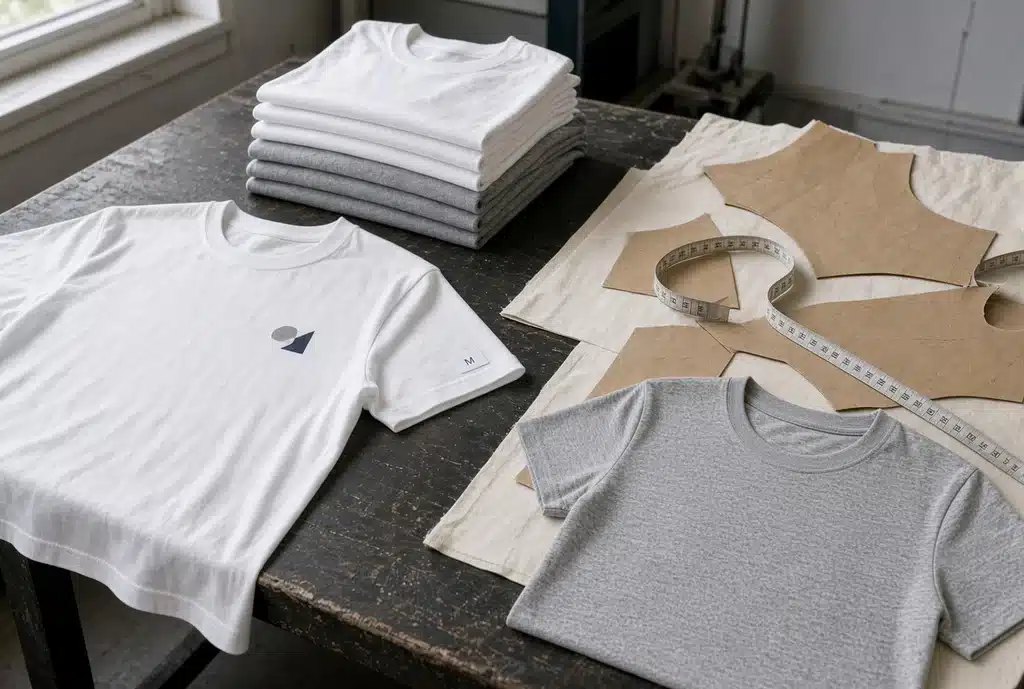
Printed blanks are a legitimate production route. They suit brands that are selling a graphic, a drop, or a merchandise piece more than a signature silhouette. The limit is garment-level control, not workmanship in general. A well-chosen blank can be a sound product. A mismatched blank stays mismatched after the print goes on.
When Printed Blanks Are a Practical Choice
Blank T-shirt printing for clothing brands works well when the artwork is the reason to buy. A tour tee, an event shirt, a collaboration graphic, or a small design release can sit on a stock body if that body already matches the brief. Early demand tests often belong here too. The question is whether people want the graphic, not whether the shoulder needs to be rebuilt.
Development work drops when the blank already fits. There is no pattern to grade and no fabric to develop before the first decorated pieces exist. That matters for a weekend drop or a retail counter program where the ship window is short and the silhouette is ordinary on purpose.
What You Give Up with a Blank
You give up control of the pattern. Fit, GSM, fiber content, neckline, sleeve shape, and body length are whatever the blank supplier already makes. Color range is their dye lot, not your palette. A private neck label can clean up the presentation. It does not correct a short body, a tight armhole, or a rib that gapes.
Packing is often limited to what the decorator or blank program allows: a hangtag, a bag, sometimes a custom carton. A full retail pack with a specific fold, tissue, and size sticker can sometimes be added, but the shirt inside that pack is still the catalog garment.
Risks to Check Before Choosing a Blank
Check the blank before you fall for the artwork. Size consistency across a run, fabric weight, shrinkage after wash, and color availability all sit with the blank supplier, and not every supplier controls them the same way. Print compatibility matters too. A slick or lightweight jersey may not hold the ink or stitch density you want, and a left-chest mark that looks centered on a sample size can drift on larger sizes if placement is not specified.
Repeat stock is the quiet risk. If the same blank is discontinued, or the next delivery is a different mill lot, your reorder is a different shirt with the same graphic. Ask what happens if that blank changes between runs before you build a style around it.
Cut-and-Sew T-Shirts: Advantages and Limitations
Brands choose cut-and-sew when the shirt is the product, not only the canvas. Control and differentiation come with sampling, fabric planning, and a longer path to the first bulk shipment. That extra work is useful only when customers can feel the difference.
What Cut-and-Sew Lets You Control
Fabric composition, GSM, knit structure, and color can be specified, then checked on a swatch or a sewn sample. Fit follows: body length, sleeve shape, neckline, shoulder line, hem, and any panel or seam that the blank catalog does not offer. A heavyweight oversized tee with a dropped shoulder and a wide custom neck rib is a pattern job. It is not a print job on a regular blank.
Labels, trims, decoration placement, and packaging can be developed with the garment instead of applied afterward. A branded retail pack, a woven neck label, and a care label can be sampled on the same piece the buyer will approve for bulk. Brands that need that level of control usually move into custom cut-and-sew T-shirt manufacturing, where fabric, fit, construction, labels, and sampling are planned as one product rather than added onto a finished blank.
What Cut-and-Sew Requires
Someone has to prepare a tech pack or a clear reference sample, develop the pattern, source or confirm fabric, sew samples, handle revisions, approve measurements, and plan bulk. Inspection then checks the approved standard, not a decorator’s idea of a “similar” tee. None of that has one universal timeline. A simple jersey in an available fabric moves faster than a new color or an unusual rib that has to be made.
The workload is the trade. If the brand cannot describe the fit it wants, cut-and-sew does not create a point of view. It only creates more samples.
When Cut-and-Sew Adds Real Product Value
The route earns its place when the garment cannot be found as a blank. A specific fabric hand feel, a shoulder and sleeve shape people recognize on a rail, unusual proportions, or a collection that has to match across styles are typical reasons. Custom T-shirt manufacturing is the point of that work: the garment is specified, sampled, and then repeated, rather than picked from a finished catalog.
Repeatability still depends on fabric. If the jersey or the rib is a one-time lot, the approved sample may not be reproducible next season. That risk should be visible before the style is treated as a core product.
Cut-and-Sew T-Shirts vs Printed Blanks Across Key Buying Factors
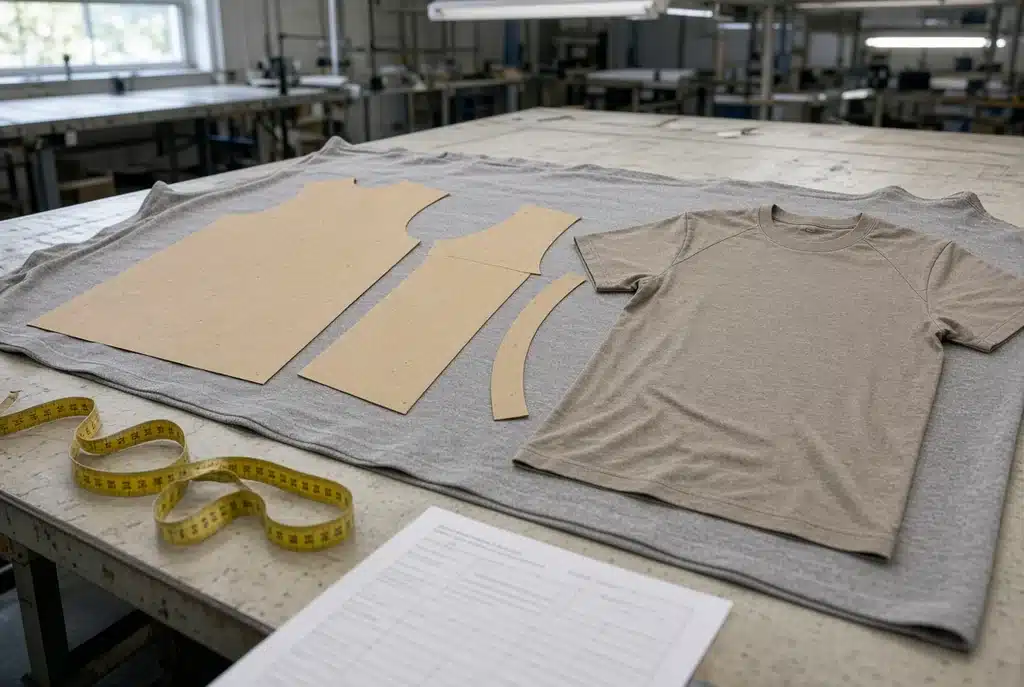
Buyers comparing cut and sew vs blanks usually need the same factors side by side: what the route starts with, what can be controlled, and what has to be developed first. The table is a decision matrix, not a promise. Feasibility still depends on the supplier, the product, the order size, and the materials.
| Buying factor | Printed blanks | Cut-and-sew T-shirts |
| Starting point | Existing T-shirt | Fabric and pattern |
| Fit control | Limited to available blank styles | Custom measurements and silhouette |
| Fabric control | Limited to supplier options | Composition, knit, GSM, color, and finish can be specified |
| Speed to launch | Often faster when stock is available | Requires development and sample approval |
| Development workload | Lower if blank already fits | Higher because patterns and samples are developed |
| Branding control | Decoration and selected labels or packing | Decoration, labels, trims, and packing can be planned together |
| Differentiation | Mainly artwork-led | Garment, fabric, fit, and artwork can all differentiate |
| Quantity considerations | Based on blank availability and decoration | Influenced by fabric, color, construction, and production setup |
| Best fit | Graphic tests, merchandise, simpler launches | Distinctive products and long-term garment development |
Read “often faster” as conditional. A blank that is out of stock is not a fast route. A cut-and-sew style in a fabric the factory already runs can move more predictably than a blank program waiting on a special color. The table shows the usual shape of the decision, not a result every order will hit.
How Cost and Quantity Differ Between the Two Routes
Cost follows the work, not a fixed premium for one route. Printed blanks can skip pattern and fabric development. Cut-and-sew adds those steps, then still has cutting, sewing, decoration, and inspection. Unit price alone does not say which route fits the brand.
Why Printed Blanks May Cost Less to Launch
An existing garment removes pattern making and, in many cases, fabric development. If the blank already meets the fit and quality bar, the early spend sits in the blank itself, the decoration, and packing. Artwork complexity, number of print locations, label changes, and shipping still move the number. A four-color back print on a special-order blank can cost more to launch than a simple one-color mark on a stock color.
Why Cut-and-Sew Needs More Planning
Fabric has to be bought or reserved. Patterns have to be made. Samples may need a second round after the first fit. Colorways, size runs, stitch details, and quality checks all sit in the setup before bulk is efficient. Quantity is tied to those inputs: fabric minimums, color count, and how the line is set up. There is no single order floor that applies to every style. Custom T-shirt production only becomes clearer once fabric, construction, and size run are named.
Why Unit Price Alone Is Not Enough
A lower unit price can hide a fit you cannot change, a label program you cannot match, or a blank you will outgrow after the first season. A higher custom cost can be justified when the shirt supports the brand’s positioning and can be reordered to the same standard. If the next run cannot use the same fabric, that justification weakens even if the first sample looked right.
Which Route Fits Your Brand Stage?
Stage matters as much as the spec sheet. A first graphic test and a third-season core tee are not the same product, even if both are called T-shirts.
Startups Testing a Graphic Concept
If the open question is whether the artwork or the audience will respond, a printed blank is often enough. Choose it carefully. Customers still feel the fabric and the fit, and a thin, twisting blank can sink a strong graphic. Use the test to learn demand. Do not treat a borrowed silhouette as the brand’s fit if you already know you will need a different body later.
Brands Building a Distinctive Core Product
Cut-and-sew fits when recognizable fit, fabric weight, construction, or a consistent silhouette is the reason the style exists. A product meant for reorder should be checked for material repeatability, not only for how the first sample looks on a table. If the fabric cannot be matched next season, the “core” product is a one-off.
Brands Moving from Blanks to Custom Production
You do not have to move every style at once. Graphic releases can stay on blanks while a core body is developed separately. The split should follow product role, demand, and how much control that style needs. Some brands validate a limited custom collection before they scale a core tee, using small-batch custom T-shirt production for that trial rather than treating every new style as a bulk program. Limited does not mean a fixed low order floor. Fabric, color, and construction still set what a trial run can be.
Questions to Ask Before Choosing a Production Route
These questions separate the two routes. They are not a full factory audit.
For printed blanks:
- Does this blank match the fit, GSM, fabric, and color you actually want to sell?
- Is the same blank likely to be available when you reorder?
- Which decoration methods work on this fabric, and where can the artwork sit?
- Can you use your own neck label, care label, and packing, or only the program’s options?
- What changes if the blank mill, fit, or color shifts between runs?
For cut-and-sew:
- Can the cut-and-sew T-shirt manufacturer develop the pattern and fit you are asking for?
- Which fabrics can be sourced or developed, and can they be repeated?
- How are sample revisions handled, and what gets approved before bulk?
- How are measurements and tolerances checked on the sample and in production?
- What order quantity applies to this style and color, given the fabric and construction?
- Can the same fabric and construction be used on the next order?
If the blank answers are mostly no, decoration will not save the product. If the cut-and-sew answers are vague, you do not have a controllable garment yet. You have a direction.
A Practical Decision Checklist
Choose printed blanks when:
- The artwork is the main reason the shirt is different.
- An existing blank already matches the fit and quality you need.
- Speed and lower development effort matter more than a new pattern.
- The brand is testing demand or producing merchandise.
- Limited control over construction is acceptable for this style.
Choose cut-and-sew when:
- Fabric, GSM, fit, or proportions are central to the product.
- The brand needs a silhouette or construction a stock blank does not offer.
- Labels, trims, and packing have to be developed with the garment.
- The T-shirt is meant to be a repeatable core style.
- The brand is ready to sample, revise, and plan production before bulk.
The better route is the one that matches the product’s real source of value. If you are selling the graphic, start with a blank you would still wear without the print. If you are selling the shirt, build the shirt.