
Before bulk fabric reaches the cutting table, compare it with the approved material reference and the written specification. That is how to evaluate fabric quality: check identity, construction, weight, usable width, shade, hand feel, surface condition, visible defects, dimensional stability, and any performance or decoration requirement the garment actually needs. A roll that looks fine when folded can still produce shade bands, marker shortages, seam twist, early pilling, print failure, or inconsistent fit once it is cut.
A swatch proves what was sampled. It does not automatically prove what arrived. Incoming fabric inspection is a comparison against that controlled reference, under an agreed method and acceptance criteria. Touching one end of one roll is not a release decision.
Start with the Approved Fabric Reference
Inspection is comparison, not personal taste. The person releasing the lot needs the approved swatch, material code, composition, construction, GSM or other stated weight, usable width, color reference, finish, and any test or performance requirement tied to the style. If that package is incomplete, stop and clarify it before cutting. Quiet assumptions in the cutting room are how a close-looking substitute becomes the production fabric.
Confirm Fabric Identity and Production Route
Check the supplier or material code, fiber content, knit or woven construction, finish, color, and lot information. Note whether the fabric is stock or custom-developed. A similar face is not the same fabric. Bulk sometimes arrives under a new code, a different mill, or a finish that was never on the approved sample. If the surface looks close, teams are tempted to release it. That is the wrong test. Stock fabric and a custom dye lot can share a name and still differ in density, shrinkage, or shade continuity.
Record what actually arrived against what was approved. If the code, finish, or route has changed, treat it as a substitution until someone with authority accepts it in writing for this order.
Keep the Physical Standard with the Written Specification
The approved swatch and the specification sheet should travel together. The swatch shows hand feel, drape, surface, and color in context. The document states measurable and process-related requirements: composition, construction, weight, width, finish, and any agreed tests. Neither one replaces the other. A sheet without a physical standard leaves hand feel open to argument. A swatch without a sheet leaves width, weight, and fiber content open to memory.
Do not let the reference sit in a sample room while the rolls are checked on the floor. The comparison has to happen where the decision is made.

How to Evaluate Fabric Quality: Weight, Width, and Construction
Identity is only the start. Weight, usable width, and construction decide whether the marker, the hand feel, and the finished garment can still match the costing and the approved sample. Check them against the approved state. A number on its own does not describe the cloth.
Verify GSM or Fabric Weight
State the unit and the measurement condition before anyone calls the weight a pass. Grams per square metre, ounces per square yard, and a relaxed or conditioned sample are not interchangeable labels. A higher GSM is not automatically better. A matching GSM does not prove matching hand feel, yarn, density, or finish. Bulk can hit the approved number and still drape differently because the knit is tighter, the yarn is coarser, or the finish has stiffened the face.
Weigh a representative piece from the bulk lot, not only the ticket on the roll. If the method differs from the one used at approval, record that difference before you treat the two numbers as comparable. ASTM D3776 is one common weight method. The point is to use the agreed method, not to treat every scale reading as the same test.
Measure Usable Width, Not Only Total Width
A roll ticket often states total width. Cutting uses usable width. Selvage, pin holes, edge curl, edge damage, and a continuous defect near the side can all shrink the cloth the marker can actually use. A roll that was costed at a full usable width may not yield the same number of panels.
Record how the width was measured, and whether the cloth was under tension or in a relaxed state. Tension can pull a knit wider than it will sit on the cutting table. If usable width is short, update consumption or isolate that roll. Do not discover the shortage after the marker is already on the table.
Confirm Construction and Surface Direction
Fiber and weight can be right while the construction is wrong. Check knit or woven structure, rib or fleece direction, nap, brushing, face and back, grain, and any one-way surface. A brushed face, a peach finish, or a directional knit cut in mixed directions will show as panels that do not match on the same garment.
Decide the marker rule before cutting: one-way, directional, face up, or free. Mixed directions on a napped or brushed cloth are a cutting decision, not a sewing repair.
Review Shade and Color Consistency
Color review has to go past the roll end. Compare bulk with the approved color reference under the viewing condition the brand and supplier agreed. Then look for continuity inside the roll and between rolls. A clean end does not describe the middle of a 50-metre piece.
Check Shade Bands and Lot Differences
Dye lots, roll-to-roll variation, center-to-edge shading, and finishing differences all show up once panels from different pieces meet on one garment. Side seams, hoods, sleeves, and pocket bags are where a shade band becomes a customer complaint.
Mark which rolls can be cut together and which must stay apart. Do not invent a universal shade tolerance. The buyer’s acceptance criterion for this color and this product is the rule. A black fleece and a pale oxford can hide, or reveal, the same measured difference in completely different ways.
Confirm Color on the Actual Fabric Surface
Brushing, peaching, coating, washing, and texture change how a color reads. A smooth shade card is not always visually identical to the finished cloth. Compare like with like: approved fabric standard against bulk fabric, under the same light. Record the standard and the viewing condition so a later argument is about the cloth, not about memory of the light box.
If the only approved reference is a lab dip on a different base, say so. That limit belongs on the inspection record before the lot is released.

Inspect Hand Feel, Drape, and Surface Condition
Tactile and visual qualities are judged against the approved reference, not against a general idea of softness. The right hand depends on the garment, the construction, and the brand standard. A stiff shirting and a fluid jersey can both be correct.
Compare Hand Feel and Drape
Check softness, firmness, compactness, fluidity, recovery, stiffness, and surface friction where they matter to the style. Composition and GSM can match while drape changes because of yarn, stitch density, or finishing. That is a common reason a substitute gets accepted: the weight is close, so the hand is waved through. Hang a length of bulk cloth next to the approved swatch. If the fall, the recovery, or the surface drag is different, record it before cutting.
Look for Pilling, Hairiness, Snags, and Finish Problems
Look for excessive hairiness, early pills, pulled yarns, streaks, glazing, uneven brushing, coating marks, and finish inconsistency across the roll. A visual check can find what is already on the surface. It does not replace a pilling, abrasion, or colorfastness test, and it does not assign a universal grade. Separate what you can see from the performance property that still needs a method and a care condition.
If one roll is hairy and the next is clean, that is a lot-control issue, not a sewing issue.
Identify Fabric Defects Before Cutting
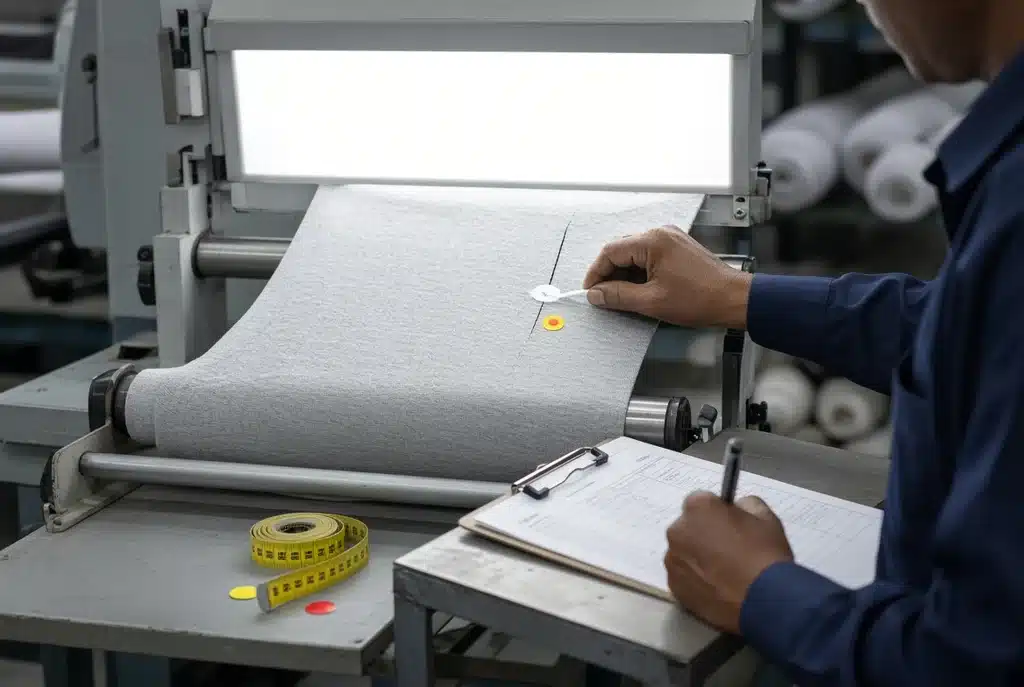
The aim of fabric defects inspection is to find, classify, record, and manage faults before they become garment faults. A defect may run the length of the roll, appear in short repeats, sit in one zone, or stay on the edge. A hole in a hidden underarm panel and the same hole on a chest panel are not the same production problem, even if the cloth fault is identical.
Common Defects in Knits and Wovens
The useful list depends on the construction. Knits often show holes, dropped stitches, needle lines, barre, contamination, and edge curl. Wovens often show broken yarns, slubs, neps, mispicks, bowing, and skew. Both can carry streaks, shade bars, oil marks, and width variation. Do not judge every fabric against one master list.
Tie each fault to visibility and panel placement. A continuous needle line may force a whole roll aside. A short slub may be marked and avoided if the marker and the cutting plan can actually do that.
Use an Agreed Inspection Method
The four-point system, described in ASTM D5430, is one commonly used way to score visible faults by length. It is not a universal rule. Point assignments, how many rolls are opened, inspection speed, lighting, and the acceptance score all have to be agreed for the product. Publishing a single defect allowance here would pretend that a jersey T-shirt and a coated outerwear shell share one standard. They do not.
Whatever method is used, it should leave a traceable record for each inspected roll or lot: identity, length checked, faults found, location, and the decision. Bulk fabric inspection for clothing is only useful if the next shift can read what the last shift saw.
Decide Whether to Hold, Segregate, Rework, or Release
Serious or repeated faults are a reason to hold the material. A local fault can be marked or the affected metreage segregated if cutting can avoid it. A concession, if the brand accepts the deviation, should name the order, the rolls, and the limit of that acceptance. It should not be assumed because the delivery date is close.
Rework, such as re-inspection after a mill repair, needs its own record. Release means the cloth may go to cutting under the conditions written on the report, not under a verbal “it should be fine.”
Confirm Dimensional Stability and Performance
Looking at a roll cannot prove shrinkage, skew, stretch recovery, pilling resistance, colorfastness, abrasion, opacity, or how a print or embroidery will sit. Those are different checks from a visual pass. Appearance, dimensions, performance, and decoration each need their own evidence. That evidence belongs in a wider fabric and garment quality control process, from the approved sample through in-line checks, finished measurements, workmanship, labeling, and packing.
Choose tests from the garment’s use and the buyer’s requirement. A lounge short and a work jacket do not share one test list.
Review Shrinkage, Skew, and Recovery
Dimensional change moves patterns and finished measurements. Skew or spirality twists side seams and hems after wash. Stretch and recovery matter on fitted styles, cuffs, waistbands, and activewear. Name the method and the care condition: a home-wash method such as AATCC 135 or ISO 6330, with measurement under ISO 5077, is not the same instruction as a commercial wash. Those methods are not interchangeable. Do not treat a single percentage as a universal pass level. The tolerance, if any, is the one agreed for this style and this fabric state.
If the bulk result differs from the result used to grade the pattern, the pattern or the cutting allowance has to be reviewed before the lot is spread.
Check Decoration Compatibility
If the garment will be printed, embroidered, washed, coated, or otherwise finished, test the actual fabric route where you can. Cloth can look correct and then show dye migration, poor ink adhesion, embroidery pucker, or surface damage after the decoration step. A method that worked on last season’s base is not confirmation for this lot. Use a strike-off or a sewn sample on the bulk cloth, or a written supplier confirmation tied to this material code. Do not clear a decoration route from a hand feel check.
Release Fabric to Cutting Only After Review
Fabric quality control before cutting ends in a decision, not a pile of notes. The release record should name the material, the lot, the rolls checked, the inspection status, open issues, any approved concession, and cutting or shade-separation instructions. If a roll is not released, say so on the same record.
Protect the Marker and Cutting Plan
Usable width, nap, grain, shade bands, marked defects, and one-way surfaces all change the marker. A roll can be in the warehouse and still fail the yield assumption used in costing. When the cloth differs from that basis, update consumption or isolate the rolls. Cutting through a short-width or shaded piece to “use what we have” moves the loss from fabric into garments.
Communicate Restrictions to the Sewing and Finishing Teams
If rolls must be cut separately, faced one way, or kept clear of marked areas, those instructions have to reach cutting, sewing, printing, washing, and packing. The usual failure is a complete inspection sheet that never leaves the fabric room. A shade-band note that the sewing line does not see becomes a mixed-lot garment.
Fabric approval is one stage. Production inspection before order release still has to cover workmanship, measurements, appearance, and packing once the cloth has become garments. A clean roll record does not close the order.
Common Fabric-Evaluation Mistakes
These are the failures that show up after the spread is already on the table.
Approving from a Single Swatch
A swatch will not show roll-to-roll shade, a short usable width, a continuous needle line, or a lot change. Compare representative bulk cloth with the approved reference before cutting. Open more than the end if the method says to.
Checking Touch but Not Identity or Measurements
A fabric can feel right and still be the wrong construction, weight, finish, or width. How to check fabric quality before production is a combined review: documents, physical standard, measurements, and the tests the style requires. Hand feel is one line on that review, not the review.
Treating a Concession as a Permanent Standard
A deviation accepted for one order is an order-specific decision. Write the order number, the rolls, and the limit. Do not let that concession become the unspoken standard on the next bulk. If the brand wants the change permanently, revise the specification and the physical standard.
Inspecting After Garments Are Already Cut
Late inspection raises the cost of every fault, because the cloth is already panels or garments. The control point is before bulk cutting, with follow-up during spreading, sewing, and finishing. Finding barre on a finished body is a recut conversation. Finding it on the frame is a roll decision.
Fabric Quality Checklist Before Bulk Production
Use this fabric quality checklist as the release gate, not as a slogan. Confirm each line against the approved reference and the agreed method:
- Approved material identity and code match the bulk lot.
- Fiber content and construction match the specification.
- GSM or other stated weight was checked in a named unit and condition.
- Usable width, not only ticket width, was measured and recorded.
- Face, back, nap, grain, or other direction is identified for the marker.
- Shade was compared with the approved color reference, and rolls that cannot be cut together are marked.
- Hand feel and drape were compared with the physical standard.
- Visible defects were recorded under the agreed inspection method.
- Dimensional stability and any required performance tests are in, or explicitly pending, before cutting.
- Decoration compatibility was checked on this fabric route where the style needs it.
- Roll, lot, and shade-separation instructions are written for cutting and sewing.
- Release status, open issues, and any concession are named for this order only.
Release the cloth against a controlled reference and an agreed inspection decision. Do not release it against memory, or against one attractive swatch.