
The lower MOQ clothing manufacturing cost is generally more expensive per garment as many of the manufacturing processes must be performed regardless of whether it’s 80 garments or hundreds. The following steps do not decrease linearly with quantity: Pattern work, material buying, cutting setup, machine preparation, decoration setup, inspection, packing, and planning. It should be viewed in the same manner as you would for the variable cost per garment, just variable cost per garment plus the fixed and semi fixed work required for the order.
A shorter run can still be a good initial step. It reduces exposure to inventory and allows a brand to gauge demand without committing money to inventory. The higher unit price is that trade-off, it’s not proof that a factory is adding to the quote. A trial with a stock-fabric T-shirt is frequently easier. A small production run of custom dyed hoodies with embroidery, woven labels, and unique packs multiple setup layers on a reduced number of units.
What Makes Up Low MOQ Clothing Production Cost?
The unit price is NOT one number. It consists of costs that change per garment and costs that are at style, color, artwork or order level. After separating those layers, it’s easy to see why the production cost for clothing with low quantities is increasing even if it appears relatively small.
Variable Costs Per Garment
Variable costs tend to increase as the number of items produced increases:
- Fabric consumption – cutting waste, size differences
- Machine labor and common thread
- A common term utilized on all clothing articles.
- Ink, thread, backing or transfers that can be used for decoration.
- Pressing and finishing
- Each pack separate from others (e.g. polybags or tissue)
Those costs are not the same for each size. The 2XL hoodie is larger than the S in terms of fabric. It takes longer to make a multi-panel construction compared to a simple T-shirt. A dense chest embroidery will require more time in the machine than a small print with only one color of thread. Although the variable cost remains with the garment, it is less pronounced. Does not account for the entire unit-price increase in a small quantity.
Fixed and Semi-Fixed Costs
Fixed and semi-fixed costs appear only once per style, color, artwork or per order, not per piece. Common tasks involve pattern preparation, grading, sample development, cutting setup, production planning, machine setup, artwork preparation, embroidery digitizing, screen or transfer setup, quality control preparation, and administrative tasks.
There are still three more steps for a factory to take to open a style file, confirm measurements, purchase material, write a cutting plan, brief the line, and establish inspection criteria. That work is on an 80-piece trial, and a 500-piece repeat. The difference lies in the number of garments whose bill is being settled.
A Simple Cost Allocation Example
Use the following figures as examples of the relationship, rather than as an industry rate.
Suppose there is style that requires $400 in setup and the order is 100 garments – then the individual garment will have a $4 set up. When the same equipment is used 500 times for 500 garments, it would be distributed as $0.80. There were no changes to the sewing minutes for garment number 87. The allocation did.
When an estimate is requested by a buyer, it should be done to distinguish the one-time from the per-unit type of work. Those buckets can be included in the one headline price and the low quantity order appears “expensive” without explanation.

Setup Costs Are Spread Across Fewer Garments
The time the factory takes to prepare a style before a needle moves. For low MOQ apparel making, that preparation is one of the initial factors that can increase the unit cost.
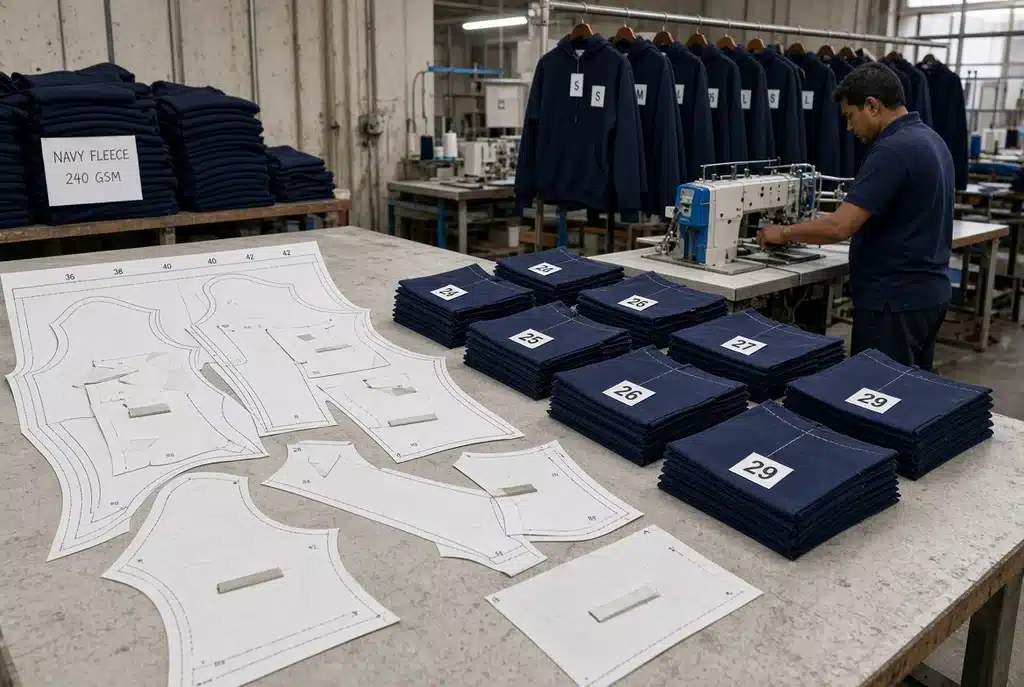
Pattern Making, Grading, and Sample Development
For a new style, the base pattern, grading across the size run, prototype, fit sample, revisions and pre-production approval may be necessary. Those steps are responsible for fit and construction. They are the same price for both small and large bulk orders, too.
A brand that takes several rounds of samples on a big hooded sweatshirt, and then gets 80 pieces, is asking the initial order to have the development of the second order of 400 pieces spared. The sample work is not going to waste. It is front-loaded.
Cutting and Marker Preparation
Cutting is more than just cutting fabric. The team is still to have a marker, ease the fabric where necessary, spread, cut, count and bundle fabric by size and colour. However, a small order with several sizes and colors is not as economical in fabric as a concentrated run. Markers get shorter. Handling increases. If there is not enough material, offcuts increase.
Not all waste is not always charged separately. It still remains within the material/cutting part of the unit cost.
Sewing-Line Setup and Changeover
There is a need for machine set up, operation sequence, operator instructions, line balancing and first piece approval for a sewing line. There is one stylish hoodie that makes the line settle. If the same amount of material is divided into three different garments—such as a zip hoodie, a pullover and a cropped silhouette—then there are more first-piece checks and more changeovers per garment produced.
Smaller Material Purchases Can Raise the Effective Cost
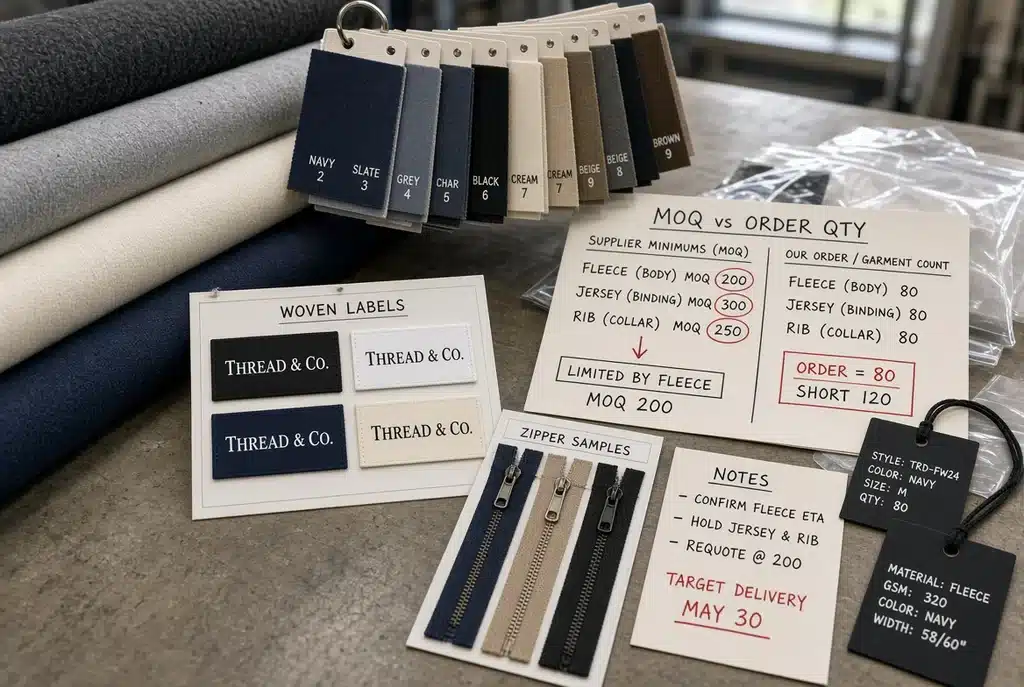
Many MOQ quotes start to get tight when it comes to buying in fabric and trims. The factory may need to buy more materials than the clothing actually uses, or it may have to agree to a supplier minimum which may not be the same as the order.
Fabric Minimums and Leftover Material
Mills and traders typically trade by minimum quantity, dye lot, roll, or lot. If consumption is near half a roll after waste, it could take an 80-piece hoodie trial just 1 or 2 rolls. Finishing pieces might not be suitable for other customers’ color, GSM or blend.
There are various approaches to leftover material when writing a quotation. Some embed some unwanted material into the unit price. Some have it as factory risk. Others request that the home buyer assume the responsibility of removing the excess yardage. None of the strategies is universal. The same thing applies here: unused material costs are a true cost in the chain.
Custom-Dyed Fabric and Lab-Dip Requirements
Lab dips, shade approval, dye-lot minimums, testing, lead time, and risk of leftover color are all added by custom dyeing. One of the quickest ways to raise the production cost of low quantity clothes is by using a custom dyed fleece that is from a substandard dye lot.
If the shade, GSM, composition, handfeel, shrinkage, and colorfastness of the stock fabric are consistent with the product, it can reduce the complexity. The stock requires further inspection. It is not “no work. It is typically a less effort than opening a new dye lot for a small first run.
Trims, Labels, and Hardware Minimums
Some items such as woven labels, care labels, hang tags, zippers, buttons, drawcords, patches, polybags and cartons may apply a minimum. An actual example: A brand requires labels for 80 garments, but the minimum order from the label supplier is 120 or 200 pieces. The additional labels, plus label or setup fee, are incorporated into the small order—unless the brand can use the old label on a subsequent style.
Multiple Styles, Colors, and Sizes Increase the Cost per Unit
When a low total quantity is divided into numerous production combinations, it becomes more costly. The cost of the clothing manufacturing unit is dependent not just on the number of units, but also on the number of workflows.
Style-Level Setup and Separate Workflows
Different styles may require different pattern, construction notes, cutting plan, first-piece approval, sewing sequence, inspection standard and packing record. Three hundred hoodies in one style is one workflow. Four setups, four first piece approvals, four chances to mix parts equals 300 garments in 4 silhouettes.
Color Separation and Shade Control
Colour requires colour planning, shade checks, cut bundles, decoration checks, label mapping and packing. Simple line sheet will consist of two colors of the same t-shirt. There are two material plans and two shade-control jobs in the factory. There’s a risk of shade when left-over fabric can’t be merged to the next colourway.
Size Distribution and Low Quantities Per Size
When using 80 pieces of various sizes from XS to 2XL, there may be some items left in each size. Marker efficiency drops. Bundles get smaller. More handling done per piece when inspection and packing. Not all factories will have a hard minimum per size, but buyers should query how a thin size curve will impact cutting waste and production feasibility.

Decoration, Branding, and Packaging Add Setup Work
A trial or a slippery trial is often a result of not having the right custom branding. There can be a small number of garments, but a large number of setups.
Printing Setup and Artwork Complexity
Artwork review, placement approval, screen preparation, or transfer preparation and test prints are still required for a one-color chest print. Multi-color, multi-location design increases separation work and risk of rework. That preparation isn’t usually given a pass on a small order. The art must still be on point.
Embroidery and Patch Production
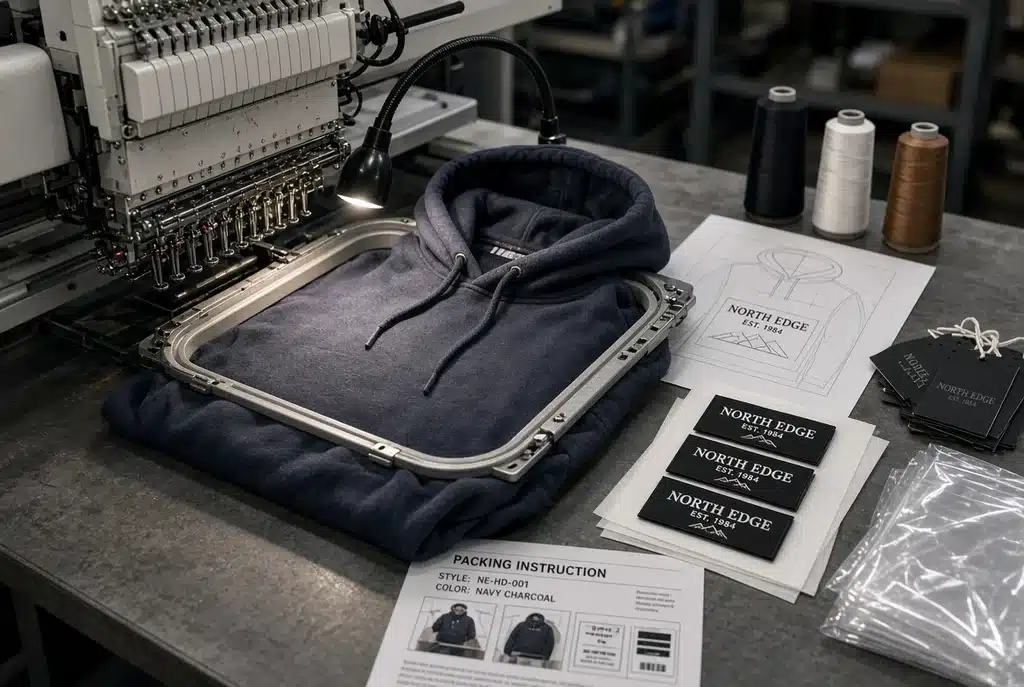
Embroidery includes digitizing, thread count selections, changes, backing, placement, and distortion testing. A small logo on 80 hoodies is feasible. Multiple setups for a short run with dense embroidery on chest, sleeve and hood, with a custom woven patch. There are sampling and minimums for patch development.
Labels, Hangtags, and Retail-Ready Packaging
The movement of woven labels, care labels, hangtags, barcode stickers, folding standards, polybags, boxes and carton marks introduce additional labor in the purchase and packing process. Simple packaging can reduce the complexity. It shouldn’t strip away necessary fiber, care content, product protection or the barcode used in the sales channel.
Production Scheduling and Labor Efficiency
Some small orders are more expensive at the factories, because they break into the normal planning. It is not a moral issue, it is an operations issue.
Line Balancing and Small Production Runs
A sewing line is designed based on sequence of operations, type of machine, operator skill, quality control points and production output. The short run can come to an end before the line has reached the rhythm of a longer run. Each factory and each garment has its own productivity rate. The pattern is the same: short runs are more intensive in terms of input per output.
Changeovers Between Styles and Materials
Changes of threads, folder or attachment, changes of fabric, changes of decoration, and new first piece approvals all require some time. The more the batches are split, the more transition time and more mix-up risk. It is easier to schedule one stock fabric T-shirt, than a capsule of three fabrics and 4 constructions.
Priority, Capacity, and Schedule Coordination
There will still be time for planning to be left to materials, samples, line up, line checking, packing and shipment. That 80 piece order can take a lot of my attention as a coordinator. Consolidation of styles, early-set specifications, and no last minute changes in artwork or trim can help lighten that burden for buyers.

Quality Control Does Not Scale Down in the Same Way
There is a small order still to be the right product. Some inspection work is either fixed or semi-fixed, meaning that the cost per garment increases even when the inspector works less total time.
Sample and First-Piece Approval
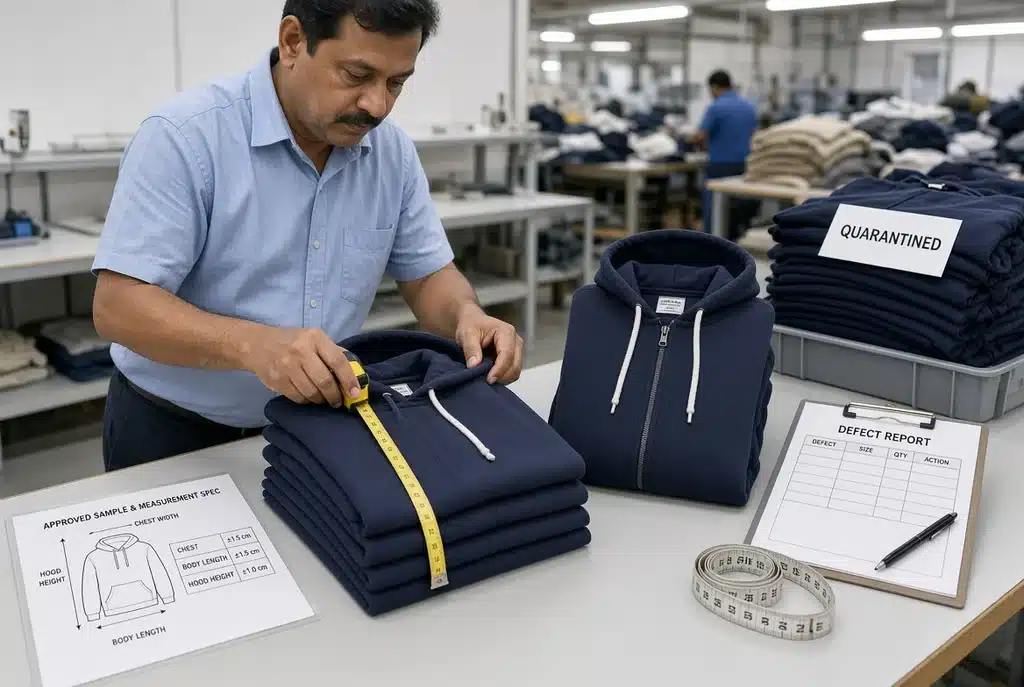
An approved reference for measurements, construction, materials, decoration, labels and packing is still required for the factory. If there is a small quantity, it is not an acceptable sample. The product risk is the same. There are more units to approve but there are not as many as there used to be.
In-Line and Final Inspection
In-line checks, measurement verification, finished garment review, label checks and packing review continue to be beneficial. Inspection can be made to suit risk level. If it is not repeated, but a large proportion of the order is affected by one defective, it is a bad deal if one saves on the cost of repeating.
Rework and Defect Cost Per Garment
Rework is more effective when the batch is small. If the label placement mistake is made on 80 garments, it’s likely that the bulk of the lot would need to be opened and rehandled and will need to be done again. The same defect is still an issue on 500, but the corrected rework activity is distributed among more people.
Low MOQ Does Not Always Mean Lower Total Cost
The price per unit is not the only factor. Sometimes low MOQ private label clothing is the more budget-friendly business selection since it eliminates dead stock.
Inventory Risk Versus Unit-Cost Premium
On a per-piece basis, a small order might actually be more expensive, but if it doesn’t result in the loss of unsold inventory, storage space, and cash held in the wrong color or size, then it will be less expensive overall. The comparison is between the price of having excess stocks and the premium in a controlled trial. The winner is determined by Demand confidence, Cash flow, Sales channel and reorder speed.
Reorder, Freight, and Stockout Costs
Multiple small runs = multiple freight, multiple schedules, more administration. No sales equals stockout. A first order with a low quantity is best if the fabric can be reordered in the same shade, and the brand is familiar with how the replenishment will take place.
Total Landed and Operational Cost
Consider development, manufacturing, branding, packing, freight, duties, storage, fulfillment, returns, and markdown risk all as one. No one-size-fits-all exists to rank each option. A clearer scope: Factory unit price is not same as cost of getting the product sold.

How to Reduce Low MOQ Clothing Costs Without Weakening the Product
The purpose is not to take the garment apart to be cheap and loose. The objective is to eliminate unnecessary complexity and maintain the elements of fit, material inspection, branding quality, inspection and repeatability.
Concentrate Quantity Into Fewer Styles and Colors
changes, and less packing maps. Keep the best product safe first. Having a tight first drop will teach more than a sprinkled capsule that never reaches an efficient number of SKUs.
Use Stock Fabrics and Standard Trims Where Appropriate
Appropriate stock fabrics and standard trims can help to minimize minimums, custom development and LMR (leftover material risk). Just approve them as you would a custom fabric, according to their composition, GSM, shade, shrinkage, colorfastness, handfeel, and repeat availability.
Share Branding and Packaging Components
A single woven label, hangtag family, carton mark and decoration method can reduce individual setups for a small collection. There may still be additional data that need to be handled separately such as size, fibre, bar code, and SKU specific data. Do not use the same brand to print the wrong care content.
Request Clear Alternative Quotes
Request that they be given opportunities to do so one variable at a time:
- Larger quantity with custom fabric.
- Simple decoration is decorating something simply, while complex decoration is to decorate something complex.
- The difference between standard packaging and retail ready packaging.
- A single focus versus a bunch of capsules
Analyze the unit price, total cost, lead time, quality, customization, and possibility of repeat of the same spec.
Plan the First Run as a Learning Order
The first order of the lowest quantity should yield information such as fit response, demand, color performance, fabric behavior, decoration durability and reorder feasibility. Maintain approved spec, measurement chart, artwork files and packing method to avoid the time required to re-invent the product the next order.
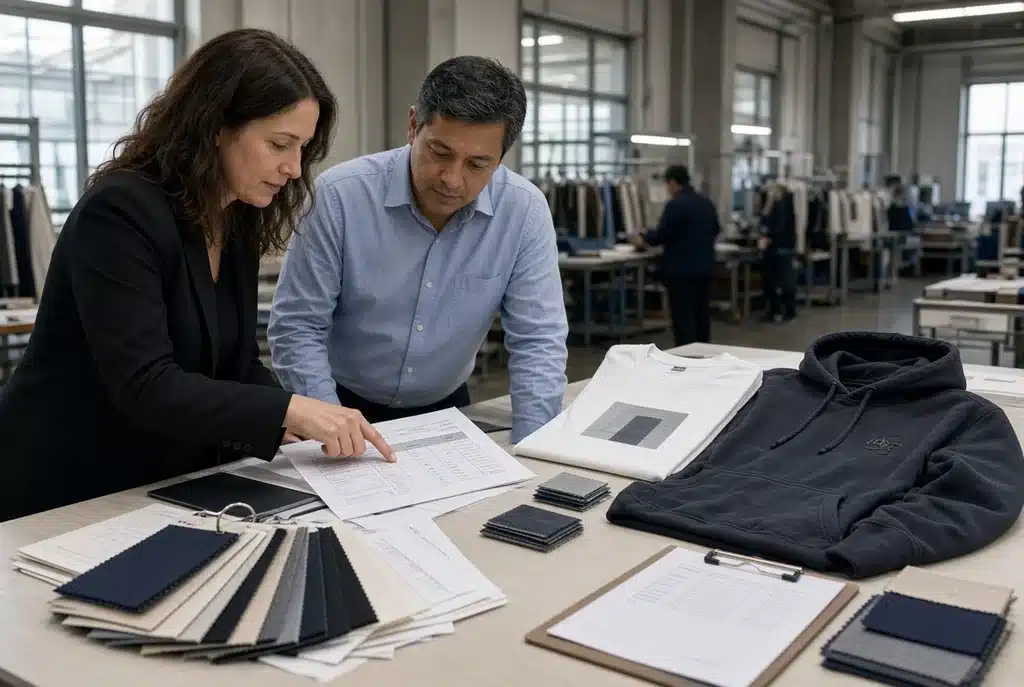
Summary Guidance – Pay for Less Inventory, Not for Avoidable Confusion
The fixed and semi-fixed costs of the clothing production are allocated to fewer items, which increases the cost of individual clothing items in low-MOQ manufacture. The changeovers, branding set-up, scheduling, and quality control for smaller material purchases further add to the pressure. This top dips can still be a business sensible aspect of the equation if it lowers risk in inventory and confirms demand.
Concentrate the initial run. Reuse materials. Give complete specifications. Request a manufacturer to break one-off, per-unit branding, packaging, inspection and logistics costs and compare it with a realistic repeat production plan. Pay for a lower stock level. Avoid overpaying yourself for a short setup that makes five setups.