
For private label garments, it may not be necessary to have a full tech pack for every order, but the factory will still need sufficient information to determine what is absolutely required, what is okay to vary, and what needs to be included in the final garment. A stock hoodie with a personalized neck label and factory run build may frequently be utilized with a structured brief. Documented measurements are required for a new oversized T-shirt block, a fitted dress in multiple sizes or a lined jacket with hardware, as these details influence quoting, sampling, fit and bulk consistency.
A tech pack should not be a substitute for sample approval and is by no means a guarantee of a flawless garment. It sets out the purpose of the product, the approved sample is a confirmation of the actual realization of the product. The level of documentation is a function of the complexity of designs, sizes, multi-factory quoting and repeat-order plans – not a function of whether or not the file is required documentation or whether or not it is decoration, optional or not. repeat-order plans—not on treating the file as mandatory paperwork or as optional decoration.
What Is a Tech Pack for Private Label Clothing?
A tech pack is a production document that converts a design idea into measurable and repeatable pattern making, sampling, costing, cutting, sewing, inspection and replenishment instructions. It is not a fashion sketch that has a logo on it. It documents the decision making process that affects fabric usage, construction time, fit, decoration, labelling and quality control.
Each factory will fill in the empty spaces when the buyer sends only a mood board or a lookbook picture. One mill takes 220GSM jersey while another takes 180GSM jersey. One pattern room takes a photograph of a dropped shoulder, another a typical set-in sleeve. A private label clothing tech pack is not going to take away all of the guesswork, but it does provide the factory with a written product definition rather than a “silent guess.”
The Difference Between a Tech Pack, Product Brief, and Reference Sample
A product brief is a document that describes the concept: category, customer, desired appearance, price range, colors, and most important feature. It is useful early. A last price quote on a new block is seldom sufficient.
A reference sample is anything real that helps convey handfeel, seam type, rib height, pocket depth or the “this is the fit I mean” moment in a drawing. Strong and yet it is not complete. If a retail hoodie has been washed, it could be shrunk. Sometimes a purchased size M will be on a different size chart than the one you wish to use to sell. Information about the construction on the inside may be the final thing you don’t wish to be duplicated.
A tech pack contains those things that need to be measurable and repeatable: points of measure, finished measurements, fabric and trim specifications, seam construction, artwork placement, label positions, and rules for packaging. For instance, the slouchy reference hoodie has a slouchy look. The tech pack specifies 320 GSM French terry, 2×2 rib at a certain height, chest and body-length measurements at the base size, coverstitching at the hem and the print position at the high-point shoulder, as well as the precise position of the neck label.
There’s no competition between tech pack and product brief. They work in different professions. The short begins the discussion. A physical target is displayed in the reference garment. The tech pack is the record of the production made by the factory for costing, sampling and then reproducing.
Why Manufacturers Use Tech Packs
It is used by pattern makers to draft and/or alter a block. It is used by merchandisers to determine fabric and trim usage. It is used by sample rooms to create the initial garment and to note comments against a named version. Costing teams use it so that the quote is in line with a specific construction and not a general “premium hoodie.” In the Cutting and Sewing Area, the approved version is used as a standard for in-line checks and final inspection by the Cutting and QC teams. It is used in repeat orders to colour in season two, and start with the same piece of garment, rather than from memory.
A usable file also provides the factory with questions. Questioning before cutting, the technician can ask if the neck is bound in the sketch; if it is, the BOM will include a rib collar. The significance of apparel tech pack requirements is that there’s less “reading between the lines” between concept and the sewing line.

When You Strongly Need a Tech Pack
Inquire if the product has been already defined by the factory, or it is defined only in the head. In that case, the factory must create the block, the fit, the grading, or the construction sequence, a full file is highly recommended. The word “private label” is not the determining factor for the decision; it is complexity and repeatability.
You Are Developing a New Garment or Original Fit
Numbers are required for new silhouettes. If the T-shirt is oversized and “a bit boxy”, then each different pattern room will draft it differently. The crop hoodie alters the body length, sleeve pitch, rib width and pocket positioning on the body. If the relationships between waist, hip, and length are not written down, a fitted dress will fit one size and then fall apart or slip in the next. A jacket with a structure, shoulder pads, and hardware has so many construction possibilities that a photo cannot be used to control it.
Product is affected by small measurement changes. A tee can be an oversized to regular size with two centimeters of chest width. Slightly different lengths on dress waist can make a big difference in the hang of the clothes. Those are the times when what you wear is at stake and wearing something without a tech pack for clothing manufacturing is no longer a theoretical concern. A base size needs to be documented and construction notes before sampling multiplies.
You Need Several Sizes or a Repeatable Grading System
A single approved medium does not constitute the size run. The factory still requires the base-size POM list, the measurement method, tolerances and the rules governing the relationship between shoulder, chest, length and sleeve to maintain consistency for the relationship between size S and XL.
If there was no record of that, the comments would be verbal/verbal. Next season, a different technician may grade from a different point. Here, a tech pack for work by a clothing manufacturer is helpful in retaining the intended size relationship not just the appearance of the first sample.
You Are Comparing Quotes From Multiple Manufacturers
Factories make their quotes based on what they believe. The unit prices of the two factories are not comparable because Factory A’s price is based on 200 GSM compact jersey with twin-needle hems and Factory B’s price is based on 160 GSM open-end jersey with single-needle hems. A stable private label clothing tech pack ensures that multiple suppliers incur the same cost of the product definition: same fabric family, same GSM target, same construction, same trims, same decoration, same packing.
This is important when considering the unit cost versus development support, lead time, MOQ and the capability of the factory to support the construction. The document doesn’t set a fixed price. It’s used to refer to the same garment as the price.
You Expect Repeat Orders or Product Scaling
If you have to replenish, make new colors, new sizes, etc., you will need a product record. Once a sample is approved, change the file to reflect the approved garment instead of the initial concept sketch. It is not uncommon to get bulk errors from obsolete measurements or old artwork versions.
The updated pack is used as the reference for the inspection and for the next PO. That’s why documentation is the vehicle to scale and not say that the first PDF was ready for production.
When a Full Tech Pack May Not Be Necessary
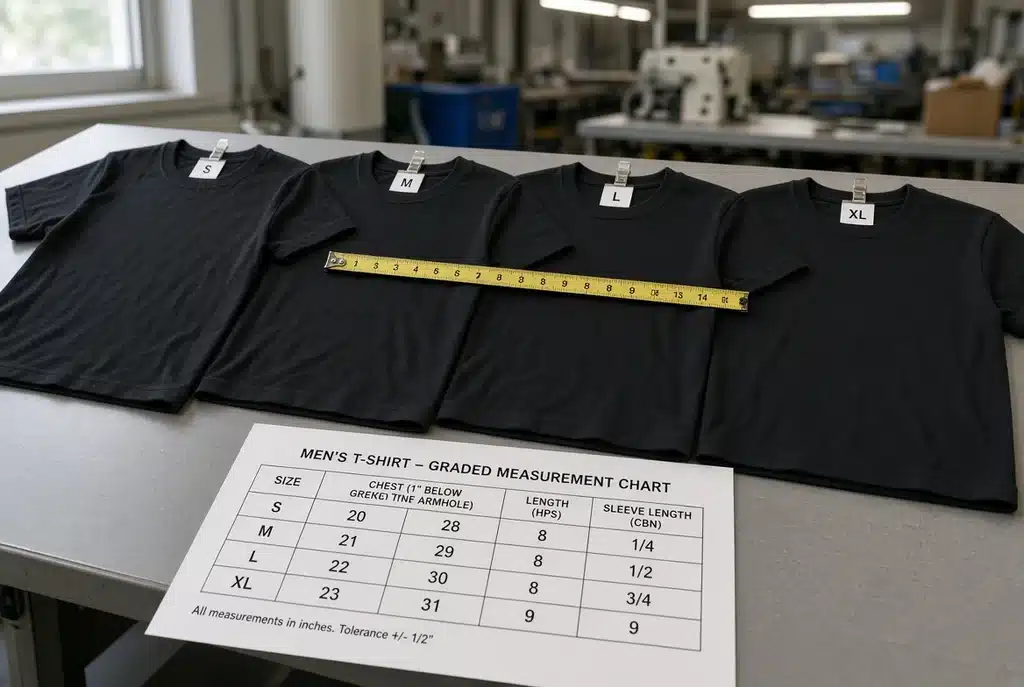
One private label begins with a factory style, and doesn’t start from a new buyer-designed block. There are such times that clothing can be manufactured without a tech pack. This is not the same as manufacturing non-specification.
Selecting a Factory Running Style
If a tee or polo or hoodie is already being manufactured by the factory that you are interested in, you might not have to write an entire tee from scratch. Request the specification available: what is it, what is the fabric made from (GSM), what is the construction, what will the factory let you change.
A lookbook picture is not a specification. For an accurate quote or for repeatable bulk orders, verify the running-style data by writing. Next, write down your exceptions—color, label, print, hangtag, packing.
Using Stock Fabric and Standard Trims
Technical development is minimal, with the exception of stock fabric, standard rib, stock buttons, and existing seam types. They do not delete confirmation work. Prior to approval, still lock composition, GSM, color standard, expected shrinkage, measurements and if that fabric lot can be repeated.
Just as an undocumented custom fabric does, a “stock” fabric that is erased after the first run is a problem. Even if you don’t have a full original tech pack, you should have availability in the production record.
Adding Simple Branding or Decoration
A woven neck label, care label, hangtag or small chest print can be placed on an already existing base style without having to order a new multi-page package. Artwork files, dimensions, placement, color references, attachment method and packing instructions are still needed.
Don’t consider the branding change as a sticker to be placed on the finish, it is product development. If a large back print requires a different stitch sequence, a patch that needs reinforcement, or a label that changes the finish of the neck, it is product development, not branding change.

What Should a Clothing Tech Pack Include?
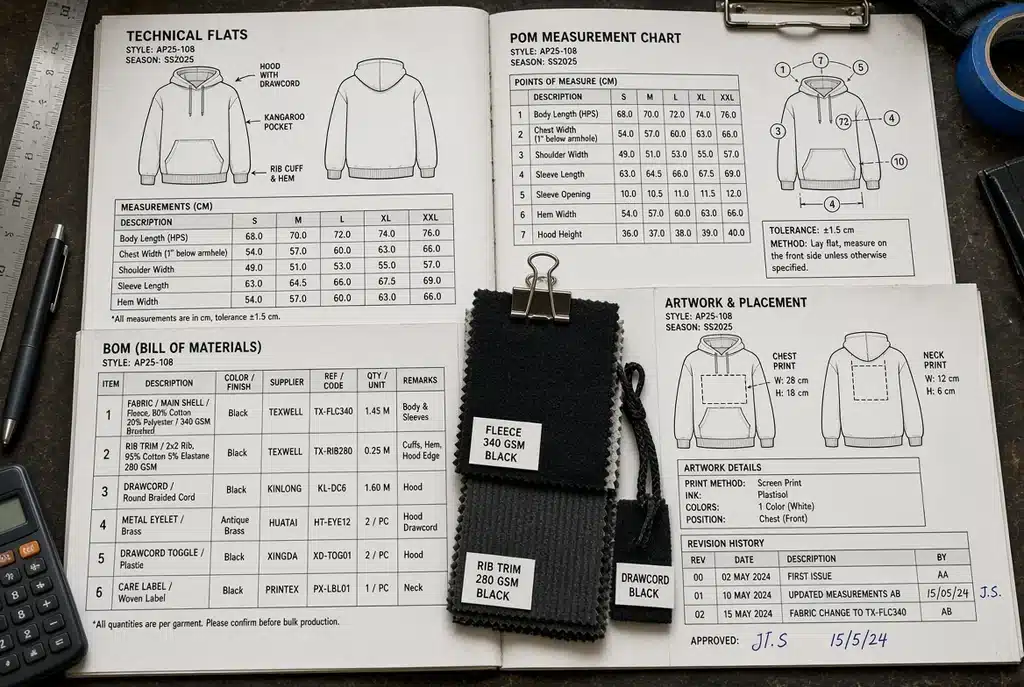
Formats vary. Any of the following may be used: spreadsheets, multi-page PDFs, or factory templates. The goal remains the same: to measure and repeat the garment. The number of pages that should be included in a clothing tech pack will vary depending on the product, but the following pages are considered to be the core pages for most private label programs.
Technical Flats and Construction Details
Draw in front and back flats, and sew in panels, pockets, collars/cuffs, hems, closures, topstitching, bartacks, tape and reinforcements. A sketch is a flat that just demonstrates fashion proportion. A production flat is used to indicate seams and changes in operations.
Identify those construction that will impact cost and durability (cover stitch vs. single needle, bound neck vs. rib, lined vs. unlined, welt pocket vs. patch pocket). The factory should be able to count from the page.
Measurement Chart, POM, and Tolerances
Specify points of measure, methods of measurement, base size, finished size, grading and tolerances. Common POM for a tee or hoodie are the chest width, body length, shoulder width, sleeve length, neck opening and hem width. A dress or trouser increases the waist, hips, rise, inseam and/or sweep.
Never say ‘slightly oversized’ without a number or a reference fit. For an oversized intent, write the chest and length desired on the base size and indicate the relationship desired in the size run.
Bill of Materials and Material Specifications
The BOM should include main fabric, rib or cuff fabric, lining, interlining, thread, zippers, buttons, elastics, drawcords, labels, patches and other parts. The following information is helpful: fiber content, fabric construction, GSM, width, finish, color reference, shrinkage/stretch notes and stock or develop.
Later on, the missing BOM items appear as substitutes. If not recorded, a different zipper tape, lighter rib or thinner drawcord can alter the appearance and price.
Artwork, Labels, and Packaging Instructions
Record the placement, size, colors and technique of print or embroidery. Enter label type, label position, care copy, hang tag, folding, polybag and carton marks. Keep artwork version-controlled. Bulk production doesn’t have a lot of time for an old file that is still lurking in someone’s download folder.
Revision History and Approval Status
Document change number, date, what has changed, name of person who requested revision, and whether the revision is approved. Once sample comments and pre-production approval, update the pack so that the production file is consistent with the approved garment. A superseded document with measurements is worse than a short, up-to-date document.
Tech Pack Quality: What Makes It Useful to a Factory?
There is no difference between a weak file and no file. Contradictions compel the sample room to make a choice. It should NOT be the responsibility of the factory to determine the current page.
Consistent Measurements and Terminology
Do use a single measurement system, a single unit system and keep the same size names used throughout. Avoiding conflicts: charted body length is 68cm, flat notes 70cm, two-inch cuff in sketch, BOM is different rib height, etc.
When making a measurement change after a sample comment, make a change throughout. There is a high occurrence of cutting errors in partial updates.
Clear Priority Between Sketch, Sample, and Written Specification
There are more discrepancies between sketch, written measurement and physical samples than buyers realize. Before bulk, make a choice on each of the source controls. If sample is approved with a shorter sleeve than the original chart, the chart shall be changed. The placement page must change if the artwork is moved during sampling.
Write the correction. Avoid walking away from the factory to select the latest looking page.
Production Feasibility and Cost Awareness
A tech pack shouldn’t just be a description of the product, but also the construction of the garments. This can increase MOQ, number of rounds, fabrication time or hardware, depending on the type of bound seam or special machinery, custom fabric, addition of rounds or unusual hardware. Request the manufacturer to highlight those risks in writing and to suggest alternatives which retain the design aim.
The document is a means of communication. This is not an expectation that every idea costs the same to sew.

What to Do If You Do Not Have a Tech Pack
There are many start-ups and first-time private-label buyers who come in with a concept and a handful of reference photos, and no technical designer. That is common. The way is to provide a controlled starting point for the factory, and then make the approved sample into a production record – bulk.
Start With a Structured Product Brief
Pass garment type, reference pictures, fit, fabric choice, any specific measurements known, colours, decoration, labels, packaging, amount, target market and preferred delivery time. That’s a good start for a preliminary review. May not be sufficient for a locked production quote on a new block.
Think of the brief as the starting point, not the end point, of the specification.
Send a Reference Garment With Specific Notes
Photos can’t convey fit or construction as well as a real garment. Identify the information that should be reproduced, altered, taken into account, and omitted. Mark if the piece has been washed, changed or purchased from another size system.
A reference sample requires no explanations. Unmarked clothing has the same interpretation issue as an unmarked sketch.
Ask What Development Support the Manufacturer Provides
Inquire if the factory can provide pattern making, development of measurements, fabric sourcing, sample making, grading, review of artwork and make a production specification. Ensure that the services that are included and those that are charged are confirmed, and any revisions that are included within the sampling fee and those that are charged are confirmed, as are the people who approve the final record.
Documentation gaps can be addressed through manufacturer-assisted development. The responsibilities, revision limits and cost still need to be agreed upon in writing. Otherwise, the project pushes through idle sample rounds without pay.
Convert the Approved Sample Into a Production Record
Even if there is no formal pack at the start of the project, don’t remove bulk from an unlabeled sample and a chat thread. Once approved, document measurements, materials, construction, labels, artwork, packaging, points of inspection and revision history. That file safeguards a first collection when reordering, adding a color or expanding the size run.

Tech Pack, Sample, and Manufacturer Responsibility
There should be shared responsibility, and it should be clear. Product direction and approval are buyer’s responsibility. Manufacturer provides feasibility, sourcing options, pattern and sample work and production control within scope.
What the Buyer Should Approve
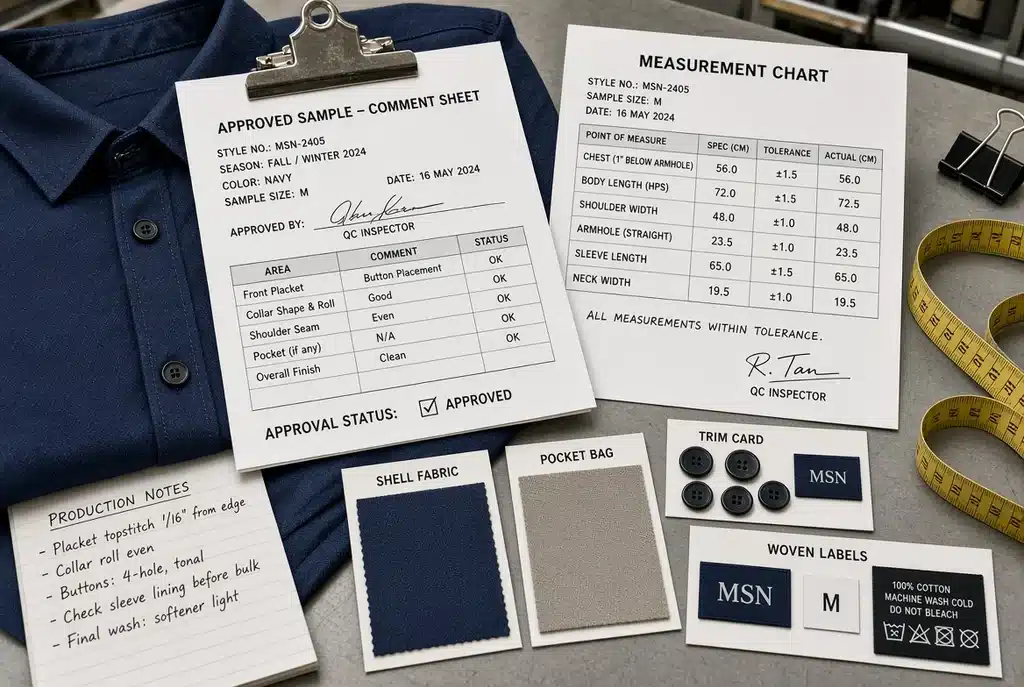
Approve design intent, measurements, fabric, colour, trims, decoration, branding, packaging and final sample if sampling is part of the process. You don’t approve of things when you don’t say anything. Attach written approval to a named sample and named document version.
Write an acceptance if you take a substitute (different rib, different zipper, adjusted length). When bulk is checked 6 weeks later, verbal comments of “looks fine” will not be seen.
What the Manufacturer Should Clarify
The factory should determine what information is missing, conflicting pages, material substitutions, construction risks and the costs and timelines associated with the information that is missing. The process of changing a defining feature in a factory should be made public. Inquire for a confirmation in writing for any proposed change before it gets to cutting.
Questions are answered in the development, indicating that the specification is being read. The word “delays” does not apply to them.
What the Approved Sample Cannot Replace
A sample illustrates one physical result in one size, typically in one color. It might not fully reflect the actual size run, all the colours, carton marks or material specification for repeat orders. The grading, inspection requirements and change control are still a part of the production documents.
Refer to the sample for confirmation of the product. Repeat using written record.
Summary Guidance – Match the Documentation Level to the Production Risk
A tech pack isn’t required for every order of private label clothing. Production information is required and must be clearly defined, measurable and approved for every order.
A running style using stock materials and simple branding can run on a structured product brief and manufacturer’s specification – artwork and packing in writing. If this is a new design, custom fit, complex construction, multiple sizes, multi-factory quoting or repeat program, there is a distinct advantage to a complete pack which is updated post sample approval.
Determine whether it’s a project type of “running style customization” or “new product development”. Create the paper that corresponds to that risk. Once accepted, the production record will be frozen and when you quote, sew, inspect and replenish, you are all quoting the same garment.