
There is no universal custom hoodie MOQ. Minimum order quantity is the smallest run a manufacturer can take for a defined product, and that number moves with fabric availability, color count, size breakdown, construction, printing or embroidery, labels, packaging, sampling, and how the factory plans the line.
A request for “100 custom hoodies” is not one job. One hundred pieces in a single black pullover, cut from stock fleece, is a different order from 100 pieces split across five colors, three fits, and embroidery. The lowest quantity you can place is also not always the cheapest per piece. Pattern work, fabric setup, cutting preparation, and decoration are spread across fewer garments, so the unit cost often rises even when the piece count falls.
What Does MOQ Mean in Custom Hoodie Manufacturing?
In apparel, hoodie minimum order quantity is rarely one figure that covers every job on the floor. A factory may set a minimum per style, per color, per fabric, or per production run. Some also keep a separate floor for decoration, woven labels, or custom packaging. Those numbers are related, but they are not the same thing.
A useful quote separates them:
- Style MOQ: the smallest quantity for one design, with its own pattern, construction, and sample path.
- Color MOQ: the smallest quantity in one colorway, which often tracks fabric purchasing or dyeing.
- Fabric MOQ: the smallest cloth purchase the mill or stock house will release for that composition, weight, and color.
- Total order quantity: every piece on the purchase order, across styles and colors.
- Size breakdown: how that total is split from XS to XXL, or whatever range you sell.
- Decoration or packaging minimums: setup or component quantities for print, embroidery, labels, hangtags, polybags, or cartons.
If those lines are collapsed into one number, you cannot tell whether the limit is the fleece, the color, the sewing line, or a hangtag supplier.
MOQ Is Not Always the Same as the Number on a Factory Page
A published minimum is often a starting point for a simple product, not a promise for every tech pack. The figure you see on a page may assume one style, one color, an available fabric, and standard packing. Change the fleece, add contrast panels, or split the order across colorways, and the working minimum can move.
Ask what the number applies to before you build a line sheet around it. “100 pieces” might mean 100 pieces of one style in one color. It does not automatically mean 20 pieces each across five colors. Those five colorways can each need their own fabric lot, shade approval, marker, and cutting bundle. The sewing room may still see 100 hoodies. The fabric room sees five small lots.
Low MOQ and Low Unit Cost Are Different Goals
A smaller run can be the right commercial decision. It can also be an expensive one per piece. Pattern development, marker making, fabric setup, decoration setup, and packing instructions do not shrink in proportion to the order. Spread across 80 hoodies, they weigh more on the unit price than they do across 800.
That does not mean a larger order is always better. A bigger buy improves unit economics only if you can sell the goods. Cash tied up in unsold fleece is not a saving. The practical choice sits between inventory risk, demand confidence, and what the factory needs to cut and sew the style cleanly.
The Main Factors That Determine Custom Hoodie MOQ
Custom hoodie production minimums come from materials, construction, decoration, and how the order is planned, not from a single policy line. A manufacturer developing the body, the fleece, the branding, and the bulk run needs those inputs before a minimum means anything. Teams comparing custom hoodie manufacturing should expect the conversation to start with the product, not with a number copied from another brand’s order.

| MOQ factor | Why it matters | What the buyer should clarify |
| Fabric availability | Stock cloth is often easier to release than a custom dye or a new knit | Composition, GSM, color, stock status, fabric minimum |
| Color count | Each color can create a separate fabric or dyeing requirement | Number of colors and quantity per color |
| Size breakdown | Very small quantities across many sizes are hard to balance in cutting | Size range and expected size ratio |
| Construction | Extra panels, special trims, or hardware add setup and handling | Technical flat and construction details |
| Decoration | Print and embroidery bring setup, digitizing, or placement checks | Method, artwork, location, and quantity |
| Labels and packaging | Branding components can carry their own order quantities | Label, hangtag, polybag, carton, and packing needs |
| Repeat production | Approved fabric and patterns can simplify the next run | Whether the style is new, a repeat, or a revision |
None of these rows has a fixed piece count. They are the questions that turn a vague minimum into a quote you can plan against.
Fabric and Color Requirements
Fabric is often the first constraint, because the mill or the stock house sells cloth by the lot, not by the hoodie. An available 320 GSM black fleece may be cut for a modest first run if the width, shade, and hand feel already match the sample. The same body in five custom colors can need five dye lots, five shade approvals, and five cutting markers.
Stock fabric does not always mean a lower minimum. A popular black may be reserved for larger programs, while a quieter heather is sitting in a quantity that fits a trial. Custom dyeing, a special brush, or a GSM the mill does not run every week usually asks for more meters, because the machine setup is the same whether you take a short piece or a full lot. Confirm the actual cloth requirement for the quality you want. Do not inherit it from a different fabric.
Style Complexity and Construction
Construction changes setup even when the fabric is easy. A plain pullover with a kangaroo pocket, rib cuff, and a single needle coverstitch is a known sequence. An engineered hoodie with a split hood, half-zip, panelled sleeves, metal eyelets, and a contrast drawcord is more markers, more bundles, and more chances for a shade or a trim to hold the line.
Oversized proportions do not automatically raise the piece minimum, but they do change marker yield and fabric consumption. A lined hood uses a second material. A special pocket bag, a heavy zipper, or a woven tape that is not in stock can carry its own purchasing floor. Treat two hoodies as the same job only when the panel count, trims, and stitch plan are actually the same.
Decoration, Labels and Packaging
A chest print or a small embroidery does not always change the garment minimum. It does add work the line has to absorb. Screen printing needs screens and a strike-off. Embroidery needs a digitized file, a stabilizer choice, and a placement check on the real fleece. Multiple locations multiply that setup.
Branding components sit beside the garment order. A woven main label, a printed care label, a hangtag, a custom polybag, and a carton mark can each have a supplier minimum that is larger than the hoodie run. On a small order with embroidery, labels, hangtags, and custom packaging, the garment quantity may be acceptable while one of those components is not. Ask which minimum belongs to the body and which belongs to the trim.
How Fabric Purchasing Affects Hoodie MOQ
The factory often cannot cut what it cannot buy in a releasable quantity. Composition, GSM, knit structure, color, hand feel, width, and finish all sit inside that purchasing decision. Fabric sourcing for custom hoodies should be settled before a quantity is treated as final, because a fleece that looks right in a photo may not be available at the meters your order needs.
A mill minimum is not a factory slogan. It is the amount of cloth that makes a dye lot, a knit run, or a stock release workable. Width matters: a narrow fleece wastes more on an oversized body. Finish matters: a peach, a brush, or an anti-pill treatment can be a separate pass. The manufacturer has to confirm the requirement for the cloth you actually approve. A number borrowed from another program is only a guess.
Stock Fabric Versus Custom Fabric Development
Selecting an available fabric and developing a new one are different timelines and different commitments. Stock fleece, already knitted and dyed, can sometimes be reserved in the quantity on hand. You are limited to the colors and weights that exist, and the hand feel is what the roll is, not what the mood board hoped for.
Custom development covers a new color, a changed GSM, or a construction the mill does not keep ready. That path can be the right one for a brand that needs a specific weight or a shade no stock book carries. It usually asks for more planning and a larger material commitment, because the machine is set up for your lot. Custom cloth is not a requirement for a better hoodie. Plenty of strong programs are built on a well-chosen stock fleece, with the design sitting in the fit, the rib, and the branding.
Why Too Many Colors Can Raise the Practical Minimum
Color count is where many first orders quietly double their difficulty. Two hundred pieces in one black is one fabric preparation, one shade approval, and one cutting plan. Two hundred pieces across four colors is four smaller runs. Each color may need its own lot, its own approval, and its own marker. The sewing total has not changed. The preparation has.
A total of 160 pieces divided among four colors is four color runs of about 40, not one run of 160. If the fabric minimum sits above each of those color quantities, the practical order is the fabric floor multiplied by the colors, not the number you wrote on the purchase order. Ask whether the quoted minimum is per style, per color, or across the whole order. The answer changes how you build the colorway list.
How Size Breakdowns and Colorways Change the Order
Factories cannot plan from a total alone. A quantity has to become a style, a color, a size, and sometimes a decoration combination. Until that grid exists, a minimum is a placeholder.
Total Quantity Versus Quantity Per Style
Three hundred hoodies in one style is one pattern, one sample path, and one set of markers. Three hundred hoodies across three designs can be three patterns, three fits, and three material lists that happen to share a purchase order. Each style may need its own sample approval before bulk cutting starts.
Ask whether the supplier calculates the minimum per style or across the entire order. A factory that accepts 300 pieces as a program may still need 150 of each body before it will open a new pattern. If you are testing three silhouettes, say so. Hiding three styles inside one total only delays the moment the quote is rewritten.
Total Quantity Versus Quantity Per Color
The same split applies inside one style. Two hundred pieces in stone may be a clean color run. Two hundred pieces in stone, black, navy, and olive are four color stories sharing a pattern. Fabric preparation, lab dips or shade bands, and cutting all feel that split.
You do not need a universal color minimum to plan this. You need the factory’s rule for the fabric in front of you. If colors can be combined against one fabric minimum, a mixed program is easier. If each color stands alone, drop a colorway before you drop the size range.
Size Ratios Matter Too
A size range with two or three pieces in the tails is awkward in cutting. Markers are planned for a ratio. A retail curve that puts most of the buy in M and L, with a few XS and XXL, is normal. A buy that puts six pieces in every size from XS to XXL, across four colors, gives the cutting room almost nothing to nest.
There is no required ratio to copy. A brand selling mostly to one body type may keep a narrow run on purpose. Send the expected breakdown with the quote request: size range, rough ratio, and any size you already know you will not carry. A factory can then say whether that grid is workable, instead of assuming a balanced shop ratio you do not sell.
Does Customization Always Increase MOQ?
Not in a straight line. Customization adds work, but the type of customization decides whether the minimum moves. A small chest print on a body the factory already knows how to cut is a different problem from a new pattern, a custom-dyed fleece, three decorations, and a full label set.
Low-Complexity Customization
A relatively simple order looks like this: one color, a body close to an existing or readily available shape, one print placement, standard folding, and limited branding. Sampling may still be required, especially if the fit is yours rather than a borrowed block. Operationally, though, the factory is not opening a new fabric program or a new trim supply chain for every detail.
That kind of order may be simpler to schedule. It is not a guaranteed low quantity. A supplier that markets itself as a low MOQ hoodie manufacturer still has to buy cloth, set up cutting, and run the decoration. Ask what “simple” includes in their quotation, and what happens if you later add a second print location or a custom woven label.
Full Cut-and-Sew Customization
Full development starts with the pattern and the fabric, not with a blank body waiting for a graphic. The factory sources or reserves cloth, cuts a first sample, revises fit, then cuts bulk, sews, decorates, labels, inspects, and packs. That path is custom cut-and-sew hoodie production, and the custom cut and sew hoodie MOQ is really a stack of those steps, not a single sewing minimum.
A lower quantity can still be possible. The cost and the conditions will not match a repeat bulk program that already has an approved pattern, an approved fleece, and a known size ratio. The first run pays for decisions the second run inherits. If the style is new, budget for that development separately from the piece price, and ask whether those costs are inside the unit or on their own line.
Small-Batch Production and Trial Orders
A trial run is useful when you do not yet know whether the hoodie will sell, not merely when you want a smaller invoice. The point is to see fit on real customers, check that the fleece and the decoration hold up, and learn whether the colorway was the right bet before you scale.
When a Trial Order Makes Sense
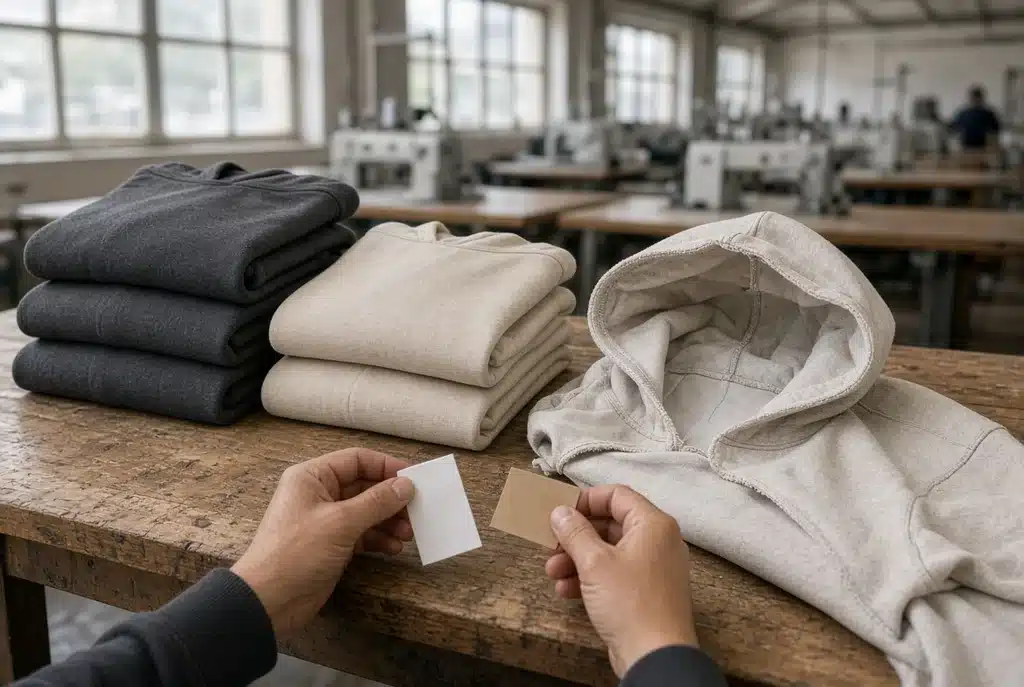
A first collection, a limited release, a seasonal capsule, or a new silhouette are the usual cases. The trial stays manageable when you hold the variation down: one body, one or two colors, a size range you can actually sell, and branding you can repeat. Adding three fits and five colors to “learn more” usually teaches you less, because each cell is too thin to read.
Startups often use small-batch clothing manufacturing to test a collection before they increase volume. Small batch custom hoodies can do that job. They are not a promise that every factory will accept a token quantity, and they do not remove a fabric minimum. Hoodie MOQ for startups is still the minimum that fits the cloth, the color, and the construction you specified.
What to Confirm Before Placing a Small Order
Before you treat a small number as agreed, confirm the edges of it:
- Whether the minimum is per style or per color.
- Whether the fabric is actually available in the quantity you need.
- Whether pattern and sampling fees sit outside the unit price.
- Whether labels, hangtags, and packaging have their own floors.
- Whether the approved fabric and construction can be repeated later without starting over.
- Whether the small-run price can be looked at again if the next order is larger.
A trial that cannot be repeated is a one-off costume. If the fleece was a leftover lot, or the pattern was cut only for that sample, the second order is a new development. Write down what is locked.
Why Low MOQ Can Mean a Higher Unit Cost
The tradeoff is arithmetic, not a sales tactic. Work that happens once per order is divided by the number of pieces. On a short run, each hoodie carries more of that work.
Fixed Costs Spread Across Fewer Garments
Pattern preparation, a marker, fabric setup, a print screen or an embroidery file, a shade approval, and a packing instruction can cost a similar amount for 50 pieces and for 500. The per-piece effect is larger on the smaller run. A factory may fold that work into the unit price, or it may show pattern, sampling, and setup as separate lines. Both can be honest. They are not comparable until you know which method the quote uses.
Ask for that split. A low piece price that excludes digitizing, screens, and labels is not lower than a higher piece price that includes them. On the next order, some of those lines may fall away if the file, the pattern, and the label are unchanged. Some will not. Screens wear. Fleece prices move. Get the assumption in writing.
Lower Inventory Risk Versus Higher Unit Economics
A startup often accepts a higher unit cost to avoid a room of unsold hoodies. That can be the correct risk. A larger order improves the unit only if sell-through is real. If the fit is unproven or the color was a guess, the cheaper piece is the more expensive mistake.
Choose from demand confidence, cash flow, and how mature the product is. A repeat of an approved style, with a known size curve, can justify a deeper buy. A first silhouette should not. Hoodie MOQ for startups is as much a cash question as a factory question: what you can afford to be wrong about, and for how long.
Questions to Ask a Hoodie Manufacturer About MOQ
A quoted minimum is only as clear as the questions behind it. MOQ depends on material coordination, schedules, approvals, production stages, and how clearly the buyer and the factory are talking. That is production planning and coordination, not a figure chosen before anyone has seen the fleece.
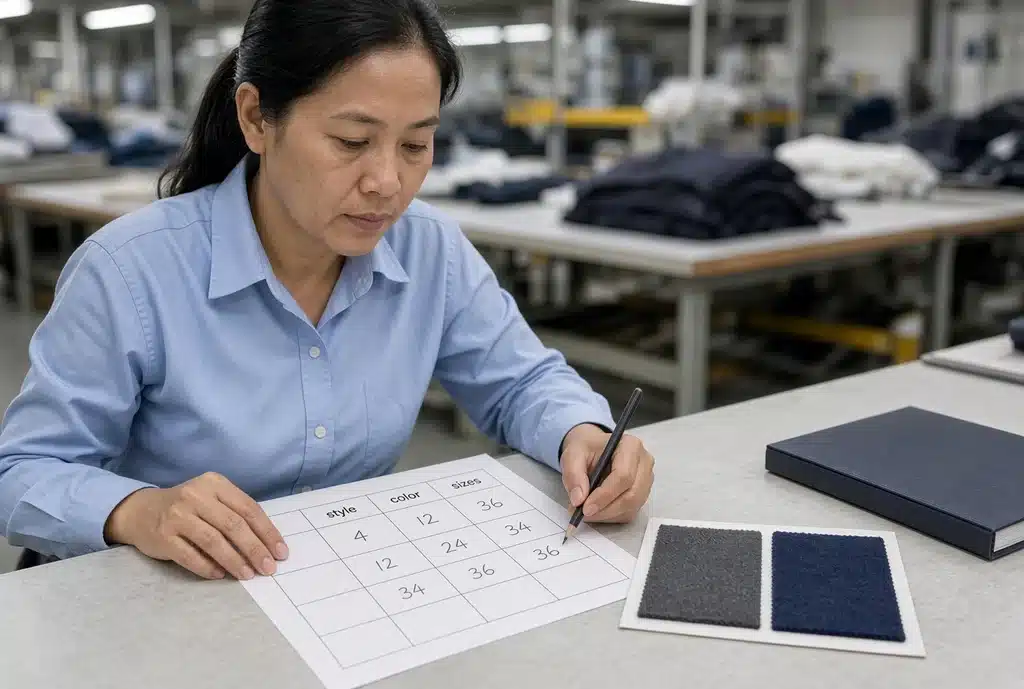
Send these with the tech pack, or ask them on the first call:
- Is the MOQ per style, per color, or on the total order?
- Does it apply to stock fabric, or only to custom-developed fabric?
- Does the requested GSM and fiber content change the minimum?
- Can different colors be combined inside one order?
- Does the size breakdown change what you can accept?
- Do printing, embroidery, labels, or packaging have separate minimums?
- Is the sample quantity included in the production quantity?
- Can the same style be repeated later on the approved fabric and pattern?
- Are pattern, sampling, and setup costs separate from the unit price?
- What do you need from us before the minimum is confirmed?
Treat three replies as warning signs. A supplier gives a number without asking about style, fabric, colors, quantity, or decoration. A supplier changes the minimum only after the tech pack arrives, with no explanation tied to cloth or construction. A quote states a minimum and never says what that minimum includes. Any of those means the number is not yet a plan.
How to Plan a Realistic First Hoodie Order
Build the order in the same order a factory has to cost it.
- Define the style and the fit: pullover or zip, regular or oversized, hood lining, pocket, rib.
- Name the fabric: composition, GSM, knit type, and color, or mark it as still open.
- Decide how many styles and colorways this order really contains.
- Draft the size breakdown you expect to sell, not a flat split across every size.
- Choose decoration, labels, trims, and packaging, and note which of those are custom.
- Say whether this is a sample, a trial run, or a repeat of an approved body.
- Ask how the minimum is calculated, and what it applies to.
- Request a quote that separates the garment, development, decoration, and packaging.
- Confirm what can be repeated if the first order sells: pattern, fabric, labels, artwork.
- Set the unit cost next to inventory and cash-flow risk before you raise the quantity to chase a price.
The minimum worth having is the one that matches this specification and this stage of the brand. A low number with no fabric, no color count, and no size grid is not an offer you can buy against.
Frequently Asked Questions
What is the usual MOQ for custom hoodies?
There is no usual industry minimum. A simple pullover in a stock color can be planned differently from a custom-dyed, multi-panel hoodie with embroidery and private packaging. The working number depends on the full specification and on that manufacturer’s fabric and production policy. Ask what the figure covers before you compare suppliers.
Is custom hoodie MOQ calculated per style or per color?
It can be either, or both. Some factories set a style minimum and a separate color minimum. Others accept a total across colors if the fabric can be combined. A purchase order of 200 pieces is not automatically one color run. Ask which rule the quote used.
Can a startup order a small batch of custom hoodies?
Often yes, if the fabric and the construction fit a short run. Small batch custom hoodies are a normal way to test a first style. Availability is not universal, and a small batch does not cancel a mill minimum or a label minimum. Confirm the cloth, the fees, and whether the same setup can be repeated.
Does fabric choice affect hoodie MOQ?
Yes. Composition, weight, color, and whether the fleece is in stock or has to be developed are common reasons a minimum changes. Stock fabric is not always the lower path. Custom dyeing or a special finish often needs more meters because the setup is shared across the lot.
Does embroidery or printing increase the MOQ?
It can add setup, and sometimes a practical minimum for the decoration itself, without changing the garment minimum. One placement on an available body is simpler than several locations, puff, or a mix of print and embroidery. Component minimums for labels and packaging can matter as much as the stitch count.
Why is the unit cost higher for a low-MOQ hoodie order?
Setup and development are divided across fewer pieces. Pattern work, markers, fabric preparation, decoration setup, and packing instructions do not fall in proportion to the quantity. A smaller order can still be the better decision if it limits unsold stock. It is rarely the cheaper decision per hoodie.
What should I ask a manufacturer before accepting its MOQ?
Ask whether the minimum is per style, per color, or on the total, whether it assumes stock or custom fabric, and whether decoration, labels, and packaging sit inside it. Ask what is excluded from the unit price, and what must be true for a repeat order to use the same pattern and cloth. A minimum you cannot attach to those answers is not ready to accept.