
What information should go on a clothing label is the set of details that still have to be readable after the hangtag is cut off: usually fiber content, country of origin, the identity of the responsible business, care instructions where the market requires them, and a size the wearer and the warehouse can find. A hangtag can carry price, story, and marketing claims. It is not a substitute for a permanent care or content label where those are required, and “100% cotton” on a swing tag is not a content label.
Treat this as a checklist for assigning each line to a permanent label or a removable piece, and for flagging what must be confirmed in each sales market. One English label does not cover every country. Some markets want specific fiber names, languages, or formats. Confirm the rules for the countries you actually sell into before the sample is cut.
Brand information versus information the market may require
Brand information is what you choose to show. Market information is what a buyer, a store associate, or a compliance check may need to find on the garment itself. Mixing the two is how a sample looks finished in the office and fails later.
For one style, write two lists. On the first, put the name, logo, and any story line you want on the garment. On the second, put fiber content, country of origin, maker or responsible-business identity, care instructions, and size. Then ask a blunt question: after the hangtag is gone, which of those second-list details can still be found? If the answer is “only on the tag we approved,” the permanent set is not done.
A high-level reminder is enough to start that list, and it is not legal advice. In the United States, most textile apparel needs fiber content, country of origin, and the identity of the responsible business, plus a permanent care instruction. In the EU, textile products sold to consumers generally need fiber composition using the permitted fiber names. Wording, language, and format still depend on the sales market. Confirm them with your own compliance source, then hand that approved text to the factory. Assigning those lines to real care labels and content labels is a production step, not a substitute for that check.
What the brand wants to show
A brand label usually carries the name and logo, and sometimes the size. That is a commercial choice. It tells the wearer who made the collection in the brand sense. It does not prove the garment meets any market rule.
The common miss is treating a beautiful woven neck label as proof that the garment is labeled. The weave can be sharp, the logo can sit straight, and the care and content lines can still be missing. Approve the brand mark for what it is: identity. Do not let it stand in for fiber, origin, or care.
What a buyer or a check must be able to find
A buyer returning a shirt, a store associate checking a delivery, and a compliance review all need to find fiber, origin, maker identity, care, and size without guessing. If any of those details lives only on a hangtag, the garment fails that test even when the tag looked complete on the desk.
We see this on samples that were signed off too early. The hangtag mockup has every line. The sewn labels are blank, or they carry only the logo. Once the tag is removed for a photoshoot or a warehouse count, the care line is gone and the fiber claim has gone with it. Approve the sewn pieces, not the tag layout.
Fiber content: what it is and where it usually lives
Fiber content is the list of fibers and their percentages by weight. On the question of what information should go on a clothing label, this is usually the first line a check looks for, and it usually belongs on a fiber content label that stays with the garment. Care is often printed on the same piece. Clothing label information requirements for the exact layout, the fiber names, and which components must be named are market-specific. Confirm them before you lock artwork.
Include every component the rule in that market cares about. Shell, lining, contrast, and filling are the usual gaps. A content label that only names the outer fabric can be incomplete even when the percentage on that fabric is right.
A jacket is the shop example that catches this. Shell in cotton, lining in polyester, contrast trim in a third fiber. The content label has to reflect more than the face fabric. If the artwork says “100% cotton” because that is what the designer remembers from the swatch meeting, the lining and the trim have been left off. List each component the market rule requires, and approve the wording before sampling. Do not invent a universal percentage layout and apply it to every country.
Shell, lining, contrast, and filling
Many garments are more than one fabric. A T-shirt may be a single jersey. A hoodie may have a body, a rib, and a drawcord. A padded jacket may have a shell, a lining, and a filling. Write the components down before you write the label.
The pitfall is listing only the shell because that is the fabric on the order sheet. Ask the pattern room which pieces are a different cloth, then ask your compliance source which of those pieces must appear on the content label for each market you sell into. Approve that wording as text, not as a verbal note in a fitting.
Fiber names and language
Some markets require specific fiber names, and some require a language other than English, or an extra line beside the English. A label that reads “cotton” in one market may need a different term, or a second language, in another. Get the approved wording from your own compliance source and give that text to the factory as the copy to set.
Copying a competitor’s content label because it looks official is how wrong fiber names travel. You do not know which market that label was written for, or whether the garment behind it matches yours. Use your own composition and your own approved terms.
Country of origin and maker identity
Country of origin is where the garment was made, or where it last underwent a substantial transformation, depending on the rule that applies. Maker identity is the name or identification of the manufacturer, importer, or other responsible business. These lines often sit on the same country of origin label or content label that carries fiber, and that piece stays with the garment.
Confirm the exact format for each market. Some expect a company name. Some expect an address. Some accept an approved identification code. Do not assume a factory will supply a registration number or file one for you. Write the entity and the format your market expects, exactly as they must appear.
Origin that matches the shipment
The origin on the label should match the origin declared on shipping and customs documents. A mismatch can create problems at import even when the garment itself is fine.
The failure is a country change after the label artwork was approved. Sampling happened in one place. Bulk moved. The cartons left with the old label still sewn in. Lock the origin text to the production country you will actually ship, and reopen the artwork if that country changes.
Responsible business the market can identify
The “maker” on the label is the entity the market can hold responsible. That may be the factory, the importer, or another named business. It is not automatically the name on the neck label.
Confirm which entity your market expects, then write that name exactly as it must appear. Using a brand name that is not the legally responsible entity in that market is a quiet error. The logo can still sit on the brand label. The responsible-business line is a separate decision.
Care instructions that stay readable
Care instructions tell the wearer how to wash, dry, iron, and bleach, and they carry any warning that matters for ordinary use. They need to be permanent and readable for the life of a normal cleaning routine. They usually live on a care instructions label that stays with the garment, sometimes combined with content.
Confirm the format, the symbols, and the language for each market. Then test text size and contrast on the sewn sample, not on the PDF. A care line that disappears after the tag is cut is the retail failure this section is meant to stop. If the only wash instruction was on the hangtag, the customer who removes the tag has no care guidance left.
Wash, dry, iron, bleach, and warnings
Keep the list tied to regular care. Wash method, dry method, ironing, bleach, and any step that is not allowed. “Do not bleach” and “do not tumble dry” need to be clear if those limits apply. You do not need a lecture on symbol sets here. You need wording a wearer can read on the garment.
The pitfall is a care line that looks fine on a PDF and fails on the cloth. Type that is too small, thread that is too close in color to the label ground, or a print that breaks on a fold will not survive a store check or a first wash. Read it on the sewn label under ordinary light before you call the copy approved.
Care that matches the finish and the decoration
A garment with a print, embroidery, wash treatment, or special finish may need care wording that matches that process, not only the base fabric. Plain cotton and a heavy garment wash are not the same care story. A special print can have limits the jersey does not.
The miss is a care label written for the greige idea of the fabric. The bulk shirt has a pigment print and an enzyme wash. The label still says what a blank tee would say. Match the care text to the finish you will actually ship, and flag a wash check if the garment is washed in production.
Size and other optional marks
Size is often a commercial choice, and it is also a practical need for the warehouse, the store, and the wearer. Clothing size label information can live on the main label, a separate size label, a heat transfer, or a sticker that retail removes. The failure is a size that exists only on the hangtag. Once that tag is gone, a picker and a customer are guessing.
Other optional marks, such as style codes or batch numbers, help internal tracking. Decide which marks must stay on the garment and which can be removable. Do not treat every code as consumer information.
Size that can be found
Size should be findable without opening every polybag or pulling the garment apart. A side seam, a waistband, or a neck label are common homes. The point is not the seam. The point is that a person in a stockroom can see the size.
A size that only lives on the hangtag fails in the warehouse. Tags get removed for display, damaged in transit, or separated from the unit. The shirt is then a blank size. Put the size on a permanent clothing label or another mark that stays, and keep the hangtag size as a duplicate if you want it.
Style codes and internal marks
Style codes, color codes, and batch marks help with inventory and returns. They rarely belong on the consumer-facing brand label. A wearer does not need your ERP code at the neck.
Crowding the brand label with internal codes confuses the person wearing the shirt and makes translation harder if you later add a second language. Park internal marks on a size label, a care label, or a packing list, and keep the brand face readable.
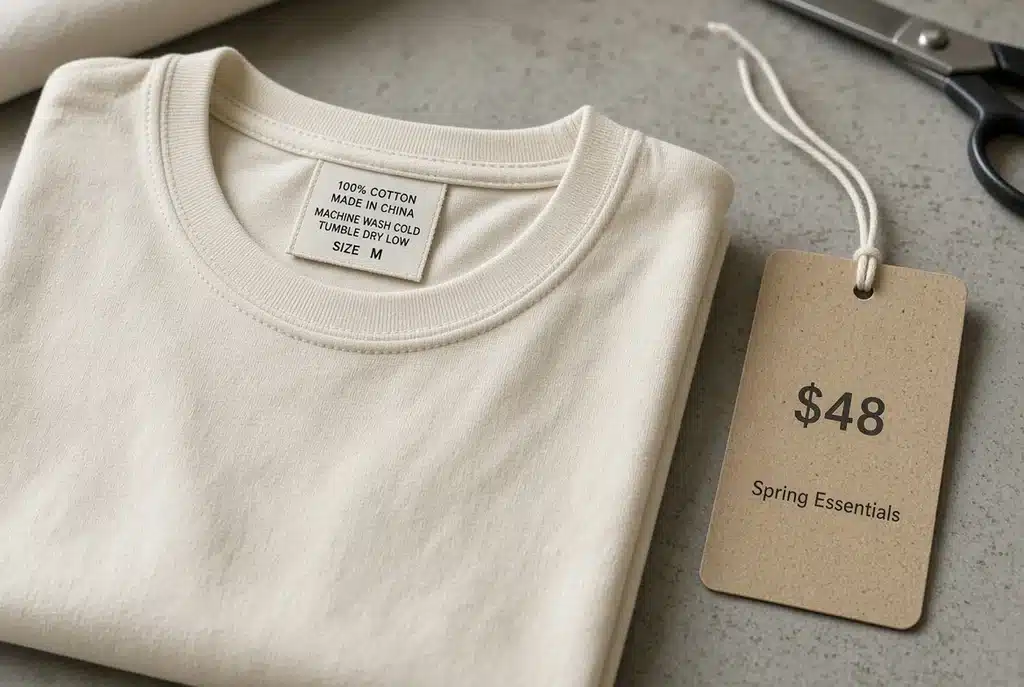
How to split information across labels and hangtags
Not every detail has to sit on one label. A brand label can carry the name and the size. A separate content or care label can carry fiber, origin, maker identity, and care. A hangtag can carry price, story, and claims that do not need to stay. Assign each detail to a permanent or removable home, then confirm the permanent set for each market.
The hangtag vs clothing label split is the decision, not a design preference. Permanent information has to survive tag removal. Removable information can support the sale and then leave.
If the style is for children, comfort and marking rules can differ from adult apparel, and the same information still has to be assigned before sampling. Brief that separately under children’s clothing manufacturing rather than copying an adult label set and hoping the rules match. That is a category check, not a certification.
One label that does two jobs
One label can carry content and care, or brand and size, if the text stays readable and the label still fits the sewing position. For a small brand that does not want four attachments on one T-shirt, a combination label is often the right set.
The limit is length and stiffness. Stacking every job onto one neck label makes it too long, too stiff, or impossible to translate without remaking the brand label. If a second language will not fit, split the jobs. Do not shrink the type until the care line cannot be read.
What belongs on the hangtag, not on the permanent label
Price, collection story, and marketing claims usually belong on the hangtag. They can support the sale. They should not replace permanent information.
The pitfall is putting the only fiber or care line on the hangtag and leaving the sewn label blank. The presentation looks complete in a lookbook. It is incomplete the moment the tag is removed. Keep claims on the tag. Keep fiber, origin, maker identity, and care on a label that stays.
Check the information on the sample, not only on the file
A complete information set names the details that must stay on the garment, the labels that carry them, the languages and formats for each market, and the placement so the text can be found. It is still unproven until it is read on the sewn sample.
Use a short brief before you call the set ready:
- Fiber, origin, maker identity, care, and size are assigned to permanent labels.
- Hangtag copy is separated from those lines.
- Languages and formats are confirmed for each market you sell into.
- Text size and contrast are checked on the sewn label, not only on the PDF.
- A wash check is flagged if the garment is washed or has a finish that can affect the label.
Approving the PDF because the wording looks complete, then rejecting the sewn sample, is the usual ending. The care text is unreadable, the origin is missing, or the size cannot be found. The information set is not finished at the file. Label text is one of the things reviewed with materials, measurements, workmanship, and packing under garment quality control. Read the label in that same pass.
What to send with the tech pack
Send the approved fiber, origin, maker identity, care, and size text in an editable file. Name the label each line belongs to. Name the languages and formats for each market. Note if the text changes by style or size. A photo of a reference label is useful only if the email says which details to copy and which to ignore.
Five files named “final,” with no market named and no label assignment, will be interpreted differently by everyone who opens them. One file, one assignment, one market list. That is the brief a sample room can sew.