
A realistic MOQ for custom T-shirt manufacturing is not a single number you can copy from one supplier page to the next. It is the smallest quantity that lets the fabric, colors, construction, decoration, labels, and packing you specified be produced without an impractical setup for the factory or for the brand. That quantity may sit on the style, the color, or the whole order, depending on how the shirt is made.
An advertised minimum often covers a simple printed blank. A fully custom tee—custom fabric, several colors, graded sizes, woven labels, embroidery, retail packing—is a different job, so the workable quantity is different too. Ask for the minimum by style, color, fabric, and decoration, not only by the total on the order.
What MOQ Means in Custom T-Shirt Manufacturing
MOQ means minimum order quantity: the smallest amount a manufacturer is willing, or able, to accept under a stated production setup. It is not only a sales rule. Fabric buying, dyeing, marker making, sewing-line balance, decoration setup, label production, and packing all have a point below which the job stops making sense on the floor.
A custom T-shirt MOQ should always be read against that setup. Change the fabric, add a color, or move from a stock blank to a cut-and-sew body, and the number that was workable last month may no longer apply. Treat any figure you hear as tied to the brief in front of the factory, not as a standing policy for every tee the brand might launch later.
MOQ per Style, Color, or Total Order
Three orders can all say “300 pieces” and still be three different jobs.
Three hundred units of one style in one color is one fabric allocation, one shade approval, one marker family, and one decoration setup. Three hundred units of the same style split across four colors is four fabric lots, four shade checks, and four cutting plans, even if the pattern does not change. Three hundred units across three styles is three patterns, three sets of operation sheets, and three labeling plans. The purchase-order total looks identical. The planning load does not.
This is why a custom T-shirt MOQ per color is often the number that actually governs the order. A factory may accept a combined total and still need a floor under each color, because dye lots, roll ends, and shade bands do not combine just because the styles share a sketch. Ask which unit the quoted minimum uses: style, color, fabric, or the whole order.
MOQ for Blanks, Private Label, and Cut-and-Sew
The production route decides what the minimum is measuring.
A blank already exists. The conversation is about available stock, decoration setup, and how the goods will be packed. Private label may start from a stock body and then add a neck label, a care label, a hangtag, or a custom pack. Those trims can carry their own quantity needs even when the shirt itself is already knitted. Cut-and-sew starts from fabric and a pattern. Nothing is in a warehouse yet, so fabric purchasing, cutting, sewing, and inspection all sit inside the minimum.
Before you compare two quotes, ask which route the number belongs to. A minimum written for a printed blank does not answer a cut-and-sew question.
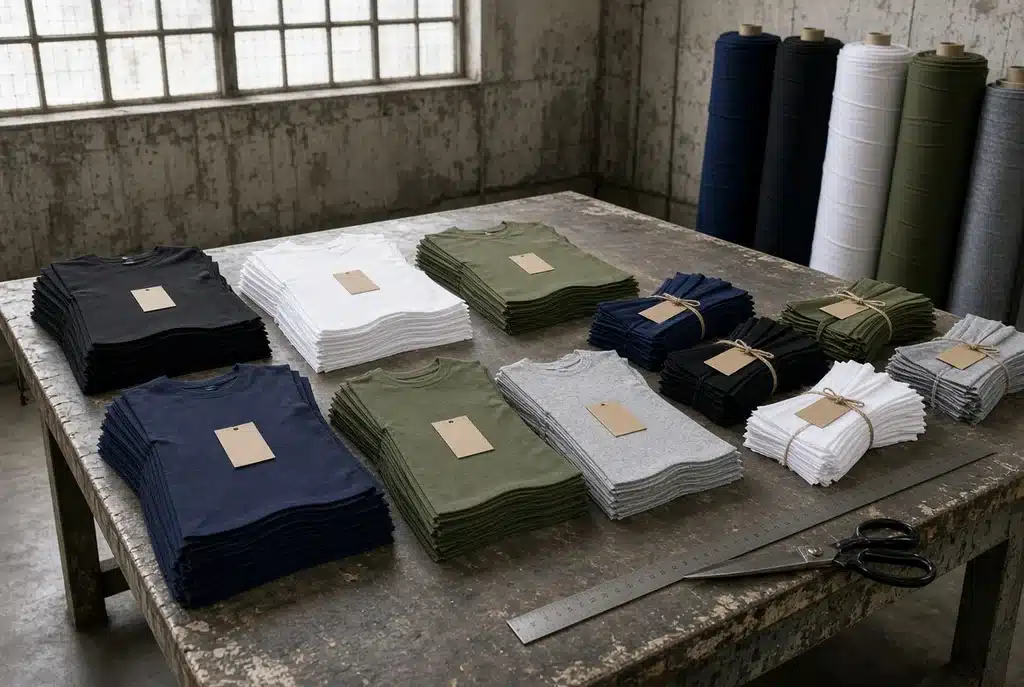
Why a Realistic MOQ for Custom T-Shirt Manufacturing Changes by Project
The workable quantity moves because the inputs move. A stock 180 GSM cotton jersey in black is not the same buying problem as a custom-dyed or enzyme-washed fabric. One chest print is not the same setup as a print, a sleeve hit, and an embroidered neck label. The sections below are the constraints that usually change the number.
Fabric Minimums and Material Availability
Stock fabric is the easier case. A mill or a fabric supplier may already hold rolls of a common cotton jersey, a cotton-polyester blend, or a standard weight. The factory can often buy closer to the garment quantity, with some allowance for cutting waste, shade matching, and replacement of damaged panels.
Custom-dyed cloth, a special finish, an unusual GSM, or a knit the mill does not run every week is a different purchase. The mill may sell by roll, by dye lot, or by a minimum it sets for that construction. Fiber, knit structure, weight, width, color, and finish all sit in that decision. Mills do not share one universal fabric minimum, so do not assume the figure from one program applies to the next.
Ask whether the quoted shirt uses stock fabric or fabric that still has to be developed or dyed. If the hand feel you want only exists as a custom lot, the garment quantity cannot fall below what that lot can sensibly become after waste.
Colorways and Dyeing Requirements
One style in one color is the simplest fabric plan. The same style in four colors means four allocations. Each color can need its own lab dip or shade approval, its own inspection for barre and stains, and its own cutting stack so a navy body does not leave the table with a black sleeve.
A brand should ask whether colors can be combined for fabric purchasing or whether each color stands alone. Combining is sometimes possible on a stock greige that is dyed to order. It is less likely when each color is a separate finished fabric already on a shelf, or when a custom dye lot cannot be split without leaving unusable remnants. “We can do 400 pieces” is incomplete until you know whether that is 400 in black or 100 in each of four colors.
Size Range and Quantity Breakdown
A total is not a cutting plan. Markers are built from the size ratio you actually order. A run of S to XXL with a sensible stack in each size can be marked efficiently. The same total spread across XS to 3XL, with only a handful of units in the ends of the range, leaves small bundles, awkward markers, and more handling for very little output.
Send the quantity by size and by color, not only the order total. A factory can often combine sizes inside one style and one color. It cannot invent a clean marker from a size curve it has not seen. If the first drop needs a wide size range for the sales channel, say so, and ask what breakdown still works before you lock the assortment.
Construction Complexity
A standard set-in or dropped-shoulder tee with a rib collar and a straight hem is a known sewing sequence. Panel work, contrast sections, a special neckline, a curved hem, a pocket, garment dye, or an unusual stitch density adds operations. More operations mean more setup, more chances for shade and panel mismatch, and a production plan that is harder to run in tiny bundles.
Construction rarely creates a minimum by itself. It raises the quantity at which the line can sew the style without constant stops. A pocket tee in one color is still simpler than a color-blocked tee in four colors with a shaped hem. Put the construction in the brief so the minimum is judged against the shirt you will actually approve.
Decoration and Branding
Screen printing, DTG, DTF, embroidery, and patches each add a setup. One chest print on one colorway is a short decoration plan. The same art on four body colors, plus a sleeve print and a back hit, multiplies screens, files, or hoop setups, and it multiplies the handling between sewing and packing.
Branding components do the same. A woven neck label, a printed care label, a hangtag, and an individual polybag or mailer can each have a preparation quantity that is separate from the shirt. A label tape ordered for 80 necks may be a poor use of the trim supplier’s setup even when the sewing line could, in theory, make the bodies.
Buyers who need fabric, fit, construction, decoration, and labels decided together—not a blank that already exists—should look at custom T-shirt manufacturing against the full specification, and ask for the minimum on that specification rather than on a generic tee.
What Is a Realistic MOQ for Different T-Shirt Production Routes?
There is no honest single figure for every route. What changes is the question you should be asking.
Printed Blank T-Shirts
Here the body already exists. The practical limit is usually available stock in the color and size you need, plus the decoration setup and the packing method. If the blank’s fit, weight, hand feel, and stitch quality already match the brand, this route keeps fabric development out of the first order.
It does not remove every constraint. A blank that is short in XL, or that only exists in a weight you do not want, is not a workable order just because a decoration minimum looks small. Confirm the blank before you treat the decoration quantity as the order quantity.
Private Label T-Shirts
Private label sits between a blank and a fully developed style. The base may be stocked, while the neck label, care label, hangtag, and pack are yours. Custom trims can carry their own minimums. If the brand also wants a custom fabric, a custom dye, or a changed construction, the job has moved out of simple relabeling and the quantity conversation should move with it.
Say which parts are stock and which parts are custom. A quoted minimum that assumes a stock body and a standard pack will not cover a custom woven label and a retail carton plan unless those items were in the brief.
Custom Cut-and-Sew T-Shirts
MOQ for cut-and-sew T-shirts covers fabric purchasing, pattern preparation, cutting, sewing, finishing, and inspection. The useful breakdown is quantity per style and per color, fabric availability, and the size ratio. Also ask whether the same fabric and trims can be bought again. A first order that uses a one-time lot is a different replenishment risk from a style built on a fabric the mill can repeat.
Custom cut-and-sew T-shirt production starts from fabric and patterns rather than from a finished blank, which is why its minimum cannot be read off a stock-tee price list. The right check is whether the quoted quantity matches that route.
How Startups Can Plan a Realistic First T-Shirt Order
A first order is a cash and inventory decision as much as a factory decision. The smallest number on a form is not always the safer one. Very small runs can raise the cost of each shirt, leave unused fabric, and still fail to show whether a size or a color actually sells.
Reduce Complexity Before Reducing Quantity
Cut the brief before you chase a lower total. One or two styles, one or two colors, and one decoration location are easier to sample, cut, and judge than six styles in four colors with embroidery and a full retail pack. A simpler specification is often more workable than the same complex shirt forced into a quantity the line cannot run cleanly.
Keep the details that define the product. If the hand feel or the logo placement cannot change, say that. Let color count, style count, or pack format be the variables. That is a production discussion, not a weaker brand.
Build a Quantity Plan by Style, Color, and Size
T-shirt order quantity planning starts with a matrix, not a single total. List each style, each color, and each size, with a unit count in every cell. Add the fabric direction, the GSM range, the decoration locations, and the label and pack plan. A factory can review that sheet. It cannot review “about 200 tees, mixed.”
[Image Placement]
Image Generation Prompt:
Realistic documentary photo of a production table in a garment development room: three T-shirt samples in different colors laid next to fabric swatches, a printed quantity matrix with style, color, and size columns, a tape measure, and bundle notes, soft natural light, no people facing camera, no prices, no promotional text.
Use two or three versions of the matrix if you are still deciding. One style in one color, the same style in three colors, and a slightly wider size run are enough for a factory to point at the variable that is setting the minimum.
Consider Test Drops and Repeat Orders
A first drop can check fit, comments from buyers, and whether a color sells. A later order can reuse the approved pattern, the size grade, and, if the fabric is still available, the same bill of materials. That repeat is often cleaner than the first run. It is not automatically a lower minimum. Fabric availability, decoration setup, and trim quantities can return with every order.
Small-batch T-shirt manufacturing is the frame for a limited first collection used to test demand before volume rises. It is not a promise that every specification can be made in a token quantity. Ask what “limited” means for your fabric and your color count.
Questions to Ask a Manufacturer About MOQ
A useful minimum survives these questions. A vague one usually does not.
- Is the minimum per style, per color, per fabric, or on the total order?
- Does it apply to blanks, private label, or custom cut-and-sew?
- Can sizes be combined inside one style and one color?
- Can colorways be combined for fabric buying or for production?
- Does the minimum include custom labels, hangtags, and packaging?
- Is the figure based on stock fabric or on fabric that still has to be dyed or developed?
- What changes if the order sits below the stated quantity?
- Can the approved style be repeated later on the same fabric and trims?
- Are sample and development quantities separate from the bulk minimum?
- Which parts of the order are fixed, and which can still be discussed?
Not every factory will accept every combination. The point of the list is to see what the number includes before you plan inventory around it.
How to Request an MOQ Review
A generic “what is your MOQ?” email gets a generic answer. Send enough of the product that merchandising can judge the job.
Product Information to Include
Include style images or a tech pack, fabric composition and GSM, intended fit, construction notes, colors, the size range, artwork, decoration method and placement, labels, packaging, an estimated quantity, and the target market. If you only have a reference photo, mark what must be copied and what is only a direction. A missing GSM or a missing size range is enough to make the reply a guess.
Quantity Scenarios to Compare
Offer two or three realistic scenarios rather than one hoped-for total. One style in one color, one style in several colors, or a test quantity with a possible repeat gives the factory a way to show which variable creates the minimum. You can then decide whether to drop a color, narrow the size run, or hold the specification and accept the quantity it needs.
Separate Confirmed Requirements from Flexible Options
State what cannot move. Fabric hand feel, a required fiber, or a logo placement may be fixed. Color count, first-order style count, and pack format may not be. That split gives the factory room to propose a workable run without quietly changing the product. It also stops a later argument about which change was optional.
MOQ Warning Signs and Misleading Minimums
Some quotes are not comparable to the shirt you want to make. These are the usual gaps.
“Low MOQ” Without a Product Definition
The phrase “low MOQ T-shirt manufacturer” shows up in searches and in sales lines. On its own it means little. A low figure for stock blanks, one print location, and bulk packing does not describe a cut-and-sew tee with custom fabric, graded sizes, woven labels, and retail packing. Ask what product the words refer to before you treat them as an offer.
One Total Number with No Per-Color or Per-Style Explanation
A total can hide the real rule. A buyer hears that 300 units are acceptable, then learns that each of four colors needs 300. The order they planned and the order the factory can cut are no longer the same order. Get the per-color and per-style reading in writing with the quote.
Minimums That Ignore Material or Decoration Setup
Fabric, dyeing, custom labels, embroidery files, screens, patches, and packaging components can each affect whether a quantity is feasible. A sewing minimum that ignores a woven label tape, or a print minimum that ignores a custom dye lot, will break once those items are added. Ask what is included in the stated minimum, and what is quoted separately.
A Practical Custom T-Shirt MOQ Checklist
Use this before you accept a number or send a first order.
- Production route: blank, private label, or cut-and-sew.
- Quantity per style.
- Quantity per color.
- Quantity by size.
- Fabric composition, knit, GSM, and whether it is available.
- Decoration method and number of locations.
- Labels, hangtags, and packaging.
- Sample and development quantities, kept separate from bulk.
- Stock fabric versus custom-dyed or special-finish fabric.
- What a later repeat depends on.
- Which of these conditions are confirmed in writing.
A realistic minimum is the quantity that matches the specification and the production setup. It is not the smallest number printed on a supplier page.