
Brands often ask how long does screen printing last, and they usually want a number. A screen print can stay intact for a long time when the ink, garment, application, curing, and care all suit the product, but there is no reliable universal count of years or washes. Failure usually comes from a mismatch between the print system and the garment, or from weak process control, not from screen printing as a category.
Durability is a system outcome. Ink, deposit, curing, fabric, artwork, placement, washing, and inspection decide whether a print cracks, peels, fades, or still looks acceptable after real wear. This guide covers those factors, the signs buyers can see, and the checks worth finishing before bulk is approved.
What Does “Screen-Print Durability” Actually Mean?
Screen-print durability is not one score. A print can fail visually, physically, or in the hand. A small chest mark on a heavyweight cotton tee and a large solid graphic on a thin jersey can age differently, even if both left the print table looking clean.
Buyers usually see cracking, peeling, or color loss. The three point to different causes. Calling every defect “bad ink” hides the garment, the artwork, and the process.
Cracking and loss of flexibility
Cracking appears when the printed layer cannot flex with the cloth. It is more common on stretched panels, large solids, and heavy ink coverage. A print can look smooth on the table and open into fine lines once the chest, sleeve, or hem is pulled in wear.
A faint crease after folding is not a network of breaks that exposes the fabric color. Note where the lines sit and whether the cloth shows through.
Peeling and weak adhesion
Peeling, or lifting at the edge, usually means weak adhesion. The film is no longer holding to the fiber. Causes include an unsuitable fabric, incomplete process control, a deposit too heavy for the cloth, or repeated stress in one spot.
Lifting shows first at sleeve edges, pocket openings, side seams, and hems. Check the edge by hand on the sample, not only under shop light.
Fading, abrasion, and color change
Fading is color loss, not a break in the film. Washing, sunlight, abrasion from a seat or bag strap, fabric-dye interaction, and the print system itself can all shift appearance. A print can fade while the film stays flexible, or crack while the color is still strong.
A darker or thicker print is not automatically longer lasting. Extra coverage can hide the garment color and also stiffen the surface. Ask what that layer costs in hand feel.
The Main Factors That Affect How Long Screen Printing Lasts
The factors affecting screen-print durability have to work together. Ink system, process control, fabric surface, and deposit all change wash and wear behavior. None is a guarantee on its own. Durable screen printing for clothing brands starts with that match, not a blanket claim.
Ink system and print construction
Ink type, opacity, deposit, layering, and finish affect flexibility, hand feel, adhesion, and wear. A thin deposit on cotton jersey will not behave like a layered print on a dark blend. Know which system is proposed for this fabric and garment color, and why it fits.
A dark shirt often needs more coverage so the body color does not show through. An underbase changes thickness and flexibility. The useful question is whether the construction still flexes where the garment will stretch.
Curing and process control
The print has to be processed in line with the chosen ink and production system. Incomplete or inconsistent curing can weaken adhesion and wash performance even when the fresh print looks correct. A dry feel is not proof the process was held on every piece.
Do not treat one temperature or time as a universal rule. Inks and fabrics are processed differently, and a number from a general guide can be wrong for this order. Ask how consistency is checked, and how the approved result is verified before bulk printing starts.
Fabric composition and surface
Screen printing on cotton and blends is not one job. Cotton, blends, stretch fabrics, fleece, smooth synthetics, and brushed surfaces differ in absorption, texture, and recovery. A result on one cotton jersey should not be assumed on a blend or brushed fleece.
Fleece and French terry shift coverage and hand feel even when the artwork does not. If the bulk body is not the test fabric, the test is about a different product.
Print thickness and coverage
A large, opaque, layered print asks more of flexibility and hand feel than a small logo. Deposit helps when the garment color would otherwise show through. It becomes a problem when the film is too heavy to follow the cloth.
A large solid back print on a lightweight tee moves every time the wearer sits or reaches. A small chest mark on heavier cotton has less film and less stretch. Set coverage for this artwork and this cloth.
How Artwork and Print Placement Affect Durability
Artwork decides how much film sits on the cloth. Placement decides how often that film is pulled, folded, or rubbed.
Large solid graphics versus fine artwork
Large solids and stacked layers hold more ink and leave fewer gaps where the fabric can move. Fine lines can look sharp on day one and still fail on a seam or a stretch panel.
Ask where the graphic must stretch, fold, or flex. A back print across the shoulder blades moves every time the wearer reaches. A small chest mark usually does not. A solid field on a light base fabric is a durability decision, not only a visual one.
High-stress placement areas
The same print can last differently by placement. Look twice at seams, pocket openings, sleeve hems, waist and hem areas, elbows, and any panel rubbed repeatedly, such as a lower back print against a seat.
A chest logo and a sleeve print are not the same wear test. If the graphic belongs on a pocket or across a side seam, print the sample there.
Stretch and fitted garments
Fitted and stretch garments strain the print. A mark that looks sound on a relaxed cotton tee may need a different deposit or placement on elastic or performance fabric. If the film does not return with the cloth, fine cracks follow.
Test in a way that matches the product. On a fitted tee, wear the sample or gently stretch the printed area. On a fleece hoodie, check the print after the sleeve is bent, not only while the garment lies flat.
Washing and Garment Care Affect Print Life
Care can speed fading, cracking, peeling, and surface wear. It does not replace a sound process, and it does not explain every early failure. Screen-print wash durability is this interaction, not a single cycle count.
Washing conditions
Water temperature, cycle intensity, detergent, friction, and drying all touch the printed surface. A hot, long cycle is a different test from a short, cool wash.
Do not issue one care label for every printed style unless it has been checked on that garment and print system. A heavyweight cotton logo tee and a stretch blend with a large back print do not share the same risk.
Drying, heat, and sunlight
Heat and long exposure can affect some prints and some fabrics. High dryer heat, sun on a retail table, and pressing during finishing are different events. General guidance is not a verified instruction for this garment.
Labels should follow the approved garment and print process. If the test used a cool wash and low heat, the label should not imply that any home cycle is fine. If customers will tumble dry, include that step in the sample test.
Care instructions for customers
Brands asking how to make screen printing last longer get more from garment-specific screen-printing care instructions than from a thicker film. Washing cool, turning the shirt inside out, and air drying can reduce friction and heat. Those steps lower risk. They do not guarantee a lifespan.
Put the instruction in plain language on the label and the product page. If the print sits on a stretch panel or a high-rub placement, the customer copy should match that product.
How to Test Screen-Print Durability Before Bulk Production
A useful test uses the intended garment, artwork, color, print size, placement, and production method. A stand-in tee in another fabric, or a reduced chest logo when bulk will carry a full back graphic, does not answer the question. You need this print on this product.

Inspect the print before testing
Check the fresh sample before any wash or wear trial. Record coverage, color, surface uniformity, edge definition, registration, hand feel, print thickness, and edge adhesion near seams or high-stress areas.
Photograph the print flat and, if you can, on the body or a form. Note the fabric, garment color, and whether an underbase was used.
Use a reasonable care or wear test
Agree a practical care or wear test that reflects how the garment will be used and washed. Write down the garment, the wash, the drying, and what you looked at afterward.
Do not copy a wash-cycle number from another brand or a general article. A streetwear fleece and a lightweight summer tee do not need the same trial. The test is useful when it matches the product.
Compare after-test appearance with the approved sample
After the test, compare cracking, peeling, color change, edge lifting, surface feel, and overall appearance with the original sample. Record screen printing cracking and peeling as separate findings, and write down what change is acceptable before bulk.
That decision should be tied to the actual piece. Once garment, artwork, placement, and print system are the ones you intend to run, durability planning sits inside the wider job of garment printing durability requirements: fabric match, placement, samples, and bulk application, not a print life considered on its own.
Common Reasons Screen Prints Fail Too Early
Early failure is often a preventable mismatch.
Printing on an unsuitable fabric. A cotton-jersey trial can lose adhesion on a smooth synthetic or brushed fleece. Retest if the bulk cloth changes.
Excessive coverage. Heavy deposit can hide the shirt color and still crack across the shoulders. Ask whether coverage can come down without losing the approved look.
Inconsistent curing. The sample looks dry, then lifts after a normal wash. Ask how the approved process is held in bulk.
A print across a seam or stretch panel that was never tested in that position. Move the art, or print the sample exactly where bulk will sit.
A sample approved on the wrong garment color, so a dark body that needs more coverage was never represented. Match the bulk color before you lock the print.
A late change of fabric, ink, or underbase. Treat it as a new approval, because the signed piece no longer represents the run.
Artwork that quietly needs an underbase. Review the separated art, not only the flat preview, or the dark body will show through or the film will be heavier than expected.
A wash test harsher than the care label you will use. Match the trial to the instruction customers will actually see.
No comparison of bulk coverage, edges, and hand feel with the signed sample. Check those points before the order is released.
A claim that the print “lasts a long time,” with no fabric, art, placement, or care attached. Ask for the test on this garment.
How Clothing Brands Should Discuss Durability With a Supplier
A short question list is more useful than a request for a promise. Ask:
- Which print system is proposed for this fabric and this garment color?
- How will the print be checked before bulk production?
- Which parts of the artwork may affect flexibility or coverage?
- Does the print need an underbase?
- How will high-stress placements be handled?
- Which sample represents the intended bulk garment?
- What care instructions fit this specific garment?
- How will print appearance be compared during production?
- What happens if the bulk print differs from the approved sample?
“The print will last a long time” is not an answer. It skips the garment, the artwork, the process, the care, and the sample standard.
For t-shirts, how long does screen printing last on t-shirts still depends on jersey weight, print size, and whether the graphic sits on a stretch panel. A small chest print on heavyweight cotton is a different discussion from a full-back solid on a light retail tee.
Sample Approval and Production Inspection
The approved sample should be the visual and physical reference for bulk. Lock artwork, print dimensions, placement, color, opacity, hand feel, surface appearance, fabric, and garment color. Care instructions and the acceptance notes from testing belong in the same file.
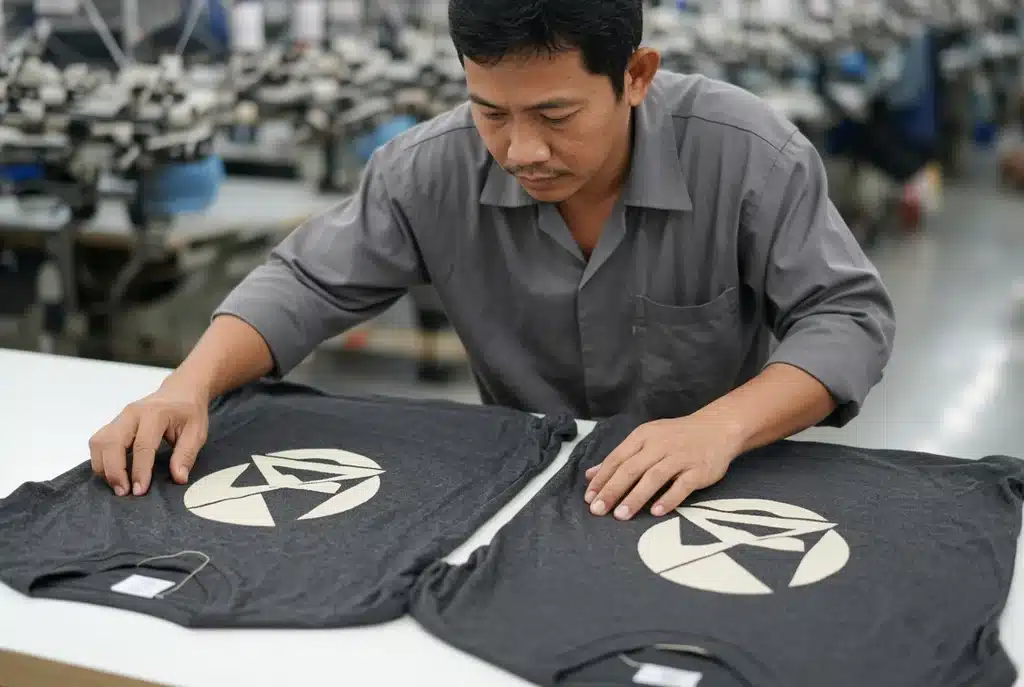
In-line and final checks should cover appearance, placement, coverage, early signs of weak adhesion, and piece-to-piece consistency. Heavier coverage, a rough edge, or a stiffer hand than the signed piece is a production difference, not a new creative choice.
That comparison is part of garment print quality control: materials, the approved sample, workmanship, appearance, labeling, and packing. Screen-printing quality control fails the buyer if bulk does not match the piece that was tested, even when the ink choice was sound.
What Is a Realistic Durability Expectation?
Judge the print against expected use, fabric, artwork, placement, care instructions, and the approved sample. A well-made print can remain visually acceptable for a long time. It is still exposed to abrasion, harsh care, stretching, and any mismatch in application. No process is immune to those conditions.
Compare the print with the garment itself. The useful question is not how many washes it will survive. It is which production and care conditions will keep this print acceptable on this garment. The sample, the test notes, and the bulk comparison are what make that question manageable.