
Brands seeking an answer to how to minimise sample revisions without sacrificing garment fit should seek to reduce not just the number of fit decisions, but the number of avoidable fit decisions. Assign each physical sample one task, secure input parameters that must have been determined and then return one round of documented feedback after each review. A hood should be re-molded if the shoulder slope, shouldering open or sleeve balance is truly incorrect. It shall not be remade as the tech pack did not contain chest width, GSM of fleece, rib width, draw cord route or position of print.
The pattern and sewing judgment can be provided by an experienced factory. It can’t still create a missing base size, a measurement that it did not state, or an unstated fabric. Increasing the number of samples does not necessarily result in a better fit. Ambiguities are frequently repeated in uncontrolled rounds, either with new comments or with a different version of the document or new fabric. The real question of control is easier: every revision should be traceable back to a technical decision.
Understand Why Garment Sample Revisions Happen
Not all additional samples are considered waste sample. Some of the changes reveal a true fit or manufacturing hazard. Others just exist due to incomplete briefs, fragmented feedback or a change in team and product during the round. Before asking the sample room to cut again, make sure to separate those two cases.
Product Development Revisions vs Preventable Rework
Problems are solved by a productive revision. This could involve rectifying the shoulder balance on a large t-shirt, refitting a hoodie hood, pulling up a t-shirt for greater shoulder square, modifying a seam that is not easy to cut cleanly, addressing any shrinkage following washing, or other such alterations. Those rounds serve to safeguard the product.
Preventable rework is not the same. It begins when the factory operates on general terms, without points of measure, on materials that are not approved, or using an old file. The right goal is not to put all styles into one sample. The correct objective is to minimize uncertainty prior to the manufacture of the next garment.
The Most Common Causes of Extra Sample Rounds
Most of the extra rounds are from the same gaps. Tech pack is incompatible with reference photo. There is inspiration shown but no measurements. There is no “base size” specified. This is referred to as the “relaxed,” “oversized,” or “premium” fit, rather than a measurable fit. Absent: Fabric composition, GSM, handfeel. Construction callouts are subject to interpretation. Artwork is not supplied with placement dimensions. Labels and packing are not part of the sampling process. Comments can be found on email, chat and marked photos. The status of approval is never recorded.
It is thus applied to tops and bottoms alike. There are no specifications for the size of a polo; it can be collar height or placket length. The team was fine with a look, not a measurement chart, and a trouser can bounce back and forth between rise and thigh ease.
Why Fabric Can Change the Fit You Thought You Approved
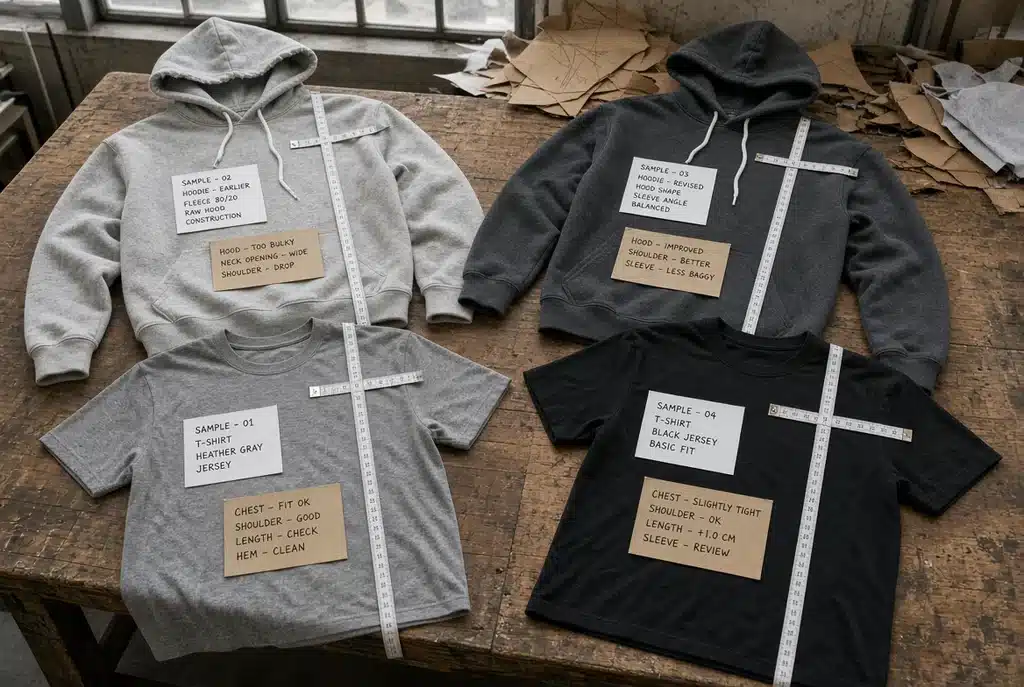
Garment fit is a pattern problem, too! A heavier jersey can help change the look of an oversized tee. Weak ribs can cause a hoodie hem or cuff to collapse. A stretch woven fabric can provide some ease which a traditional Chinese was lacking in the initial specification. Sometimes a garment wash will alter length, twist, shade and handfeel after you’ve liked the dry sample.
Sometimes it’s necessary to approve fit in substitute material. Use this sample as a limited evidence. Fabric, even if it is the final or approved-representative fabric, must be reviewed before bulk.
Build a Better Brief Before the First Sample Is Made
The best way to minimize the number of apparel sample revisions is to send a brief to the factory that is ready to make. It doesn’t require a costly software. It does require sufficient information for the pattern maker, sourcing team, and the sample room to have a standard.
Define the Garment’s Intended Fit and Base Size
Before sampling, specify the category, customer, silhouette and size of the base. Include a body/garment reference if available. Next explain how the garment should fit and be worn.
There is no spec for oversized. Convert into chest width, shoulder drop, body length, sleeve shape, neck opening and hem behavior. Rise, thigh ease, taper and leg opening should be “Relaxed Chino”. Use of fit language can assist the brief. It cannot take the place of measurable points of measure.
Include Technical Flats, Measurement Specs, and Tolerances
A first sample is only useful if the team has a chart that they agree on and can compare it to. Use front and back flats, names of points of measure, target dimensions, condition of the garment, measurement method and tolerances.
If these details are not provided, then the length of the chest, sleeve and body is taken from different points. The sample will then look “wrong” even if the factory has been only told one thing. The first spec may be changed subsequent to the fit sample. It still needs to be created prior to sample work. A full tech pack — for less sample revisions — is not about pretty pages, but rather one measurement language.
Clarify Fabric, Trims, Construction, and Branding Inputs
State what is agreed, what is not agreed. Cover composition, construction, GSM, handfeel, color direction, stretch, finish, lining, rib, labels, hardware, artwork method, artwork placement and packing.
Black cotton hoodie is not sufficient. There is still a need for sample room parameters like fleece type, GSM target, rib behavior, hood construction, pocket details, drawcord route, eyelet, label, and print instructions. Unresolved inputs are OK if they can be seen as development decisions. Extra samples are hidden gaps.

Give Each Sample Stage One Job
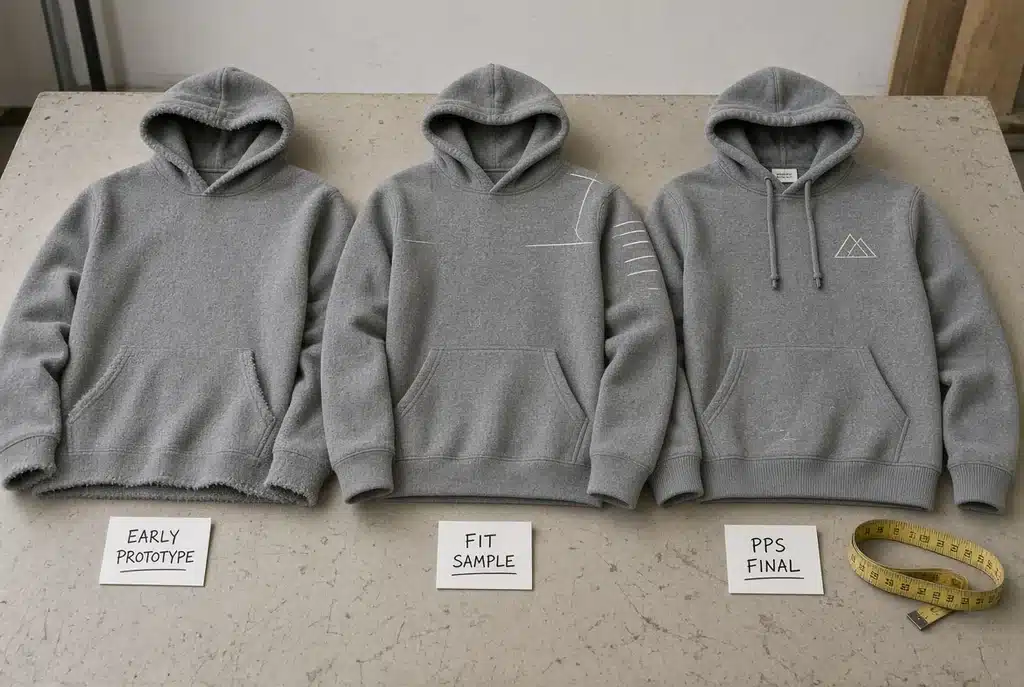
Each step of an apparel sampling process is successful if it answers a question. A first prototype is required to make a concept concession, fit, fabric, color, wash, decoration, labels, and packing, wasting time.
Prototype Sample: Test Concept and Construction
The prototype verifies silhouette, main panels, machinability, pockets, hoods, collars, plackets and closures, as well as product direction. May utilize available or alternate material. The limits must be recorded on the sample record.
Never lock bulk fabrics handfeel, shrinkage, color, or retail packaging with a proto. The following are questions that can be answered later.
Fit Sample: Lock Measurements, Proportion, and Wearability
The fit sample should be based on the base size block, points of measure, balance, movement, ease and comfort. Look for chest and shoulder on a T-shirt. Check the balance of a hoodie on hood and sleeve. Inspect collar and placket on a polo shirt. Look for a rise and thigh on trousers.
Sample fit for clothing manufacturers needs to be measured, aggregated and added to the current specification. If aesthetic opinions aren’t connected, it’s not a fit review.
PPS: Confirm the Final Bulk Combination
The pre-production sample verifies final or approved-representative fabric, colour, trims, construction, decoration, wash or finish, labels and packaging. Bulk should only be released once bulk options are stable, after approval by PPS.
A PPS may be able to identify a material related problem that a previous substitute fabric wouldn’t have identified. It should not reopen the original design, unless the team actively decides to do so.
Review Fit With a Consistent Method
The quality of revision is determined by the quality of sample-review. A competent factory still can re-make the wrong issue if the reviewers switch method in each round.
Measure the Physical Sample Before Giving Visual Feedback
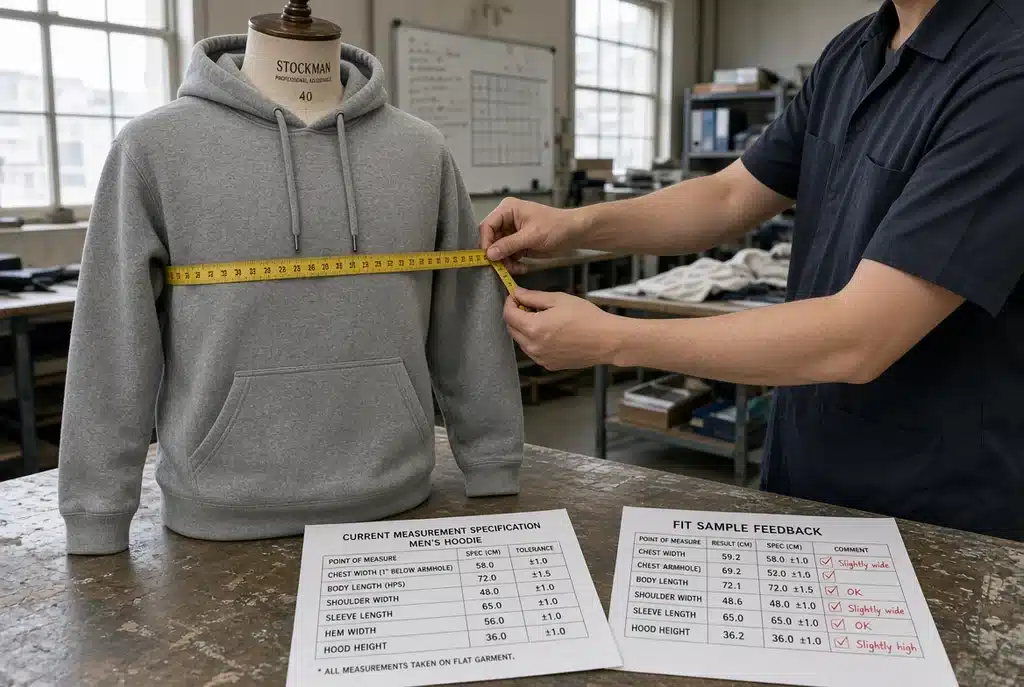
Compare the garment to current specification: Base size, pertinent points of measure, target value, tolerances, condition of the garment, before or after washing. Photos help. They are not a substitute for a tape measure.
The length of a men’s hoodie may be perceived as short due to the angle of the camera. It could be the slope of the shoulders or a true body length deviation. First, measure and then comment.
Review the Garment on the Right Fit Model or Form
Check the fit on a representative fit model, fit form or documented body standard. Check shoulder seam position, neck opening, arm mobility, body balance, trouser rise, thigh ease, knee movement and sleeve rotation.
Separate Fit Problems From Fabric, Styling, and Preference Comments
Please include type of comment before you send. Is this pattern and fit, fabric and drape, construction and workmanship, decoration and branding or personal styling preference?
The options to “make the tee feel less oversized” include: decreasing chest width, decreasing shoulder drop, increasing fabric weight, changing sleeve shape, or altering the sample’s style. The factory can only act once the desired change and its measurable cause are given names. This is how teams can achieve better garment sample approvals without all that noise.
Make Sample Comments Easy to Execute
The good technical feedback gives the factory what, where, why and if the change is approved for the next sample or still open.
Use One Comment File and One Current Document Version
Make all comments in a single, dated file or controlled workspace. Approval status, current measurement, point of measure, photo or page number, sample stage, base size, and reference style code.
This prevents pattern makers, sample rooms, sourcing teams and buyers from using different ‘final’ files. The software name is not as important as revision numbering. It’s sufficient to have a shared version habit.
Write Comments That a Pattern Maker and Sample Room Can Act On
“Make the sleeve better” is NOT a direction. The instruction to reduce the base-size sleeve length by the approved measurement, to keep the cuff opening the same, and to recheck the sleeve pitch on the fit form is.
State if the factory has to make a change in a pattern, a material, a method of sewing, artwork or give a technical explanation. All of these comments—construction, fit, material, and decoration—must be made with that same precision.
Return One Consolidated Decision, Not Multiple Uncoordinated Opinions
Position internally before comments go out the brand. Marketing, design, founders and sales can all ask for opposite: wider body but not too much; softer fabric but not so soft; lower cost but not so simple a construction.
Identify one responsible approver or create final sets of comments for each sample round. A decision, rather than a debate, should be made for the factory.

Control Material, Trim, and Branding Changes Before They Trigger Another Sample
Late changes outside fit lead to significant additional sampling. Several of those changes might have been voted on them one by one if the team had planned the sequence.
Approve Fabric Direction Before Final Fit Sign-Off
Ensure composition, construction, GSM, handfeel, stretch, recovery, shrinkage, color direction and finish are confirmed well in advance so that fit work has meaning. A declared substitute may only be used when the team is aware of what the sample cannot prove in the case of a “fit sample.
Test real or approved-representative fabric on garments prior to final PPS approval. If you’re not it, you’re approving a pattern on a fabric that isn’t going to be used in the bulk order.
Separate Artwork and Trim Tests From Full Garment Revisions Where Possible
Print strike-offs, embroidery samples, label proofs, zipper samples, button cards and packing mock-ups can often be viewed separately. A brand can test a left-chest print size and ink performance on a fabric panel prior to producing a whole hoodie, simply to ensure that the graphic would look as desired.
If you make any alterations to fit, fabric properties or construction, it will still need to be checked on the fit itself.
Freeze Decisions at the Right Gate
Secure the locks in a sequence. Concept and construction after proto. After having the fit sample, base fit. Final material, trims, branding and packing following PPS.
If a decision is closed, the reopening should lead to a cost review, MOQ review, lead time review, and an impact on resampling review. It’s not about stopping change. The idea is to make change intentional and visible.

Common Mistakes That Create Avoidable Sample Revisions
These errors are found in T-shirts, hoodies, polos, shirts, trousers, jackets, printed clothes, washed streetwear, embroidered clothes and more. Each produces another sample, but doesn’t answer a better question.
Changing Fit and Fabric at the Same Time Without Knowing the Cause
Altering measurements, pattern weight, fabric weights or wash the garment in the same round, you will not know whether the garment was improved or damaged by the change. The team also adjusted the shoulder width and the oversized tee can be returned a shorter length after wash. A trouser can change due to the different stretch recovery of the fabric.
Separate key variables, if possible. Record the purpose of each change.
Sending Vague or Conflicting Feedback
The initial sample might show issues due to the design not being sufficiently worked out, fitting of the intent, or the material not being adequate. That is development job and not factory failure.
Distinguish between execution failures and undecided brands. Write down what was said, what was made, what happened and what will follow.
Treating Every Revision as a Factory Error
The initial sample might show issues due to the design not being sufficiently worked out, fitting of the intent, or the material not being adequate. That is development job and not factory failure.
Distinguish between execution failures and undecided brands. Write down what was said, what was made, what happened and what will follow.
Rushing to Bulk Because Another Sample Feels Expensive
Because Another Sample Feels Expensive” is something that happens to lots of people.“Because Another Sample Feels Expensive” is something that happens to many.
Failure to address a required fit, material or PPS change can compound a sample problem into hundreds or thousands of units. Cost of unapproved hoodie opening or untested T-shirt shrinkage increases significantly once fabric has been cut.
It is a good strategy to eliminate unnecessary sample turns early. It is not for eliminating real approval gates.
Practical Pre-Sampling and Review Checklist
Don’t decorate this, use it as a working control. Reducing clothing sample rounds is primarily a question of determining what has to be learned before the next round of cutting.
Before the First Sample
Verify product category and intended customers, technical flats, sample stage, base size, intended silhouette, measurement spec and points of measure, tolerances, fabric composition, construction, GSM, handfeel, color and finish, bill of materials, construction callouts, trim and label requirements, artwork placement, packing needs, quantity assumptions, target price, and known open development questions. Label unresolved items. Never leave them undefinable.
During Each Sample Review
Determine the sample stage and current tech-pack version. Take the measurements of the physical piece of clothing. Note the condition of the garment before and after washing. Fit review – fit form/ fit model. Inspect construction, workmanship, fabric, trims and artwork. Photograph the issues. Create a single set of comments, including a named owner, requested changes, and cost, MOQ or lead-time impact. Record the approved, rejected or pending sample. Rotate back 1 full turn.
Before Pre-Production Sample and Bulk Release
To confirm final pattern and grading, approved measurements and tolerances, approved bulk or representative fabric, color standard, wash or finish result, final trims and hardware, decoration, labels, care content, packaging and current BOM and tech pack, documented PPS approval and early-bulk or top-of-production sample plan. This gate is there to prevent a late decision from being a bulk defect.
| Revision Cause | Control That Prevents It | Best Stage to Resolve It |
| Vague fit intent | Convert silhouette words into base size, wear description, and measurable points of measure | Before first sample |
| Missing POMs or tolerances | Issue a measurement chart with method, garment condition, and acceptable variance | Before first sample / fit sample |
| Substitute fabric treated as final | Declare the substitute limit and recheck in approved-representative fabric | Fit sample / PPS |
| Unclear construction | Add callouts for seams, hoods, pockets, plackets, rib, and closures | Prototype |
| Late artwork or trim changes | Approve strike-offs, labels, and trims separately when they do not change fit | Before PPS |
| Fragmented comments | Use one dated comment file tied to style, stage, POM, and photos | Every sample review |
| Conflicting internal approvals | Return one compiled decision from a named approver | Every sample review |
| Untracked document versions | Number the current tech pack and retire old files | Every stage |
Questions to Ask Your Factory Before Another Sample Is Made
Turn frustration into a technical conversation before the next development garment is cut.
Questions About the Cause of the Current Sample Issue
Ask whether the issue comes from pattern, fabric, sewing method, wash, grading, or measurement method. Which points of measure differ from the current spec? Was the sample made in the intended material or a substitute? Which construction details did the sample room interpret? What change do they recommend, and what will that change affect?
Ask for evidence and a proposed corrective action. “Redo it” is not a technical request.
Questions About the Next Sample and Bulk Readiness
What is the purpose of the next sample: concept, fit, size set, PPS, or another defined test? Which decisions will be locked if it is approved? Which materials, trims, print methods, or washes remain open? Does the requested change affect MOQ, cost, or lead time? Which document version will govern the next sample? What must be confirmed before bulk fabric can be cut?
These are shared development controls. They keep the next sample useful.
How to Reduce Sample Revisions Without Compromising Garment Fit: Keep the Useful Rounds
Brands reduce unnecessary sample revisions by defining the garment clearly, giving each sample stage one job, reviewing fit with a consistent method, consolidating comments the factory can execute, and freezing decisions in sequence. Keep the revisions that protect fit, fabric performance, and production quality. Remove the loops created by guesswork, missing measurements, late branding changes, and untracked files.
No single sample round, software platform, or comment format will eliminate revisions for every garment. Complexity, fit risk, fabric behavior, wash, decoration, and brand standards still decide how much physical validation a style needs. A structured process simply makes each sample answer a specific question before bulk production starts.